Published By Tuna Karslı, editorHow guides are checked
Every autumn hundreds of cruising yachts leave the Canary Islands and point their bows towards the Caribbean. For most crews it is the longest passage they will ever make: around 2,700 nautical miles of open water with no realistic place to stop, followed by the reward of steady , warm water and a landfall among the islands. The crossing is well trodden, and that is precisely why it rewards careful preparation. The route itself is rarely the problem. What turns a good passage into a hard one is almost always the boat, the crew or the timing.
This guide covers the classic east-to-west trade-wind route, how to time it around the hurricane season, the choice between an organised rally and an independent passage, how to prepare the boat and crew, provisioning, communications and what it is likely to cost. Figures for rallies come from the organisers’ published 2026 information; climate figures come from the US National Hurricane Center.
The trade-wind route in outline
The standard westbound crossing follows the clockwise circulation of the North Atlantic. Yachts sail south from northern Europe or the Mediterranean to Madeira and the Canaries, then wait for the north-east trade winds to establish themselves before heading south-west and west towards the Lesser Antilles. The old advice to “sail south until the butter melts, then turn right” still captures the idea: the further south you go before turning west, the more reliable the wind tends to be, at the cost of a longer track.
Direct from the Canaries
The most popular single leg runs from Las Palmas de Gran Canaria to Saint Lucia. The Atlantic Rally for Cruisers (ARC), organised by World Cruising Club, has started in Las Palmas since 1986 and finishes at IGY Rodney Bay Marina in Saint Lucia. World Cruising Club gives the distance as 2,700 nautical miles and says the average yacht takes 18 to 21 days. Other common departure points include Tenerife, Lanzarote and La Gomera, and other common landfalls include Antigua, Barbados, Martinique and Grenada.
Via Cape Verde
The alternative is to break the crossing at Mindelo on São Vicente in the Cape Verde islands. World Cruising Club’s ARC+ rally does exactly this: it publishes the Las Palmas to Mindelo leg as 850 nautical miles (five to seven days at sea) and Mindelo to Grenada as 2,150 nautical miles (12 to 16 days). The stopover splits the voyage into a manageable shakedown leg and a shorter ocean leg, lets crews fix whatever broke in the first week, and puts the boat further south where the trades are often steadier. The trade-off is a longer total distance and more time overall.
The return: Bermuda and the Azores
Most boats that cross westbound eventually come back the other way in spring, leaving the Caribbean before the next hurricane season. The eastbound route usually runs north to Bermuda, then across to the Azores and on to mainland Europe. World Cruising Club’s ARC Europe 2027, which starts on 8 May 2027, publishes these legs: Sint Maarten to Bermuda 870 nautical miles, Chesapeake Bay to Bermuda 720, Bermuda to Faial 1,800, Faial to São Miguel 200 and São Miguel to Lagos in Portugal 875. The eastbound crossing is generally more demanding than the westbound one, with more variable winds and a greater chance of a depression passing through.
Timing: hurricanes, trade winds and Christmas
Timing is the single most important decision. The US National Hurricane Center defines the Atlantic hurricane season as 1 June to 30 November, with the climatological peak on 10 September and most activity between mid-August and mid-October. Its 1991 to 2020 averages are about 14 named storms, seven hurricanes and three major hurricanes a year. A westbound crossing that leaves the Canaries in November and arrives in December arrives at the very end of the season or after it, when the statistical risk of meeting a tropical system in the Caribbean is low.
That is why the main rallies cluster in November. ARC+ 2026 leaves Las Palmas on 8 November and holds its prizegiving in Grenada on 10 December. The ARC 2026 starts on 22 November, with prizegiving in Saint Lucia on 19 December, and the ARC 2027 is scheduled to start on 21 November 2027. On the 2025 ARC timetable, most boats arrived in Rodney Bay between 10 and 15 December.
Leaving earlier than November gains time in the Caribbean but increases exposure to late-season storms. Leaving later, in December or January, means the trades are often better established and stronger. Many experienced independent sailors prefer a December or January departure for that reason, accepting a fresher and sometimes boisterous crossing in exchange for more consistent wind. A November start can meet light and patchy trades, which is one reason many rally boats end up motoring for part of the way.
Reading the weather before departure
- Do not leave just because the calendar says so. Wait for the trade-wind pattern to be established along your intended track, and for any low-pressure systems north of the Canaries to have cleared.
- Look at the position of the Azores high. A weak or displaced high can leave large areas of light wind; a strong one can bring reinforced trades with big seas.
- Check for late-season tropical activity using the National Hurricane Center’s outlooks, even in late November.
- Plan an initial course south-west rather than straight for the destination; the great-circle route often passes through lighter winds.
Typical passage distances and times
The table below combines published rally distances and durations with indicative durations for the return legs. Where the organiser does not publish a duration, the estimate assumes an average of 120 to 150 nautical miles a day, which is typical for a well-sailed cruising yacht of around 12 to 14 metres; smaller or heavily laden boats will be slower.
| Leg | Distance (nm) | Typical time | Basis |
|---|---|---|---|
| Las Palmas to Rodney Bay, Saint Lucia | 2,700 | 18 to 21 days | World Cruising Club (ARC) |
| Las Palmas to Mindelo, Cape Verde | 850 | 5 to 7 days | World Cruising Club (ARC+) |
| Mindelo to Grenada | 2,150 | 12 to 16 days | World Cruising Club (ARC+) |
| Sint Maarten to Bermuda | 870 | about 6 to 7 days | Distance from ARC Europe; time estimated |
| Chesapeake Bay to Bermuda | 720 | about 5 to 6 days | Distance from ARC Europe; time estimated |
| Bermuda to Faial, Azores | 1,800 | about 12 to 15 days | Distance from ARC Europe; time estimated |
| Faial to São Miguel | 200 | 1 to 2 days | Distance from ARC Europe; time estimated |
| São Miguel to Lagos, Portugal | 875 | about 6 to 7 days | Distance from ARC Europe; time estimated |
Treat these as planning figures, not promises. Provision, and plan crew leave and flights, on the basis that the passage could take noticeably longer than the average.
Rally or independent?
Around 150 boats a year sail in the ARC, according to World Cruising Club, and ARC+ is usually capped at just under 100. Rallies are not the only option: Cornell Sailing, founded by the ocean-sailing author Jimmy Cornell, has run the Atlantic Odyssey from the Canaries to Martinique, and many other yachts cross each season on their own timetable.
What a rally gives you
- A fixed date and a structured run-up, with seminars, shoreside events and a handbook.
- A pre-start safety equipment inspection against a published list, which is a useful discipline even for experienced crews.
- A satellite tracker loaned to each boat, so family and the organisers can follow progress.
- A reserved berth and a welcome at the finish, which matters at busy Caribbean marinas in December.
- The company of other boats, a radio or messaging network at sea, and help from people who have done it before.
What independence gives you
- Freedom to choose your departure window on the weather, not the calendar.
- No entry fees, and often easier berthing if you avoid the rally peak in the departure port.
- Freedom to choose your landfall and to change it at sea.
The honest summary is that a rally does not make the ocean safer, but it does make preparation more systematic and the social side much richer. Crews making their first crossing, families with children and crews new to each other often find the structure worth the fee. Experienced crews who prefer to pick their own weather often go independently.
Rally entry rules worth knowing
World Cruising Club’s published rules for its Atlantic rallies include a minimum length of 8.23 metres (27 feet), with the ARC accepting boats up to 32 metres (100 feet). Every rally boat must carry at least two adults aged 18 or over; single-handed entries are not accepted. The skipper and at least one other crew member must have training that covers liferafts, crew overboard, damage control, first aid, weather and emergency communications. Boats in the racing division must comply with World Sailing Offshore Special Regulations Category 1 and hold a valid IRC certificate.
Preparing the boat
According to World Cruising Club, the average boat in its rallies is about 15 years old, and multihulls make up almost a third of ocean rally fleets. Age matters less than condition. A trade-wind crossing is three weeks of constant motion with the wind and sea from behind, and that motion finds every weakness in , steering and sails. A pre-departure survey by an independent marine surveyor, and a rig inspection by a rigger, are money well spent, especially on a boat that is new to you.
Rig and sails
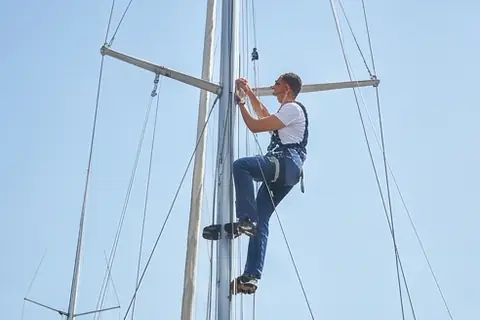
- Have the standing rigging inspected aloft, with particular attention to swage terminals, chainplates and spreader roots. Replace wire that is near the end of its life rather than hoping it will last.
- Check the running rigging for chafe points. Downwind sailing for weeks concentrates wear on at the masthead sheave and on sheets at fairleads.
- World Cruising Club notes that worn sails can fail quickly in trade-wind sailing. Have them checked and repaired before you leave, and carry a sail repair kit with spare sailcloth and needles.
- Plan your downwind configuration: twin headsails, a poled-out genoa with the main, or an asymmetric or parasail-type sail. A spinnaker pole on a mast track is valuable for poling out the .
- Rig a preventer for the and practise setting and releasing it in the dark.
Steering and self-steering
Self-steering is the piece of equipment the crew will depend on most. An autopilot must be rated for long periods of continuous use, properly installed and tested. A hard-working autopilot draws a lot of current and can burn out, so carry spares that can be fitted at sea, such as a drive unit or belt. A windvane needs no power and, if it has its own rudder, doubles as emergency steering. Whatever system you use, balance the sails so the steering is not overloaded.
The ARC safety rules require an emergency that fits the rudder stock, plus a back-up method of steering if the rudder itself is lost, such as a windvane with its own rudder or a drogue controlled from the sheet winches. Test the emergency tiller before you leave; many do not fit as well as their owners believe.
Power and water
Start with a power audit: list everything that uses electricity, estimate the daily consumption at sea (autopilot, navigation instruments, fridge, communications, lighting), and compare it with battery capacity and charging sources. World Cruising Club points out that running the main engine to charge batteries is noisy, hot and inefficient; hydrogenerators work well on long passages but produce nothing at anchor; wind generators suit breezy anchorages better than downwind sailing; and solar rarely covers everything on its own. Most boats use a combination.
A is useful but not essential. If you carry one, also carry enough water in tanks and containers to complete the crossing without it.
Safety equipment
The ARC’s published safety requirements are a sensible baseline even for independent crews. They include:
- An ocean for the whole crew meeting ISO 9650 Type 1 Group A, stowed so it can be launched within 15 seconds and in service for the whole passage. Coastal and aviation rafts are not accepted.
- A lifejacket for each crew member with a light, whistle, spray hood, crotch strap, reflective tape, a personal AIS beacon and a three-point tether no longer than 2 metres.
- Two crew overboard recovery systems and a floating throwing line of 15 to 25 metres.
- Two main bilge pump systems, one manual pump operable from on deck, and an emergency pump of at least 200 litres per minute.
- A 406 MHz EPIRB, four red hand flares (two of which may be electronic visual distress devices) and two orange smoke signals, plus a powerful searchlight.
- An AIS transponder, a 25-watt DSC VHF with an emergency antenna, and a waterproof 5-watt handheld VHF.
Pre-departure boat checklist
- Engine serviced, with spare impellers, filters, belts and enough oil for at least one change.
- Seacocks exercised, hose clamps checked, softwood bungs tied next to every through-hull.
- Rig inspected aloft; spare halyard rigged and ready.
- Autopilot spares and emergency tiller tested.
- Liferaft serviced, grab bag packed with water, handheld VHF, flares and copies of documents.
- Rig-cutting tools tested on wire of the same diameter as your rigging, as World Cruising Club recommends.
- Jackstays rigged from cockpit to bow, and strong points for clipping on at the companionway.
- Gas installation checked, with spare bottles and the right regulator for the islands you will reach.
- Paper charts or a stand-alone back-up for the electronic navigation system.
- Insurance confirmed in writing for the ocean passage and the Caribbean cruising area, including the dates you will be there.
Crew and watches
Crew choice matters as much as boat choice. Three weeks in a small space with no way out tests patience as much as seamanship. Before committing, sail together for at least a weekend, agree how decisions are made, discuss alcohol and smoking aboard, and be clear about how costs are shared. Check that every crew member has a valid passport, any visas needed for the destination and onward travel, and travel insurance that covers sailing.
A crew of four allows a comfortable watch rota with plenty of sleep; a crew of two or three is perfectly workable on a boat with good self-steering but leaves less margin if someone is ill or injured. Common systems are fixed three- or four-hour watches, or a mix of longer day watches and shorter night watches. Whatever you choose, write it down, keep the night handovers short and formal, and agree in advance when the skipper must be woken: a squall on the radar, a ship on a converging course, any change in the sound of the rig or the motion of the boat.
Crew skills checklist
- At least two people who can navigate, reef, handle the engine and operate the radio and satellite system.
- One crew member with an offshore first-aid qualification, and a medical kit chosen with a doctor for a three-week passage.
- Everyone briefed on crew overboard recovery, liferaft deployment, fire extinguishers and the location of seacocks.
- Everyone able to reef the main at night and in squalls.
- A clear rule on wearing lifejackets and clipping on, especially at night and when leaving the cockpit.
Provisioning
World Cruising Club describes Las Palmas as a good place to provision, with supermarkets, a fresh produce market and suppliers that deliver to the marina. The general principles are the same wherever you leave from.
- Plan for more days than you expect. If the average is 18 to 21 days, provision for at least 25 to 30 days, with a reserve of food that needs no cooking.
- Plan drinking water separately from washing water, and keep an emergency reserve in sealed containers that cannot be lost through a tank leak or contamination.
- Buy fresh produce unwashed and unrefrigerated where possible; it lasts longer. Store fruit and vegetables in a ventilated space and check them daily, removing anything that is turning.
- Plan meals so that the most perishable food is eaten first and tinned or dried food is kept for the second half of the crossing.
- Prepare and freeze a few meals before departure for the first days at sea, when crews are adjusting to the motion.
- Carry spare cooking gas and know your consumption per day.
- Stow heavy items low and wedge everything; a trade-wind roll will empty any locker that is not secured.
Communications at sea
Ocean communications have changed more in the last few years than in the previous two decades. World Cruising Club now says that most rally boats use Starlink or another satellite system, and its rules for ocean-crossing rallies require each boat to be able to send and receive email at sea. Its guidance describes Iridium GO! as cost-effective but slow, and Starlink as offering high-speed browsing and downloads; it also warns that data plans can cost more than the hardware, so read the terms carefully.
The options
- Starlink. Low-earth-orbit satellite internet with broadband speeds. It makes downloading full weather files, video calls and normal email practical in mid-ocean. It needs a substantial and continuous power supply, so include it in your power audit, and check that your plan covers use at sea, not just on land or in coastal waters.
- Iridium. Iridium’s network covers the whole globe. Devices such as the Iridium GO! family provide narrowband data for compressed email and weather files, voice calls and messaging. Iridium says its newer GO! exec, built around the Certus 9770 module, transfers data more than 35 times faster than its predecessors. Its main virtue is low power draw and resilience, which makes it a strong back-up even on a boat with Starlink.
- SSB radio. Long-range HF radio is no longer required for most rallies. It is expensive to install but offers free voice communication with other boats and an additional distress channel.
- Trackers and satellite messengers. Small Iridium-based units such as the YB tracker supplied to rally boats report position for family and organisers and can send short messages, but World Cruising Club does not accept the tracker’s messaging as a boat’s email method on ocean rallies.
Communications checklist
- At least two independent ways to get a weather forecast at sea.
- Satellite system tested on passage before departure, with the account active and the plan confirmed for the dates of the crossing.
- A daily schedule for weather downloads and a position report to someone ashore.
- Emergency contacts and the boat’s EPIRB registration details up to date.
- A handheld satellite device or messenger in the grab bag, independent of the boat’s power.
Arrival and departure formalities
Each Caribbean state has its own clearance rules, and several use online pre-arrival systems. Fly the Q flag on arrival, clear in with customs and immigration before going ashore, and keep the outward clearance from your last port; officials frequently ask for it. Crew who leave the boat and fly home usually need to be signed off the crew list in the presence of the skipper and may need an onward ticket when they arrive.
The departure end matters too. Since the European Union’s Entry/Exit System became fully operational at Schengen external borders on 10 April 2026, non-EU crew leaving Spain by sea should make sure their exit is recorded.
What it costs
Costs vary enormously with the boat, how much gear you add and how you crew it. The rally fees below are from World Cruising Club’s published information for a 13.2 metre (43 foot) monohull; multihulls pay a supplement. The four-crew totals are simple arithmetic from those published rates. Other lines show what drives the cost rather than a single figure, because these depend on quotes for your boat.
| Item | Published figure | Example: 13.2 m yacht, 4 adults |
|---|---|---|
| ARC 2026 entry (Las Palmas to Saint Lucia) | GBP 1,500 boat fee plus GBP 185 per crew; children 6 to 16 GBP 150; under 6 free | GBP 2,240 |
| ARC+ 2026 entry (via Cape Verde to Grenada) | GBP 1,900 boat fee plus GBP 300 per crew; children 6 to 16 GBP 175 | GBP 3,100 |
| ARC Europe 2027 entry (return via Bermuda and Azores) | GBP 1,200 boat fee plus GBP 495 per crew; under 6 free | GBP 3,180 |
| Liferaft (purchase or hire) and service | Quote-dependent | Driven by raft size and whether you buy or hire |
| Rig inspection and replacement work | Quote-dependent | Can be the largest single item on an older boat |
| Satellite communications | Hardware plus a monthly or usage-based plan | Data plans can exceed hardware cost over a season |
| Insurance extension for ocean passage and Caribbean | Quote-dependent | Insurers may set conditions on crew numbers and survey |
| Food, water and fuel | Depends on crew and diet | Plan for 25 to 30 days |
| Marina berths before and after | Depends on port and season | Check what berthing your rally entry includes |
Final pre-departure checklist
- Weather window confirmed with trades established on the route and no tropical activity forecast.
- Crew briefed on watches, safety equipment, crew overboard drill and abandon-ship procedure.
- Food and water for 25 to 30 days stowed and listed.
- Fuel and gas tanks full, with reserve containers secured.
- Satellite communications tested and a shore contact agreed for daily position reports.
- Outward clearance obtained, passports stamped or EES exit recorded for non-EU crew.
- Insurance documents, ship’s papers and crew list printed and in a waterproof folder.
- Grab bag packed and liferaft position checked.
- A conservative initial course chosen, with the option to head further south if the trades are weak.
The Atlantic trade-wind crossing is not a test of heroics. It is mainly a test of preparation: a sound boat, a crew that gets on, sensible timing and enough food, water and spares to cope with a passage that takes longer than planned. Get those right and most crews find the crossing one of the best experiences they have had at sea.
Sources
- World Cruising Club, ARC event information: https://www.worldcruising.com/events/arc
- World Cruising Club, ARC+ event information: https://worldcruising.com/events/arc-plus
- World Cruising Club, ARC Europe event information: https://worldcruising.com/events/arc-europe
- World Cruising Club, safety equipment: https://worldcruising.com/safety-equipment
- World Cruising Club, communications: https://worldcruising.com/communications
- World Cruising Club, equipment guidance: https://worldcruising.com/equipment
- World Cruising Club, crew guidance: https://worldcruising.com/crew
- US National Hurricane Center, tropical cyclone climatology: https://www.nhc.noaa.gov/climo/
- Iridium, GO! exec product page: https://www.iridium.com/products/iridium-go-exec/
Read next
 Provisioning for a Long Passage: What to Stock and How to Store ItOn a long passage, food is fuel, comfort and morale. A good galley can turn a…
 Best Weather Apps for Sailors Compared (Windy, PredictWind and More)Most cruising sailors now carry several weather apps on their phone, and still get caught out…
 Why Is My Anchor Dragging? 7 Common CausesThere is a particular feeling when you look up and the hills have moved. A dragging…
Reader ratings
No ratings yet. Was this useful? Rate it and add what you know: corrections and first-hand tips help the next reader.
★ Rate this guide
Suggest a correction
Cite this page
Crossing the Atlantic by yacht: routes, timing and preparation. Boat Almanac, updated 24 October 2026. https://boatalmanac.com/articles/crossing-the-atlantic-by-yacht-routes-timing-and-preparation/ (accessed 21 November 2026).