World voyage planner
A circumnavigation planned season by season: every ocean passage in its window, where to spend each hurricane and cyclone season, distances and time. The calculations run in your browser.
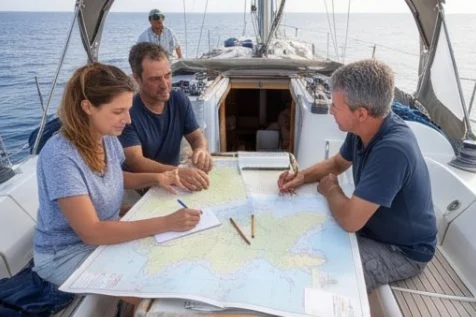
How a circumnavigation is really planned
Almost every cruising circumnavigation today follows the trade winds west-about: across the Atlantic to the Caribbean, through the Panama Canal, across the Pacific, across the Indian Ocean and round the Cape of Good Hope, and back across the South Atlantic. The route is not chosen for distance but for the seasons. The skipper's calendar has two fixed points each year: be out of the hurricane or cyclone belt in its season, and be at the start of each ocean passage when its window opens. Everything else, how long you stay in each place, fits in between.
- Two storm seasons a year, six months apart. North of the equator (Caribbean, North Pacific, Bay of Bengal) storms come from June to November; south of it (South Pacific, northern Australia, south-west Indian Ocean) from November to April. The classic route crosses each ocean in the safe half of the year and spends the dangerous months in a safe place: the Canaries or Europe, New Zealand or southern Australia, South Africa.
- Some windows are short and fixed. Leave the Canaries for the Caribbean from late November; leave Panama or the Galápagos for the Marquesas from March to May; leave Tonga or Fiji for New Zealand or Australia by early November; cross the Indian Ocean from August to October; round the Cape of Good Hope between November and February. Miss one and you usually wait a year, or take a different route.
- A real plan has slack. Cruisers like to say their plans are written in the sand at low tide. Breakages, weather and places you love all cost time. Most crews take three years or more; two years is fast and leaves little time ashore.
- Insurance follows the seasons too. Most policies exclude the hurricane or cyclone belt in the storm season, or ask for a named-storm plan; read the cruising limits before you plan.
The boat
- Self-steering you trust: a wind vane and an autopilot, with spares for both. Steering failure ends more voyages than anything except rig failure.
- Rig inspected by a rigger before you leave; standing rigging over about ten years old replaced. Carry spare wire or Dyneema long enough for the longest stay, bulldog clips, a spare halyard and a way to climb the mast at sea.
- Sails for the trades: downwind sails you can handle short-handed, a third reef or a storm sail, and sail repair gear with spare cloth.
- Ground tackle for coral and deep anchorages: an oversized anchor and 60 to 100 m of chain, a snubber and floats to lift the chain off coral.
- Water and power: a watermaker (with the means to repair it), solar and a second way to charge, and fuel for at least 500 NM of motoring.
- Communication and weather: satellite messaging or data for GRIB files and email, AIS transponder, and an HF/SSB receiver as a backup for weather; an EPIRB registered to the boat and a PLB for each person on deck.
- Safety: liferaft serviced for the voyage, grab bag, jacklines and tethers, man-overboard gear, fire extinguishers and a fire blanket, bilge pumps (one manual, operable from the cockpit), collision mats or a plug for every through-hull.
- Spares and tools: impellers, belts, filters, injectors, a starter motor and alternator for the engine; pumps and seals; epoxy and fibreglass; the manuals on paper. Hardware stores are a few days' sail away for most of the voyage.
Crew, health and paperwork
- Medical: an offshore first-aid course for at least two crew, a medical kit with antibiotics and painkillers agreed with a doctor, dental checks before you go, and the vaccinations a travel clinic advises for the whole route. Some countries ask for a yellow fever certificate depending on where you come from.
- Passports valid for at least six months beyond each stay, the boat's registration papers and insurance, crew lists, the ship's stamp, and the clearance (zarpe) from your last port: every new country asks for it.
- Advance notices and permits: the Galápagos (permit through an agent), French Polynesia (visa length), New Zealand and Australia (advance notice of arrival, biosecurity checks of hull, food and wood), Indonesia (cruising permit). Rules change often: check them a few months before each country.
- Biosecurity: New Zealand, Australia and the Galápagos check the hull for growth; clean it shortly before you arrive. Fresh food, meat, eggs and honey are taken off at many borders: arrive with little.
- Flags: the Q flag on arrival until cleared, and the courtesy flag of each country.
Money and time
What a voyage costs depends more on how you live than on the boat: marina or anchor, eating out or on board, how much you fly home. Budget for the fixed items: insurance, the Panama Canal transit and agent, the Galápagos permit and fees, cruising permits and clearance fees in each country, a haul-out in each storm-season stop, a rigging and sail refresh halfway, and flights. Keep a reserve for the breakage nobody plans for.
Plan each passage with the route planner; read each crossing on the ocean passages pages and each sea area on the sailing seasons pages.
Not for navigation. These tools give estimates from simple models; they support good seamanship and do not replace it. Check every result against official charts, tide tables, nautical publications, your instruments and the conditions you see. The skipper is responsible for the boat and the people on board.
More tools
24 calculators and planners
- World route plannerMarina to marina anywhere on the sea: the route, sailing days, overnight and fuel stops, fuel, water, provisions and packing.
- Provisions plannerHow many people, how many days: shopping list, daily menu and estimated cost, for a single hob and a compact fridge.
- Packing plannerClothing, documents, health and electronics by season and region; tick off and print.
- Where to anchor tonight?Bays near you ranked for tonight's forecast wind, from what sailors reported about their shelter, bottom and holding.
- Position and distanceConvert between position formats and get the distance and bearing between two points.
- True, magnetic and compassConvert headings and bearings with variation and deviation, and update variation to this year.
- Course to steer in a currentThe heading that keeps you on track across a tidal stream, your speed over the ground and arrival time.
- Distance off and horizonDistance to the horizon, when a light rises, distance off by vertical angle, doubling the angle and the rule of 60.
- Collision risk (CPA)From two bearings and ranges of another vessel: closest point of approach, when, and its course and speed.
- Tide height (rule of twelfths)Estimate the height of tide at any time between low and high water.
- Sun and moonSunrise, sunset, twilight and the moon phase for any position and date.
- Beaufort scale and sea stateWind force from speed, what the sea looks like, what it means for a yacht and how hard the wind pushes.
- Barometer trendWhat a rise or fall in pressure over three hours tells you, in the words forecasters use.
- True and apparent windWork out the wind you feel on board from the true wind, or the true wind from your instruments.
- Anchoring calculatorScope, how much chain or rode to let out, and the circle your boat will swing in.
- Hull speed and design ratiosHull speed, displacement/length, sail area/displacement, capsize screening and comfort ratio.
- Battery and solar budgetWhat you use in a day, how big the battery bank should be and how much solar covers it.
- Cable size and voltage dropThe cable cross-section a DC circuit needs for its length and current.
- Water and watermakerHow long your fresh water lasts and how long the watermaker must run.
- Unit converterKnots, miles, metres and feet, litres and gallons, bar and psi, kW and hp, °C and °F.
- Radio, signals and lightsVHF channels, the phonetic alphabet, Mayday, Pan-Pan and Sécurité, sound signals, lights and buoyage regions.
- Signal flags and flag etiquetteThe single-letter flags of the International Code of Signals and where to fly ensign, courtesy flag and Q.
- Crew list for clearing inThe crew list harbour offices, customs and police ask for when you clear in or out: boat details and every person aboard, printed in one tidy page.
- Watch scheduleA fair watch rota for your crew and passage, in the common watch systems.