Boating terms and nautical glossary
310 terms you meet when buying and keeping a boat, at anchor and on passage, with the tide and the weather, and when you clear into another country, sorted by subject and explained briefly and plainly.
Topics
- The boat and her hull
- Types of boat
- Rig and sails
- Sailing and boat handling
- Lines, knots and deck hardware
- Anchoring and mooring
- Marinas, boatyards and laying up
- Engine and systems
- Navigation, tides and radio
- Safety at sea
- Weather and Mediterranean wind names
- Ocean winds and long passages
- Materials, maintenance and survey
- Papers, charter and rules
- Where sea words come from
- Sayings and sailors' lore
By first letter
The boat and her hull
The parts and measurements of a boat. These are the first words you meet in a listing, a survey report and a marina contract.
- Beam
- The width of the boat at its widest point; it decides which berths and lifts fit.
- Berth
- Two meanings: a bed on board, or the place in a marina where the boat is tied up.
- Bilge
- The lowest space inside the hull, where water collects; bilge pumps empty it. Check it every day at sea.
- Bow
- The forward end of the boat.
- Cabin
- A room inside the boat, usually a sleeping room. "A three-cabin boat" sleeps about six.
- Coachroof
- The raised roof of the cabin above the deck, where the portlights and grab rails usually are.
- Cockpit
- The open, lower area where you steer and sit outside, usually at the back of the boat.
- Deck
- The surface that closes the top of the boat and that you walk on.
- Displacement
- The weight of water the floating boat pushes aside, equal to the weight of the boat. Also used for a hull that moves through the water rather than planing over it.
- Draft
- The depth from the waterline to the lowest point of the keel; it decides where you can go and anchor.
- Flybridge
- An open upper steering position above the main cabin of a motor yacht.
- Frame
- A rib that stiffens the hull from the inside, running across the boat.
- Freeboard
- The height from the waterline to the deck edge. High freeboard keeps the inside dry but catches the wind and makes boarding from a low pontoon harder.
- Galley
- The kitchen on a boat.
- Guardrails
- The wires or rails round the deck edge that stop people falling over the side. Also called lifelines.
- Hatch
- An opening panel in the deck for air, light or access.
- Head
- The toilet on a boat (and the small room it is in). Most need pumping by hand or with a button, and nothing but what is natural and the special paper may go in.
- Helm
- The steering position, a wheel or a tiller. "On the helm" means steering.
- Hull
- The body of the boat.
- Keel
- The fin or long spine under a sailing boat that stops it being blown sideways and keeps it upright. Fin, bilge (twin) and lifting keels each suit different waters.
- LOA (length overall)
- The full length of the boat from bow to stern, including fixed fittings. Marinas usually charge on it.
- LWL (waterline length)
- The length of the hull at the waterline. On a boat that does not plane, it largely sets the top speed.
- Planing
- When a powerboat goes fast enough to rise and skim over the water instead of pushing through it.
- Port
- The left side of the boat when facing forward. The red navigation light is on this side.
- Porthole
- A small, usually round window in the hull or coachroof. Also called a portlight.
- Pulpit and pushpit
- The stainless steel rails at the bow (pulpit) and stern (pushpit) to which the guardrails are fixed.
- Roll
- The side-to-side rocking of a boat in waves. An anchorage open to swell makes for a rolly night.
- Rudder
- The blade under the back of the boat that turns it when you steer.
- Saloon
- The main living space inside a boat, with the table and seating.
- Starboard
- The right side of the boat when facing forward. The green navigation light is on this side.
- Stem
- The upright edge at the very front of the hull, where the two sides meet.
- Stern
- The back end of the boat.
- Swim platform
- The flat step at the transom that makes it easy to climb out of the water or into the tender.
- Tiller
- A long arm fixed to the rudder, used to steer smaller boats: push it the opposite way to where you want to go.
- Topsides
- The sides of the hull between the waterline and the deck edge.
- Transom
- The flat back end of the boat. Many have a bathing platform and a ladder.
- Trim
- The fore-and-aft attitude of the boat in the water; on powerboats adjusted with trim tabs or the drive.
- Trim tab
- A movable plate at the bottom of the transom of a powerboat that adjusts its trim.
- Underwater hull
- The part of the hull below the waterline, cleaned and antifouled when the boat is hauled out.
- Waterline
- The line where the floating hull meets the water, often marked with a painted stripe.
- Wheel
- The steering wheel on larger boats.
Types of boat
The kinds of boat you see in listings and charter fleets.
- Bowrider
- An open motor boat with seats in the bow (front) as well as behind the windscreen; for day trips and watersports.
- Catamaran
- A boat with two hulls side by side. Stable, roomy and flat under sail, but wider, so berths cost more.
- Centre console
- An open motor boat steered from a console in the middle, with room to walk all round; popular for fishing.
- Cuddy
- A small cabin under the front deck of a day boat, for shelter and storage, sometimes with a simple berth.
- Gulet
- A traditional wooden yacht from the Turkish coast, with a broad stern and two or three masts, built in places such as Bodrum. Most now cruise under engine with guests aboard.
- Inflatable
- A small boat made of inflated tubes, which can be rolled up and carried. With a solid hull it becomes a RIB.
- Ketch
- A two-masted sailing yacht whose smaller aft mast, the mizzen, stands forward of the rudder post.
- Monohull
- A boat with one hull, the most common kind of sailing yacht. It heels (leans) under sail.
- Motor yacht
- A boat driven by engines and fitted out for cruising and living aboard.
- RIB
- Rigid inflatable boat: a solid hull with an inflated tube round it. Seaworthy, fast and light.
- Sailing yacht
- A boat driven by the wind in her sails. Most also have an auxiliary engine for harbours and calms.
- Sloop
- The most common sailing rig: one mast, a mainsail behind it and one headsail in front.
- Speedboat
- A fast, planing motorboat.
- Tender (dinghy)
- The small boat used to go ashore from an anchorage.
- Trawler
- A displacement motor yacht built to cover long distances at an economical speed. The name comes from the fishing boats that inspired the type.
Rig and sails
The mast, the wires that hold it up, the sails and the lines that control them.
- Backstay
- The wire from the masthead to the stern. Tensioning it bends the mast and flattens the mainsail.
- Block
- A pulley that a line runs through to change its direction.
- Boom
- The horizontal pole along the bottom of the mainsail. Keep your head clear of it when turning.
- Forestay
- The wire from the masthead (or near it) to the bow. The jib or genoa sets on it.
- Gennaker
- An asymmetric downwind headsail, between a spinnaker and a genoa. Easier to handle than a spinnaker.
- Genoa
- A large headsail that overlaps the mast and the mainsail, giving power in light wind.
- Halyard
- A rope that pulls a sail up the mast.
- Jib (headsail)
- The sail in front of the mast. A larger one that overlaps the mast is called a genoa.
- Kicker (boom vang)
- A tackle or strut that pulls the boom down, so it does not rise on a reach or a run.
- Lazy jacks
- Lines from the mast to the boom that catch the mainsail and hold it on the boom as it comes down.
- Mainsail
- The sail behind the mast.
- Mast
- The upright spar that carries the sails. It stands on the deck or on the keel.
- Mizzen
- The smaller aft mast on a two-masted boat, and the sail set on it.
- Reef (sail)
- To make a sail smaller for stronger wind. The old rule: the time to reef is when you first think of it.
- Rigging
- The wires and ropes that hold up the mast (standing rigging) and control the sails (running rigging). Standing rigging is usually renewed every 10 to 15 years.
- Roller furling
- A system that rolls the jib or genoa round the forestay to set and stow it.
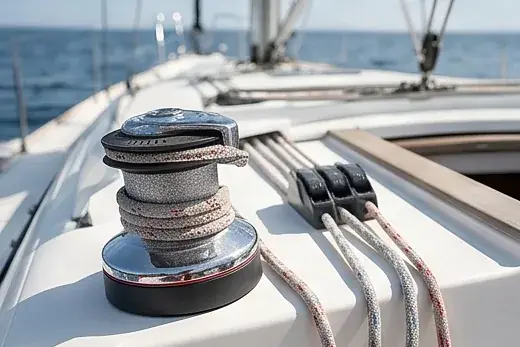
- Rope clutch
- A lever that locks a line under load on the deck or coachroof.
- Running rigging
- The lines that hoist, lower and trim the sails: halyards, sheets and the rest.
- Sheet
- A rope that pulls a sail in or lets it out. On a boat, ropes have names for their jobs.
- Shroud
- A wire that supports the mast from the side.
- Spinnaker
- A large, light, balloon-shaped sail set in front of the boat when sailing downwind.
- Spreaders
- The short arms either side of the mast that hold the shrouds out so they support the mast better.
- Standing rigging
- The wires that hold the mast up. Usually renewed every 10 to 15 years, depending on condition; the terminals are checked for fine cracks and rust.
- Tackle
- Lines run through several blocks to multiply the pull.
- Topping lift
- A line from the masthead to the end of the boom that holds the boom up when the mainsail is down.
- Winch
- A drum turned with a handle that pulls in sheets and halyards and holds the load.
Sailing and boat handling
Points of sail, turns and the calls you hear on deck.
- Beam reach
- Sailing with the wind directly on the side of the boat. For most boats a fast and comfortable point of sail.
- Bear away
- To turn the bow away from the wind; the opposite of luffing up.
- Broad reach
- Sailing with the wind coming over the back quarter.
- Close reach
- Sailing with the wind forward of the beam, between close-hauled and a beam reach.
- Close-hauled
- Sailing as close to the wind as the boat will go, with the sails pulled in tight.
- Ease
- To let a line out a little.
- Gybe
- To turn the back of a sailing boat through the wind. Done carelessly in a strong wind, the boom swings across hard.
- Hard over
- The helm or wheel turned as far as it will go to one side.
- Heave to
- To stop a sailing boat at sea by backing the headsail against the mainsail and lashing the helm; the boat drifts slowly and rides the waves quietly. Used in heavy weather, for a meal or after a man overboard.
- Heel
- The lean of a sailing boat under the push of the wind. Normal and safe; too much means it is time to reef.
- Knockdown
- When a wave or gust lays the boat on her side, with the mast near or in the water.
- Lee shore
- A coast that the wind blows onto: dangerous, because a boat that loses power or drags is pushed onto it.
- Luff up
- To turn the bow towards the wind.
- Make fast
- To tie a line off on a cleat or bollard so that it holds.
- Points of sail
- The angles a sailing boat can sail to the wind: close-hauled, close reach, beam reach, broad reach and run. Straight into the wind no sailing boat can go.
- Run
- Sailing with the wind directly behind. A preventer on the boom stops an accidental gybe.
- Tack
- To turn the front of a sailing boat through the wind, so the wind comes from the other side.
- Windward and leeward
- Windward is the side the wind comes from; leeward is the side it blows towards.
Lines, knots and deck hardware
On a boat every rope has a name for its job. These are the ones you hear most.
- Bitter end
- The very end of a line or anchor chain, made fast inside the boat. Lash it with a line you can cut in an emergency.
- Bollard
- A short, thick post on a quay that mooring lines are tied to.
- Bowline
- A knot that makes a loop that will not slip and still unties easily after a heavy load. The most used knot on a boat.
- Cleat
- A two-horned fitting that a line is wound round and made fast to.
- Clove hitch
- A quick knot for tying a line round a post or rail. It can slip under load, so do not trust it alone.
- Coil
- To gather a line into neat loops so it runs out without tangling when you need it.
- Fender
- A cushion hung between the boat and a quay or another boat.
- Foul
- Tangled or caught. A foul anchor has its chain wrapped round it or caught on another chain.
- Line
- Any rope in use on a boat. Each one is named for its job: halyard, sheet, mooring line.
- Mooring line
- A rope used to tie the boat to a quay, pontoon or buoy.
- Splice
- A join or an eye made by unlaying the strands of a rope and tucking them back into each other. Stronger than a knot.
- Spring line
- A mooring line led fore and aft at an angle that stops the boat moving forwards and backwards along the quay.
Anchoring and mooring
Words for anchoring in a bay and for tying up to a buoy or a quay.
- Anchor
- A heavy, shaped device that digs into the seabed and holds the boat, with chain or rope (the rode).
- Anchor chain
- The chain between the anchor and the boat. Its weight helps the anchor pull along the seabed rather than up.
- Bow-to mooring
- Mooring with the bow to the quay. The cockpit is kept away from the quay, but you need a boarding ladder or plank at the bow.
- Breakwater
- A wall of rock or concrete that protects a harbour from waves.
- Dragging
- When the anchor fails to hold and slides over the seabed. Watch your position against fixed marks ashore; the anchor alarm on a plotter or app helps.
- Holding
- How well the seabed grips an anchor: good in sand and mud, poor in weed, rock and soft silt.
- Lazy line
- A line fixed to a mooring block on the seabed, picked up from the quay and taken to the bow when mooring stern-to.
- Mooring
- Where a boat is kept tied up, or the act of tying up. A swinging mooring is a buoy fixed to the seabed; the boat swings round it with the wind.
- Mooring buoy
- A floating buoy fixed to a heavy weight on the seabed, which a boat ties to instead of anchoring.
- Pay out
- To let out chain or line gradually.
- Pontoon
- A floating or fixed walkway in a marina where boats tie up.
- Posidonia
- A seagrass found only in the Mediterranean, vital for clear water. Anchors and chains tear it up, so anchor on sand instead; in some protected bays anchoring on it is forbidden and fined.
- Quay
- A solid stone or concrete wall where boats tie up.
- Rode
- The chain, rope or both between the anchor and the boat.
- Scope
- The ratio between the length of rode let out and the height from the seabed to the bow at high water. 5:1 with chain in settled weather, more as the wind rises.
- Shore line
- A line taken from the boat to a rock, tree or ring ashore, usually from the stern with the anchor out ahead. It stops the boat swinging in a narrow bay.
- Snubber
- A length of stretchy rope hooked onto the anchor chain to take the shocks off the windlass and the bow.
- Stern-to mooring
- Mooring with the stern to the quay and a lazy line or the anchor holding the bow; the usual way in the Mediterranean.
- Swing circle
- The circle the boat moves in around its anchor as the wind and current turn.
- Windlass
- The winch, usually electric, that hauls the anchor chain in and lets it out.
Marinas, boatyards and laying up
The words you meet when the boat comes out of the water, during the refit season and over winter.
- Boat stands and cradle
- The props or frame that hold a boat upright ashore.
- Dry storage
- Keeping the boat out of the water on a cradle, stands or a rack during the off season.
- Fuel dock
- The berth in a marina where boats take on fuel.
- Haul-out yard
- A yard where boats are hauled out of the water for maintenance, repair or storage.
- Marina
- A harbour for yachts with berths and services such as power, water, fuel and security.
- On the hard
- With the boat lifted out of the water and standing ashore in a boatyard, on stands or in a cradle.
- Shore power
- Electricity taken from the marina pedestal to the boat by cable.
- Slipway
- A ramp or rails used to haul a boat out of the water or launch it.
- Travelift
- A wheeled lifting frame with slings that takes boats in and out of the water at marinas and yards.
- Winterising
- Getting the boat ready for winter: protecting the engine and water systems from frost, taking the sails off and looking after the batteries.
Engine and systems
Engine, fuel, water and electrics. These words appear on yard invoices and in survey reports.
- Anode (zinc)
- A sacrificial block of zinc, aluminium or magnesium that corrodes instead of the propeller, shaft and other metal parts. Replace it when about half is gone.
- Autopilot
- An electric system that steers the boat on a compass course or at an angle to the wind.
- Batteries
- The engine battery starts the engine; the service (domestic) batteries run the lights, fridge and electronics. Kept separate, they make sure the engine always starts.
- Bilge pump
- An electric or manual pump that empties the bilge. Most electric ones have a float switch that starts them automatically.
- Bow thruster
- A small propeller in a tunnel through the bow that pushes the boat sideways for berthing. One at the stern is a stern thruster.
- Engine hours
- The total running time of an engine. On a used boat, read it together with the service records.
- Fuel water separator
- A filter that takes water and dirt out of the diesel before the engine. Water in its bowl means the tank needs checking.
- Galvanic corrosion
- The wasting away of the weaker of two different metals connected in sea water. Anodes are there to take it instead.
- Generator
- A separate small engine with an alternator that makes mains electricity on board.
- Heat exchanger
- The part that cools the engine's fresh water circuit with sea water.
- Holding tank
- The tank that collects toilet waste, emptied at a pump-out station or far enough offshore where the rules allow.
- Impeller
- The small rubber wheel in the engine's water pump that pushes cooling water through. Cheap, wears out, and the most common reason an engine overheats: carry a spare.
- Inboard
- An engine inside the boat, driving a propeller on a shaft (or a sail drive) under the hull.
- Inverter
- A device that turns 12 or 24 volt battery power into 230 or 110 volt mains power.
- Outboard
- An engine hung on the back of the boat, easy to service and remove; common on day boats, RIBs and tenders.
- Pressure pump
- The pump that sends fresh water from the tank to the taps under pressure.
- Propeller
- The bladed part the engine turns to drive the boat. A dented or bent blade causes vibration.
- Propeller shaft
- The shaft that carries the engine's power to the propeller.
- Raw water strainer
- The filter that stops weed and debris in the sea water before it reaches the engine. Check it often.
- Saildrive
- On many sailing yachts, a leg that comes down from the engine through the hull and carries the propeller. The rubber seal where it passes the hull is replaced at the interval the maker gives.
- Seacock
- A valve on a hole through the hull for water in or out. Close it when you leave the boat and exercise it every season so it does not seize.
- Self-steering
- A wind vane or autopilot that steers the boat; on an ocean passage it is the most important crew member.
- Sterndrive
- An engine inside the boat driving a leg outside the back, which steers and lifts like an outboard.
- Stuffing box
- The seal where the propeller shaft leaves the hull. The traditional type is meant to let a few drops of water through while the shaft turns, to keep it cool.
- Watermaker
- A machine that turns sea water into drinking water by reverse osmosis.
Navigation, tides and radio
Courses, charts, tides, buoys, electronics and radio language.
- AIS
- Automatic Identification System: ships and boats broadcast their name, position, course and speed by VHF, and see each other on the plotter.
- Bearing
- The direction of an object from the boat, in degrees. If the bearing of an approaching boat does not change, you are on a collision course.
- Cardinal mark
- A yellow and black buoy that shows on which side (north, east, south or west) of a danger the safe water lies.
- Channel 16
- The VHF channel for distress, urgency and first calls. Once contact is made, you move to a working channel.
- Chart datum
- The level from which charted depths are measured, usually about the lowest tide. Depth = charted depth + height of tide.
- Chartplotter
- A screen that shows the boat's position, course and other data on an electronic chart.
- Compass
- The instrument that shows direction against magnetic north.
- Course
- The direction the boat is steered or travels, in degrees.
- Current
- A horizontal movement of water that is not caused by the tide, such as the flow through a strait. It can reach several knots in narrows.
- Dead reckoning
- Working out your position from course, speed and time since the last known position.
- Depth sounder
- The instrument that measures the depth with sound waves. Sailors once used a lead line.
- DSC
- Digital Selective Calling: the VHF function that sends a distress alert with your identity and position at the press of a button.
- Great circle and rhumb line
- The great circle is the shortest route over the globe; the rhumb line is a constant compass course, a little longer.
- Height of tide
- How far the sea is above chart datum at a given time.
- IALA region A and B
- The two buoyage systems. In region A red marks are left to port coming in from sea; in region B (the Americas, Japan, Korea, the Philippines) red is left to starboard: red right returning.
- Knot
- A speed of one nautical mile per hour, about 1.85 km/h. The story on Sea words
- Lighthouse
- A tower on the coast with its own pattern of light flashes, shown on the chart.
- Logbook
- The book where position, weather, engine hours and events are written down during a passage.
- Mayday, Pan-Pan, Sécurité
- The three radio priorities: Mayday for grave and imminent danger, Pan-Pan for urgency, Sécurité for safety information. The story on Sea words
- MMSI
- The nine-digit number that identifies a boat's radio, DSC and AIS.
- Nautical mile
- The unit of distance at sea: 1,852 metres, one minute of latitude.
- Passage plan
- The written plan for a passage: route, distances, tides, weather, hazards, ports of refuge and timings.
- Position
- Where the boat is, as latitude and longitude.
- Radar
- An instrument that shows other boats, the coast and rain clouds by radio waves; most useful at night and in fog.
- Rule of twelfths
- A rough way to estimate the height of tide between low and high water: 1, 2, 3, 3, 2 and 1 twelfths of the range in each of the six hours.
- Slack water
- The short time around the turn of the tide when the stream is weakest; the time to pass a tidal gate or a reef pass.
- Spring and neap tides
- Spring tides (around full and new moon) have the biggest range and strongest streams; neap tides (half moon) the smallest.
- Tidal gate
- A headland, channel or pass where the stream is so strong that you can only go through at certain hours.
- Tidal range
- The difference between high and low water. From almost nothing in the Mediterranean to over 12 m in parts of north-west Europe.
- Tidal stream
- The horizontal flow of water caused by the tide; it can reach several knots off headlands and in narrows.
- Variation and deviation
- Variation: the difference between true and magnetic north at a place. Deviation: the compass error caused by the boat itself.
- VHF radio
- The marine radio for talking to other boats, marinas and the coastguard, and for calling for help (channel 16). Using one needs a short course and an operator's certificate in most countries.
Safety at sea
Lifesaving equipment and the language of emergencies.
- Coastguard
- The service responsible for search and rescue and safety along a coast, reached on VHF channel 16 and by the national emergency number.
- EPIRB
- Emergency Position Indicating Radio Beacon: when activated it sends your identity and position by satellite to the rescue services. Registered to the boat.
- Fire extinguisher
- Every boat needs them within easy reach, near the engine space and the galley. Check the service date.
- Flares
- Hand or parachute flares fired to show your position in distress. They have an expiry date.
- Grab bag
- A waterproof bag kept ready by the companionway with what you need in the life raft: water, handheld VHF, beacon, flares, medicines, documents.
- Harness
- A belt and shoulder straps worn on deck at night and in rough weather, clipped to the boat with a tether.
- Jackline
- A strong line or webbing along the deck that a crew member clips a tether to, so they can move around without being washed off.
- Lee cloth
- A canvas side on a bunk that keeps the sleeper in it when the boat heels.
- Life jacket
- A jacket that keeps a person afloat in the water. Inflatable ones need checking every season.
- Life raft
- An inflatable raft packed in a canister or valise, serviced at fixed intervals, for abandoning ship.
- Lifebuoy
- A ring or horseshoe float thrown to someone in the water.
- Man overboard
- The call when someone falls in the water. Shout, point and keep one person watching only the casualty, throw a lifebuoy and press the MOB button on the plotter.
- MRCC
- Maritime Rescue Coordination Centre: the authority that runs search and rescue in a sea area.
- PLB
- Personal Locator Beacon: a small satellite distress beacon carried by one person.
- Tether
- A short line with hooks connecting a crew member's harness to a jackline or strong point.
Weather and Mediterranean wind names
The language of the forecast, and the local winds of the Mediterranean that you hear on the radio and in the harbour.
- Barometer
- The instrument that measures air pressure. A fall of 3 hPa or more in three hours means strong wind is on its way.
- Beaufort scale
- The scale of wind strength from force 0 to 12. Force 4 (11 to 16 knots) is pleasant sailing; force 7 (28 to 33 knots) and above is dangerous for small boats.
- Bora
- A cold, gusty north-easterly that falls down the mountains onto the Adriatic coast, worst in winter. The story on Sea words
- Gale
- Wind of force 8 (34 knots) or more on the Beaufort scale.
- Gregale
- The north-easterly of the central Mediterranean, which can push a big sea into harbours facing that way, such as Malta's.
- GRIB file
- A compact weather forecast file (wind, pressure, waves) downloaded over satellite or the internet and shown on a plotter or app.
- Imbat
- The steady afternoon sea breeze that blows into the Gulf of Izmir and along the north Aegean coast in summer.
- Levante and poniente
- The easterly and westerly winds of the Strait of Gibraltar and southern Spain. The story on Sea words
- Libeccio
- The south-westerly of the western Mediterranean and the Italian coast, which can raise a heavy sea.
- Lodos
- The south-westerly of the Turkish coast. The story on Sea words
- Maestro
- The steady north-westerly summer breeze of the Adriatic and Ionian.
- Meltemi
- The strong, dry northerly of the Aegean, from about late May to September, at its strongest in July and August. Also called the etesians. It often builds through the day and eases in the evening, so passages start early.
- Mistral
- A strong, cold north-westerly that funnels down the Rhône valley into the Gulf of Lion and on towards the Balearics, Corsica and Sardinia. The story on Sea words
- Poyraz
- The north-easterly of the Turkish coast and the Black Sea, from the same root as the Greek Boreas. The story on Sea words
- Sirocco
- A hot south or south-easterly from North Africa that often carries dust, and later rain with red mud in it, onto the northern shores. Called jugo in Croatia.
- Squall
- A sudden, short burst of strong wind and rain under a dark cloud, common in the tropics and often at night.
- Swell
- Long waves made by wind far away, which keep coming after the wind has dropped. It can roll into a bay sheltered from the wind.
- Tramontana
- The north wind off the mountains in the western Mediterranean.
- Weather window
- A spell of suitable weather long enough for the passage you plan. Ocean sailors leave on a window, not on a date.
- Wind against tide
- Wind blowing against the tidal stream, which makes short, steep and dangerous waves.
- Wind rose
- A star-shaped diagram showing wind directions and, in the Mediterranean, the old names of the eight winds.
Ocean winds and long passages
The great wind belts and seasons that decide every ocean route.
- Crossing the line
- The ceremony when a boat first crosses the equator. The story on Sea words
- Doldrums (ITCZ)
- The belt of calms, squalls and changeable wind near the equator between the two trade winds. The story on Sea words
- Horse latitudes
- The belts of high pressure at about 30° north and south, with light and changeable winds between the trades and the westerlies. The story on Sea words
- Hurricane hole
- A very sheltered anchorage or creek where boats can ride out a tropical storm, usually among mangroves or high land. The story on Sea words
- Hurricane, cyclone, typhoon
- The same kind of tropical storm, named by ocean: hurricane in the Atlantic and eastern Pacific, typhoon in the western Pacific, cyclone in the Indian Ocean and South Pacific. Each area has its season.
- Monsoon
- Seasonal winds that change direction with the time of year, in the Indian Ocean and around South and South-East Asia. The story on Sea words
- Pilot chart
- A chart showing, month by month, the average winds, currents, gales and storm tracks of an ocean. Used to plan ocean passages and their season.
- Roaring Forties
- Strong westerly winds between about 40° and 50° south. The story on Sea words
- Trade winds
- The steady easterly winds either side of the equator (north-east in the north, south-east in the south) that carry most cruising boats around the world. The story on Sea words
- Westerlies
- The prevailing westerly winds in the middle latitudes (roughly 35 to 60°), with passing lows and gales. The story on Sea words
Materials, maintenance and survey
Hull materials, common faults and checks before buying.
- Antifouling
- Paint that keeps weed, barnacles and mussels off the underwater hull. Most boats renew it every one or two years before launch; in warm tropical water it wears faster.
- Caulking
- Filling the seams between the planks of a wooden boat with cotton or oakum and sealing them. Gulets are still caulked this way. A wooden boat that has been ashore a long time may leak for a few days after launch until the planks swell.
- Delamination
- Separation of the layers of a composite hull or deck.
- Epoxy
- A resin stronger and more waterproof than polyester, used for repairs and osmosis treatment.
- Gelcoat
- The coloured, glossy outer layer of a fibreglass boat.
- GRP
- Glass reinforced plastic, or fibreglass: the material most modern boats are built from.
- Moisture reading
- Measuring moisture in the hull and deck with a meter, to find osmosis or water in a sandwich core. For a fair reading the boat should have dried ashore for at least a week.
- Osmosis
- Blisters in a fibreglass hull caused by water getting into the laminate; found when the hull is out of the water and checked with a moisture meter.
- Primer
- The first coat that helps paint stick to a surface and protects it.
- Sandwich construction
- A hull or deck with a light core (foam or balsa) between two fibreglass skins.
- Sea trial
- A test sail or run before buying a boat, to check the engine, steering, systems and how she behaves.
- Stainless steel
- The steel used for most fittings on a boat. It can still corrode in sea water; fine cracks are looked for at rigging terminals.
- Survey
- An independent inspection of a boat's condition, before buying, for insurance or after damage.
- Teak deck
- A deck laid with teak strips. Non-slip and good-looking, but it wears thinner over the years; the seams and screws are checked.
Papers, charter and rules
Boat papers, crossing borders, licences, charter and insurance words.
- APA
- Advance Provisioning Allowance, an upfront payment collected on top of the charter fee to cover expenses such as fuel, harbour dues and provisions; any unused portion is refunded. Application varies by operator.
- ASA
- The American Sailing Association, which sets a ladder of sailing courses (ASA 101, 103, 104 and on) taught in the US and abroad.
- Bareboat
- A charter where you sail the boat yourself, without a skipper.
- Cabotage
- The rule that keeps the carrying of paying passengers or cargo between a country's ports for boats under its own flag. It is why a foreign-flagged yacht cannot simply charter between ports of another country.
- Clearing in and out
- Reporting to customs, immigration and the port authority when you arrive in a country, and getting clearance when you leave.
- Competent Crew
- A five-day RYA course for complete beginners: you learn to be a useful, safe crew member on a sailing yacht.
- Courtesy flag
- A small flag of the country you are visiting, flown under the starboard spreader.
- Crew
- Everyone on board who helps sail or run the boat.
- Crew list
- The list of everyone on board with passport details, asked for when clearing in and out.
- Cruising permit
- A permit some countries require for a foreign yacht to cruise their waters, often with a time limit.
- Day Skipper
- An RYA course and certificate for skippering a yacht by day in waters you know. Many charter companies accept it for a bareboat charter.
- Excess
- The part of an insurance claim you pay yourself before the insurer pays the rest.
- Flotilla
- A holiday where several charter boats sail together, with a lead boat and crew to help, plan the days and fix problems. A good first step to skippering.
- Harbour master
- The official in charge of a port, its traffic and its rules.
- ICC
- International Certificate of Competence: a card issued by national bodies under a United Nations agreement (Resolution 40) to show officials and charter companies abroad that you can handle a boat. In the UK the RYA issues it.
- Liveaboard
- Someone who lives on their boat, or a boat set up for it.
- Port of entry
- A port where a boat arriving from abroad may clear in.
- Q flag
- The yellow flag a boat flies on arrival from abroad until it has cleared in, where the country still asks for it.
- Radio operator's certificate
- The certificate needed to use a marine VHF radio in most countries, gained after a short course and test. The usual one for yachts is the Short Range Certificate (SRC).
- Registration
- Entering a boat in a country's register, which gives it the right to fly that country's flag.
- RYA
- The Royal Yachting Association, the UK's national body for boating, whose courses (Competent Crew, Day Skipper, Yachtmaster) are taught worldwide.
- Security deposit
- The deposit taken on a charter against damage, returned when the boat comes back in good order.
- Ship's papers
- The documents carried on board: registration, insurance, radio licence, crew list and the clearance from the last port.
- Skipper
- The person in charge of the boat and responsible for everyone on board, whatever the size of the boat.
- Skippered charter
- A charter where a professional skipper comes with the boat, so you need no licence and learn as you go.
- Temporary admission
- The customs status that lets a foreign boat stay in a country for a limited time without paying import duty or VAT.
- Third-party insurance
- Insurance against damage or injury the boat causes to others. Many marinas and countries require proof of it.
- Zarpe
- The clearance paper from your last port, which the next country usually asks to see.
Where sea words come from
Sea words with a documented history. For the longer stories, the named winds and the lore, see the sea words page.
- Admiral and arsenal
- Both reached Europe from Arabic through the Mediterranean: admiral from amir al-, "commander of the", and arsenal from dar al-sina'a, "house of making". The story on Sea words
- Aloof
- From the Dutch loef, windward. A ship that kept aloof held her head up to windward, away from a lee shore. The story on Sea words
- Fathom
- A depth of six feet, from the Old English for the span of a man's outstretched arms. The story on Sea words
- Grog
- Rum mixed with water, introduced in the Royal Navy in 1740 by Admiral Edward Vernon, nicknamed "Old Grog". The story on Sea words
- Knot (origin)
- From the knots tied at even spaces along a log line streamed from the stern and counted against a sandglass.
- Lingua franca
- The shared working language of Mediterranean ports for centuries, mostly Italian, Venetian and Genoese with Greek, Spanish and Arabic mixed in. Many sea words in Turkish, Greek and other languages of the region come from it.
- Quarantine
- From the Venetian quaranta giorni, forty days: ships from places with plague waited forty days before landing. The story on Sea words
- Scuttlebutt
- The cask of drinking water on a ship, where sailors swapped news; later, gossip. The story on Sea words
- Starboard and port (origin)
- Starboard comes from the Old English steorbord, the steering side, where the steering oar hung on the right. Ships came alongside on the other side, the loading side or port, which replaced the older word larboard.
- Yacht and skipper
- Both came from Dutch: jacht, a fast hunting boat, and schipper. So did sloop, boom and avast.
Sayings and sailors' lore
Sayings you hear on the pontoon and old weather lore, with a note on which holds up.
- A schedule is the most dangerous thing on a boat
- A flight to catch or guests to meet push crews to leave in bad weather. Plan spare days.
- Davy Jones's locker
- The bottom of the sea, where lost things go. The story on Sea words
- Learn the ropes
- An old hand knew every line on board. Now it means learning how a job is done.
- Long foretold, long last
- A slow fall of the barometer means a large, slow system and a long blow; a quick fall means a small one that passes soon.
- Mackerel sky and mares' tails
- High, thin cirrus and dappled cloud that often run ahead of a front and a low, often 12 to 24 hours before. Check the barometer.
- One hand for yourself, one for the boat
- Always keep one hand holding on as you move around on deck. Add a harness at night and in any sea.
- Red sky at night
- "Red sky at night, sailor's delight; red sky in the morning, sailor's warning." Works fairly well in the mid-latitudes, where weather moves west to east; much less in the trades.
- Reef early
- The first time you think of reefing is the time to do it. It is easy before the wind arrives and hard after.
- Renaming a boat
- Old lore says renaming a boat brings bad luck unless the old name is first removed and the sea is asked to forget it. The story on Sea words
- South until the butter melts
- The old rule for crossing the Atlantic from Europe: sail south until it is warm enough to melt the butter, which means you are in the trade winds, then turn west.
- Step up into the life raft
- Only leave a boat that is still floating when you have to step up into the raft. Many abandoned boats have been found afloat later.
- Three sheets to the wind
- With three sheets loose, an old sailing ship lurched about. The story on Sea words
This term is not here. Request it be added →
Keep going
Know these waters?
Free and quick. What you add helps the next crew decide.
Boat Almanac is free for every sailor and grows with what sailors add.