Boat emergency card: mayday and first actions
A short quick-reference card. It does not replace training or your own boat's emergency plan. People first, then boat.
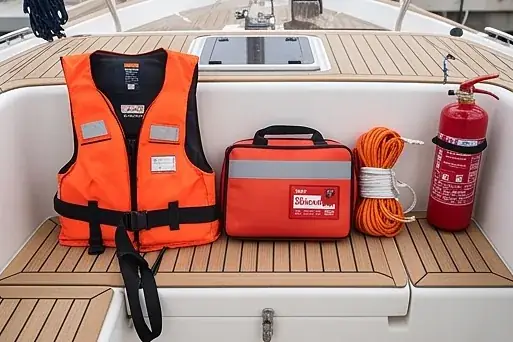
At sea, VHF channel 16 (or a DSC distress alert) reaches the coastguard and nearby vessels directly and is the first choice. Use a phone as a back-up.
Emergency numbers at sea, by country
At sea, first VHF channel 16 or the red DSC distress button: they reach the coastguard and every vessel nearby at once. Use a phone only as a back-up or close to shore. 112 works across the European Union.
| Country | Number | Who answers |
|---|---|---|
| Turkey | 158 | Coast Guard (Sahil Güvenlik); 112 also works |
| Greece | 108 | Hellenic Coast Guard; 112 also works |
| Italy | 1530 | Guardia Costiera, emergencies at sea; 112 also works |
| Croatia | 195 | National search and rescue centre (MRCC Rijeka); 112 also works |
| France | 196 | CROSS, emergencies at sea from a phone; 112 also works |
| Spain | 112 | Emergencies, passed to Salvamento Marítimo (whose own line, 900 202 202, is widely published; we could not open their official page to confirm it) |
| United Kingdom | 999 or 112 | Ask for the Coastguard |
| New Zealand | 111 | Ask for the Police, who coordinate search and rescue at sea |
| Australia | 000 (or 112 from a mobile) | Emergency services; VHF 16 at sea |
| USA | 911 | Emergency services; at sea the US Coast Guard on VHF 16 (not checked on an official page here) |
| Other EU countries | 112 | The European emergency number works in every EU country, also from a foreign mobile |
Numbers checked on 26 October 2026 against these pages: Turkey, Greece, Italy, Croatia, France, United Kingdom, New Zealand, Australia. Before you sail to a new country, check its number and save it in your phone.
🔴 DSC distress alert (the red button)
- Lift the cover of the red DISTRESS button on the VHF, choose the nature of distress if you have a few seconds, then hold the button for about 5 seconds until the alert goes.
- The radio sends your MMSI number and GPS position to every coast station and DSC-equipped vessel in range. It only works if an MMSI is programmed and the radio is connected to a GPS: check both before you need them.
- Wait about 15 seconds for an acknowledgement, then make the voice call below on channel 16.
Mayday voice call (VHF channel 16)
- Channel 16, high power.
- "MAYDAY, MAYDAY, MAYDAY."
- "This is" your vessel name three times, then your call sign and MMSI.
- "MAYDAY", the vessel name, call sign and MMSI once more.
- Your position: latitude and longitude, or bearing and distance from a known point.
- What has happened: fire, sinking, man overboard, grounding.
- What help you need, the number of people on board and any injuries.
- Anything else that helps: abandoning to the life raft, boat colour and type, "Over".
- No answer: repeat. Still nothing: try other channels, a phone, the EPIRB.
MAYDAY is for grave and imminent danger to the boat or a person. PAN-PAN (said three times, same pattern) is for urgent help when nobody is in immediate danger of death: engine failure near a lee shore, a medical problem, a lost rudder. If you hear a Mayday nobody answers, write down the details and relay it: "MAYDAY RELAY".
🧍 Man overboard
- Shout "Man overboard!", throw the life ring and danlight, press the MOB button on the plotter or send a DSC alert.
- One person only points at the casualty and never looks away; in a seaway a head disappears in seconds.
- Under sail: stop the boat at once (crash tack and heave to, or the quick-stop turn) and stay close; do not sail away to drop the sails. Under engine: turn towards the side the person fell, and stop the propeller near the person.
- Recovery is the hardest part: a tired person cannot climb a ladder. Use a lifting sling or a halyard on a winch, and practise it with your crew before you need it.
- At night and offshore, everyone on deck wears a lifejacket with a light and a personal AIS or PLB beacon, and is clipped on.
Fire
- Everyone puts on a life jacket; muster and count heads.
- Cut fuel and gas supply; cut electrics at the source if possible.
- Turn the boat so the fire is downwind of the crew; aim the extinguisher at the base of the flames. Use a fire blanket on a galley fire; never water on burning fuel or fat.
- In the engine room, do not open the hatch wide: use the fire port or the automatic system.
- If the fire is not under control within a minute or two, send the distress call and prepare the life raft.
Flooding
- Find the source fast: taste the water (salt or fresh), check seacocks, hoses, the stern gland, the rudder and the toilet.
- Close the seacock or push a tapered wooden plug into a failed through-hull; keep one tied next to every through-hull.
- Run every bilge pump; back up with the hand pump and buckets. A frightened person with a bucket moves more water than most electric pumps.
- If the water still rises, send the distress call early, while the radio and batteries still work; lifejackets on, life raft ready.
🪨 Grounding
- Count heads; check for injuries.
- Check for hull damage and water in the bilge, at the keel bolts and rudder stock.
- Do not force the engine astern before you know the damage: you may pull a holed boat into deep water.
- In tidal waters, note the time and the state of the tide: on a rising tide you may float off; on a falling tide lay out an anchor towards deep water, prepare for the boat to heel, and get help before she dries out.
- If needed, call for assistance and give your position.
⚕️ Medical emergency at sea
- Near the coast: call the coastguard on VHF 16 (PAN-PAN, or MAYDAY if life is in danger) and ask for medical advice; they connect you to a doctor by radio.
- Offshore: the rescue coordination centre (MRCC) for the area connects you to radio medical advice. Save its number in the satellite phone before you leave.
- Have ready: age, symptoms, pulse, breathing, temperature, medicines taken, and what your medical kit holds.
Abandon ship
- Only step up into the life raft: the boat, even half full of water, is often safer than a raft.
- Distress call first; activate the EPIRB and take it with you.
- Lifejackets on, warm clothes, grab bag (water, handheld VHF, PLB, flares, medicines, documents, seasickness tablets).
- Keep the raft tied to the boat until you must cut it free.
Steering or rudder failure
- Lock what is left of the steering; check the bilge at the rudder stock for water.
- Rig the emergency tiller; under sail, balance the boat with the sails or steer with a drogue or a warp towed astern.
- Near a lee shore with no steering: PAN-PAN and anchor if the depth allows.
If you do not have a radio operator's licence, print this card and keep it visible on the boat. Checklists · Document tracker
Keep going
Know these waters?
Free and quick. What you add helps the next crew decide.
Boat Almanac is free for every sailor and grows with what sailors add.