Published By Tuna Karslı, editorHow guides are checked
Why is fuel consumption different at sea?
On land, fuel efficiency is measured in litres per kilometre. At sea, consumption is expressed per hour, because a boat is always fighting water resistance, and current and wind alter the load every moment. Unlike a car on a fixed road surface, the same boat at the same speed can consume thirty percent more or less depending on conditions. This means the consumption figures in brochures represent ideal conditions; real-world figures running a little higher is completely normal.
The main factors affecting fuel consumption are, in order: hull type, boat weight, engine power and propeller match. hulls work hard at low speed, then resistance drops dramatically once the hull lifts onto the plane and reaches its efficient cruise speed. Semi-displacement hulls give reasonable consumption at all speeds but have an upper speed limit. Full-displacement hulls are slow, and the most economical option at low revs.
How to calculate consumption simply
For diesel engines, a rough figure is 0.20 to 0.25 litres per horsepower per hour. For petrol engines the figure rises to 0.30 to 0.40 litres per horsepower per hour. The calculation is simple: multiply the engine horsepower by the appropriate factor and you have the approximate hourly consumption. Multiply by passage time to estimate daily and weekly fuel budgets.
Example: a 150hp diesel at full throttle burns roughly 30 to 37 litres per hour. But nobody runs flat out for an entire passage. At cruise revs, typically 60 to 70 percent of maximum power, consumption drops noticeably. That same 150hp diesel at cruise revs uses around 18 to 22 litres per hour. Over a long passage the difference in cost is substantial.
On twin-engine boats, divide the total horsepower by two, apply the factor, then multiply by two. Note: twin engines consume ten to fifteen percent more in total than a single of equivalent power, because two propellers and two gearboxes create more drag. The trade-off is manoeuvrability and redundancy.
Outboard, inboard and stern drive: which uses how much?
motors are common on smaller boats. Outboards from 30 to 300hp generally run on petrol, though large diesel outboards also exist. A petrol outboard typically burns forty to fifty percent more than an equivalent-power diesel . For short-range and occasional use petrol is acceptable; for regular, longer passages the fuel saving from a diesel is significant.
Inboard diesel engines are the standard for medium and larger boats. In efficiency terms, the inboard diesel is generally the most advantageous choice. Stern drive (I/O) systems have the engine inside and the lower unit outside; consumption is similar to an inboard, but the outdrive’s maintenance cost is a factor worth considering.
Electric motors are currently viable for small boats and short distances. Battery technology is improving rapidly, but for long range and high power applications a direct comparison with diesel or petrol is premature for now.
Average consumption by boat size
The figures below are approximate, for cruise revs, single diesel engine and a moderately loaded hull:
A 5 to 6 metre with a 40 to 80hp engine: 8 to 15 litres per hour. A 7 to 9 metre cruiser with 100 to 200hp: around 15 to 35 litres per hour. A 10 to 12 metre motoryacht with 200 to 400hp: 30 to 60 litres per hour. Boats over 15 metres and gulets start at 50 litres per hour and go up with engine power.
Sailing yachts under auxiliary power typically use a small single diesel. A 35-foot sailing yacht with a 30 to 40hp engine uses only 4 to 7 litres per hour. When the wind fills the sails the engine stops, that is the sailing yacht’s fundamental fuel advantage.
Practical fuel-saving measures
Hull cleanliness is the cheapest and most effective fuel-saving measure. Weed and barnacles on the bottom can increase drag by fifteen to thirty percent. Regular diver cleaning or an annual repaint lets the engine hold the same speed at lower revs.
Propeller selection and condition directly affect consumption. A bent, damaged or worn propeller forces the engine to work harder. Propeller diameter and pitch must match the boat and engine; a mismatched propeller both reduces performance and increases fuel burn.
Weight management is simple but effective. Unnecessary load, especially on small boats, raises consumption noticeably. Filling the water tank only to the level needed, not leaving unused gear aboard, all make a difference.
Speed planning is the biggest single saving. Planing hulls have two efficient zones: at speed (below hull speed) and at full plane. The transition zone in between loads the engine hardest and burns the most fuel. Either cruise economically at displacement speed or drive fully onto the plane, avoid getting stuck in the hump.
Accounting for wind and current when planning a route saves fuel on longer passages. Reducing speed into a strong headwind, or plotting a route that uses a favourable current, creates a meaningful difference over distance.
Keeping engine hours and fuel records
The only way to base fuel consumption on real data is to keep records. At every fill, note the engine hours, litres taken and distance covered in the preceding period. After a few seasons you will have your own boat’s real consumption profile: what speed costs what, how much more a fouled bottom burns, how much a clean bottom saves. This data lets you build a realistic fuel budget and maintenance schedule.
Engine hours also determine maintenance intervals. Oil changes, filters and belts are all tracked by hours. Timely maintenance keeps the engine running efficiently and indirectly keeps fuel consumption down.
Fuel quality and storage
Fuel quality is critical in diesel engines. Diesel that has been sitting in the tank for a long time absorbs moisture, and bacteria and fungi can grow. This contamination clogs injectors, reduces engine performance and increases consumption. A primary fuel filter with a water separator catches this; checking the filter regularly is cheap insurance.
Never leaving the tank completely empty reduces the risk of condensation on tank walls. A fuel stabiliser additive in a boat that will sit unused for a long time slows fuel degradation. If you have doubts about fuel quality, a fuel sample can be sent to a laboratory for testing.
Read next
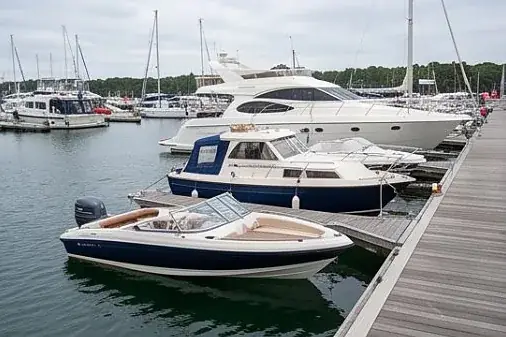 Boat Prices: What a Boat Costs by Size, Type and EngineAsk "how much does a boat cost?" and the honest answer is "anything from the price…
 How Much Does It Really Cost to Own a Sailboat per Year?The question every first-time buyer asks after "how much is it?" should be "how much will…
 How Much Does It Cost to Live on a Sailboat? Real Monthly Numbers"How much does it cost?" is the first question people ask when they hear you live…
Reader ratings
No ratings yet. Was this useful? Rate it and add what you know: corrections and first-hand tips help the next reader.
★ Rate this guide
Suggest a correction
Cite this page
Motorboat fuel consumption: calculating costs, comparing engines and saving money. Boat Almanac, updated 22 October 2026. https://boatalmanac.com/articles/motorboat-fuel-consumption-calculating-costs-comparing-engines-and-saving-money/ (accessed 21 November 2026).