Sea words: from the Roaring Forties to Fiddler's Green
Every anchorage has its own language. These are the names and sayings that ocean sailors use, from the wind belts that shape a circumnavigation to the eight winds of the Turkish coast, the weather lore older than the barometer, and the everyday English and Turkish words that came ashore from the deck. Where a word's origin is only a good story, we say so.
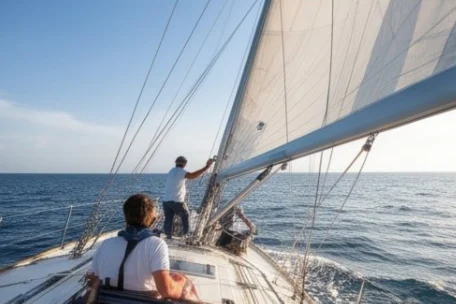
- Winds of the open ocean
- Named winds
- 🇹🇷 The Turkish wind rose
- Routes and places sailors talk about
- Traditions and lore
- Old weather sayings
- What cruisers say
- Everyday English that came from the sea
- 🇹🇷 Sea words the Turkish language took from the Mediterranean
- 🧂 Good stories, doubtful roots
- 📜 A few words from the books
Winds of the open ocean
The big belts of wind that decide every ocean route. Learn these first: the whole of passage planning hangs on them.
Roaring Forties
Strong westerly winds between about 40° and 50° south. With almost no land in the way, wind and swell build round the whole planet.
For your passageThe fast road east for the Southern Ocean races and for the passage from South Africa to Australia. For a cruising yacht it means big following seas, so a drogue and a well-tested self-steering system matter more than speed.
Furious Fifties
The belt from 50° to 60° south, windier and colder than the Forties, where Cape Horn sits at about 56° south.
For your passageCruising boats that go here do it in the southern summer, with weather routing and every hatch and washboard secured. Rounding the Horn is a planned event, not a passing one.
Screaming Sixties
South of 60°: the Southern Ocean near Antarctica, with gales, very large waves and ice.
For your passageExpedition territory. Ice limits are set for the races for good reason; a cruising plan stays north of them.
Trade winds
The steady easterly winds of the tropics: north-east in the northern hemisphere, south-east in the southern.
For your passageThe reason a round-the-world voyage goes west. Crossings are timed to sail in them and to leave the tropics before the storm season.
Doldrums (ITCZ)
The calm, squally belt near the equator where the two trade wind systems meet, now called the Intertropical Convergence Zone. It moves north and south with the seasons.
For your passageCross it at its narrowest point (check the latest weather files), carry enough fuel to motor through, and keep a sharp watch for squalls, especially at night.
Horse latitudes
The high-pressure belts at about 30° north and south, with light and variable winds between the trades and the westerlies.
For your passageSlow going. On the Atlantic return from the Caribbean, boats go north towards Bermuda and the Azores to pick up the westerlies on the far side.
Westerlies
The prevailing westerly winds of the middle latitudes, roughly 35° to 60°, in both hemispheres, bringing the weather systems from west to east.
For your passageThe way home across the North Atlantic, from Bermuda or the Azores to Europe, in early summer.
Named winds
Local winds with their own names, and the habits that go with them. Locals use the name; knowing it helps you read the forecast and the harbour talk.
Meltemi (Etesians)
The strong, dry northerly of the Aegean, from about late May to September, at its strongest in July and August. Often force 5 to 7, sometimes more, and it usually eases at night.
For your passagePlan to go north early in the season or early in the day, and use the meltemi to run south. In the Cyclades, the windward side of an island is no place to anchor.
Bora
A cold, gusty north-easterly that falls down the mountains onto the Adriatic coast, worst in winter. It can arrive in minutes with little warning.
For your passageIn Croatia and Slovenia take the bora warnings seriously, choose a harbour with shelter from the north-east and put out extra lines.
Mistral
A strong, cold north-westerly that funnels down the Rhône valley into the Gulf of Lion and on to the Balearics, Corsica and Sardinia.
For your passageThe Gulf of Lion can turn rough fast in a mistral. Cross it between blows, and watch the forecast for Corsica and Sardinia as well.
Sirocco (Scirocco)
A hot south or south-easterly from North Africa, often carrying dust, then rain with red mud in it on the northern shores.
For your passageBrings a heavy swell into south-facing harbours in Malta, Sicily and southern Italy. Wash the dust off the sails and the deck before it bakes on.
Levante and Poniente
The easterly and westerly winds of the Strait of Gibraltar. The levante can blow hard for days, accelerating through the Strait.
For your passageLeaving the Mediterranean westward you want a light levante and the right tide. Against a strong levante or a westerly gale, wait in Gibraltar, La Línea or Ceuta.
Tramontana and Gregale
In the western Mediterranean, the north wind off the mountains (tramontana) and the north-easterly (gregale), which can push a big sea into harbours facing that way.
For your passageMalta's Grand Harbour and many Balearic bays are open to the gregale. Know which way your anchorage faces.
Williwaw
A sudden violent gust that drops off high, steep land, best known in the channels of Patagonia and Tierra del Fuego.
For your passageAt anchor under high ground, use two anchors or lines ashore. Under way, reef early and keep the sheets in hand.
Southerly buster
A sudden, cold, strong southerly change along the coast of New South Wales, often after a hot day.
For your passageOff Sydney a hot north-easterly afternoon can flip to a southerly gale within minutes. Be in or ready to be in before it comes.
Cape Doctor
The strong south-easterly summer wind of Cape Town, said to blow the pollution out of the city.
For your passageArrivals in Cape Town in the southern summer often come in with it. Have fenders and lines ready, and reef before the harbour.
Christmas winds
The reinforced, stronger trade winds of the Caribbean around December and January.
For your passageExpect 20 to 25 knots and rough channels between the islands. Plan inter-island hops for the lulls.
Papagayo and Tehuantepecer
Gap winds that blow through low passes from the Caribbean side to the Pacific coast of Central America, in Nicaragua and Costa Rica (Papagayo) and southern Mexico (Gulf of Tehuantepec), mainly in winter.
For your passageOff the Gulf of Tehuantepec the classic advice is one foot on the beach: hug the shore so the sea has no room to build.
Shamal
A north-westerly wind over the Persian Gulf, sometimes for days, carrying dust.
For your passageReduces visibility and raises a short, steep sea in shallow water.
🇹🇷 The Turkish wind rose
On the Turkish coast the old names of the eight winds are in daily use on the VHF and in the harbour. Most come from the sailors of the eastern Mediterranean and are shared with Greek and Italian names.
Yıldız
North wind. The name means "star": it blows from the direction of the Pole Star.
For your passageCold in winter. In the northern Aegean in summer, part of the meltemi family.
Poyraz
North-east wind, from the same root as the Greek "Boreas".
For your passageStrong and cold in the Marmara and the Black Sea in winter. The well-known Bosphorus wind.
Gündoğusu
East wind: "where the sun rises".
For your passageUsually light on the Aegean coast.
Keşişleme
South-east wind, said to be named after Mount Keşiş (Uludağ) near Bursa, which lies south-east of Istanbul.
For your passageCan bring rain and swell into south-east-facing anchorages.
Kıble
South wind, named after the direction of Mecca from Turkey.
For your passageWarm and often damp. Sends swell onto south-facing coasts.
Lodos
South-west wind. The most feared winter wind in Istanbul and on the Marmara, it piles a big sea onto the coast.
For your passageIn winter, the lodos is the reason for a well-protected winter berth. In the Aegean it brings rain and swell.
Batı (Günbatısı)
West wind: "where the sun sets".
For your passageOften the afternoon sea breeze on west-facing coasts.
Karayel
North-west wind.
For your passageThe direction of much of the summer meltemi in the southern Aegean, from Bodrum to Marmaris.
meltemi
The Turkish name for the summer northerlies, the same wind as the Greek meltemi.
For your passageIn Bodrum and Datça it usually builds from late morning and dies at sunset. Do your passages early.
İmbat
The steady afternoon sea breeze that blows into the Gulf of İzmir and along the north Aegean coast in summer.
For your passageA pleasant sailing wind in the afternoon. Expect it to fill in around noon and ease in the evening.
Routes and places sailors talk about
The names you will hear in every cruising anchorage, from Las Palmas to Opua.
South until the butter melts, then turn right
The old rule for crossing the Atlantic from Europe: sail south towards the Canaries and Cape Verde until it is warm enough to melt the butter, which means you are in the trade winds, then turn west for the Caribbean.
For your passageStill the right idea. The trade winds settle in late November, which is why the big crossings leave then.
The Milk Run (Coconut Milk Run)
The classic downwind route west across the South Pacific from Panama: the Galápagos, the Marquesas, the Tuamotus, Tahiti, the Cook Islands, Tonga and Fiji, then south to New Zealand or Australia before the cyclone season.
For your passageGentle sailing most of the way, but the season sets the timetable: arrive in the Marquesas after March, leave the tropics by November.
The Puddle Jump
The roughly 3,000 NM crossing from Panama or Mexico to the Marquesas, the longest passage of most circumnavigations.
For your passageAllow three weeks, carry spares for everything that chafes, and expect very little help on the way.
Hurricane hole
A naturally sheltered anchorage, often among mangroves, where boats ride out a tropical storm.
For your passageIn the hurricane season, know where yours is before you need it, and what the local rules are for using it. Many insurers also want the boat south of a set latitude.
Cape of Storms
The first name the Portuguese gave to the Cape of Good Hope (Cabo das Tormentas). The Agulhas Current against a south-westerly gale makes some of the steepest seas anywhere.
For your passageRound it in a window between fronts and stay out of the strongest current in a south-westerly.
The Thorny Path
The name cruisers give the windward route from Florida to the eastern Caribbean, through the Bahamas, the Dominican Republic and Puerto Rico, against the trades.
For your passageDone in short hops, using the calm nights and early mornings along the coasts.
Med mooring
Mooring stern-to (or bow-to) the quay with a slime line or your own anchor holding the bow off, as in most Mediterranean harbours.
For your passageGo in slowly, have lines ready on both quarters, and take the slime line forward with gloves on. Handbook: marina culture.
Traditions and lore
Customs that most long-distance sailors know and many still keep, with a smile.
Crossing the line
The ceremony when a boat first crosses the equator. A first-timer is a pollywog (or tadpole); after King Neptune's court has had its fun, he or she is a shellback.
For your passageKeep it kind. A tot for Neptune over the side is the usual offering.
Golden shellback
Someone who has crossed the equator at the 180th meridian, where it meets the International Date Line.
For your passageA rare one: few yacht routes pass that point.
Cape Horner
A sailor who has rounded Cape Horn under sail. Old lore gave a Cape Horner the right to wear a gold earring.
For your passageThe earring is lore, not law. The pride is real.
Renaming a boat
Sailors say renaming a boat brings bad luck unless the old name is first removed from the boat and its papers and the sea gods are asked to forget it.
For your passageMany owners hold a small denaming ceremony anyway. It does no harm and the crew enjoys it.
Whistling up a wind
Old belief that whistling on board calls up a wind, and too much whistling calls up a gale.
For your passageSome skippers still frown at a whistling crew on a windy day.
Davy Jones's locker
The bottom of the sea, where lost things (and drowned sailors) go.
For your passage"It went to Davy Jones" is what you say when the winch handle goes over the side.
Fiddler's Green
In sailors' lore, the happy afterlife for seafarers, where the music never stops.
Old weather sayings
Weather lore from the days before forecasts. Some of it holds up well, some only half. Here is which is which.
Red sky at night, sailor's delight. Red sky in the morning, sailor's warning.
A red sunset means the western sky is clear, so the weather coming towards you in the westerlies is likely fair. A red sunrise means the clear air has passed and cloud may be coming.
For your passageWorks fairly well in the mid-latitudes, where weather moves west to east. Much less use in the trades.
Mackerel sky and mares' tails make tall ships carry low sails.
High, thin cirrus (mares' tails) and dappled cirrocumulus (mackerel sky) often run ahead of a warm front and a depression.
For your passageA good early warning, often 12 to 24 hours ahead. Check the barometer.
Long foretold, long last. Short notice, soon past.
A slow fall of the barometer means a large, slow system and a long blow; a quick fall means a small, fast one.
For your passageHolds up well. A fall of 3 hPa or more in three hours means strong wind is on its way.
First rise after low foretells a stronger blow.
When the barometer starts to rise after a low, the strongest winds often come in the cold air behind the front.
For your passageDo not relax at the bottom of the low. The gusts often come with the clearance.
When the rain comes before the wind, halyards, sheets and braces mind.
Rain first, then wind, means the wind behind the rain may be strong.
For your passageSquall lore: reef as the rain arrives, not after.
What cruisers say
Sayings you hear on the pontoon and on the evening cruisers' net. Most have no known author; they are just true.
One hand for yourself, one for the boat.
Always keep one hand holding on when you move around on deck.
For your passageAdd a clipped-on harness at night and in any sea. Most falls overboard happen doing something simple.
Reef early. The first time you think of it is the time.
Shorten sail as soon as the idea crosses your mind. It is easy before the wind arrives and hard after.
For your passageAt night, reef before dark when in doubt.
The most dangerous thing on a boat is a schedule.
A flight to catch or a guest to meet pushes crews to leave in bad weather.
For your passagePlan your dates with spare days in them. The route planner adds them for you.
Gentlemen never sail to windward.
The old line for choosing a route and a season with the wind behind you.
For your passageThe whole logic of the trade-wind circumnavigation.
Step up into the liferaft.
Only leave a boat that is still floating for the liferaft when you have to step up into it, meaning the boat is sinking beneath you.
For your passageMany people have died in liferafts from boats that were later found afloat.
Cruising is fixing your boat in exotic places.
The honest description of long-distance cruising.
For your passageCarry spares, tools and the manuals, and learn your systems before you leave.
B.O.A.T.: bust out another thousand.
The joke every owner knows about what boats cost.
For your passageBudget about 10% of the boat's value a year for upkeep. The cost calculator helps.
Any fool can carry on, but only a wise man knows when to shorten sail.
An old saying about seamanship and turning back.
For your passageTurning back is a skill, not a failure.
Cruising plans are written in the sand at low tide.
Plans change with the weather, the boat and the people.
For your passageHold the route loosely and the safety rules tightly.
Everyday English that came from the sea
Words and phrases that started on deck and ended up in offices and kitchens. Where the origin is documented we say so; where it is only a good story, we say that too.
Three sheets to the wind
The sheets are the ropes that trim the sails. With three of them loose, an old sailing ship staggered and lurched about. Now it means very drunk.
For your passageOn your own boat: a flogging sheet is a sail out of control. Make it fast before you do anything else.
Doldrums
The calm belt near the equator where sailing ships could lie becalmed for days. In everyday English it now means a low, stuck mood or a slow market.
Scuttlebutt
The cask of drinking water on a ship (a butt with a hole, or scuttle, cut in it). Sailors gathered round it and swapped news, so the word came to mean gossip. The office water cooler is its modern heir.
Loose cannon
A gun of several tonnes that broke its lashings in a seaway rolled across the deck, crushing anything in its path. Now an unpredictable person.
For your passageThe same goes for an unlashed battery or a loose outboard below: secure everything heavy before you go to sea.
Show your true colours
Colours are a ship's flags. Warships could approach under a false flag as a ruse, but the custom of the sea required them to hoist their own colours before opening fire. Now: to show what you really are.
For your passageToday a yacht flies her own ensign, the courtesy flag of the country she visits, and the Q flag on arrival.
Splice the mainbrace
An order in the Royal Navy for an extra tot of rum for the whole crew, given after a hard job or on a great occasion. It is still ordered on rare royal occasions. Sailors explain it as the reward for repairing the main brace, one of the hardest jobs aloft.
Marooned
Put ashore on an empty island and left there, a punishment in some pirate codes. The word comes from the Spanish cimarrón, a runaway living wild.
Grog
Rum mixed with water, introduced in the Royal Navy in 1740 by Admiral Edward Vernon, nicknamed "Old Grog" after his coat of grogram cloth. Groggy came from it.
Quarantine
From the Venetian quaranta giorni, forty days: from the 14th century, ships arriving at Venice and Ragusa (Dubrovnik) from places with plague waited forty days before landing.
For your passageThe yellow Q flag you fly on arrival still means "my vessel is healthy and I request free pratique".
Mayday, Pan-Pan, Sécurité
All three are French: Mayday from m'aidez, "help me", Pan-Pan from panne, a breakdown, Sécurité, "safety". They were adopted for radio in the 1920s.
For your passageMayday for grave and imminent danger, Pan-Pan for an urgent problem, Sécurité for a safety message. See the emergency card.
Admiral and arsenal
Both came to Europe from Arabic through the Mediterranean: admiral from amir al-, "commander of the", and arsenal from dar al-sina'a, "house of making", through the Venetian arzanà, the great shipyard of Venice.
Monsoon
From the Arabic mawsim, "season", the season for sailing to India, passed on through Portuguese sailors.
For your passageThe monsoons still set the sailing calendar in the Indian Ocean and the Red Sea.
Hurricane and typhoon
Hurricane came through Spanish from the Taíno word hurakán in the Caribbean. Typhoon has roots in both Greek (Typhon, a storm giant) and Chinese (tai fung, "great wind").
Avast, yacht, skipper, boom, sloop
Dutch gave English much of its sea language: avast from houd vast (hold fast), yacht from jacht (a fast hunting boat), skipper from schipper, boom (a tree, a pole), sloop from sloep, and cruise from kruisen.
Aloof
From the Dutch loef, windward. A ship that kept aloof held her head up to windward, away from a lee shore. Now: distant, standing apart.
Fathom
From the Old English fæthm, the span of a man's outstretched arms, about six feet, the way a leadline was measured hand over hand.
For your passageOlder charts still give depths in fathoms. Check the units on every chart.
Knot
From the knots tied at even spacing along a log line streamed from the stern and counted against a sandglass.
For your passageOne knot is one nautical mile an hour, 1,852 metres an hour.
Starboard and port
Starboard from the Old English steorbord, the steering side, where the steering oar hung on the right. Ships therefore came alongside on the other side, the loading or port side, which replaced the older word larboard.
For your passageIn Turkish the same two sides are sancak and iskele.
The bitter end
The last part of the anchor cable, made fast to the bitts on board. When you reach the bitter end, there is no more to let out.
For your passageMake the bitter end of your chain fast with a lashing you can cut in an emergency.
Taken aback, know the ropes, high and dry, by and large
Taken aback: a sail caught by the wind on the wrong side. Know the ropes: an old hand who knew every line on board. High and dry: aground with the tide gone out. By and large: sailing close to the wind (by) and with it free (large), so in general.
Under the weather
Sailors say a seasick hand was sent below, out of the weather. A good story and a likely one, but the origin is not documented.
Between the devil and the deep blue sea
Some sailors say the devil was the hardest seam to caulk, close to the waterline, so the man working on it hung between that seam and the sea. The phrase is old, but this explanation is not proven.
🇹🇷 Sea words the Turkish language took from the Mediterranean
For centuries the sailors of the Mediterranean shared a working language, the Lingua Franca, built mostly on Italian, Venetian and Genoese, with Greek, Spanish and Arabic mixed in. Turkish seamanship took much of its vocabulary from it, and you will still hear these words on every Turkish quay.
Fırtına (storm)
From the Venetian fortuna, which meant both luck and a storm at sea.
For your passageIn a Turkish harbour, "fırtına var" on the VHF means stay put.
Pruva and pupa (bow and stern)
From the Italian prua and poppa.
For your passageMed mooring: "pupa" means stern-to, "pruva" means bow-to.
İskele and sancak (port and starboard)
İskele, from the Italian scala, a ladder or landing stage, is the port side, where the gangway went; sancak, a Turkish word for flag or banner, is the starboard side.
Mayna, vira, alarga, fora
Mayna (lower away) from the Italian ammaina; vira (heave up) from virare; alarga (stand off, keep clear) from al largo; fora (let go, out) from fuori.
For your passageYou will hear "Vira bismillah" as the anchor comes up, and "alarga" when a gulet captain wants you to keep your distance.
Orsa and poca (luff up and bear away)
From the Italian orza and poggia, the old commands for steering towards and away from the wind.
İskota (sheet)
The rope that trims a sail, from the Italian scotta.
Laçka (slack)
From the Italian lasco, loose or slack: "laçka et" means ease the line.
Pusula (compass)
From the Italian bussola, a small box, for the box the compass card sat in.
Kaptan, levent and tayfa
Kaptan from the Italian capitano. Levent, the old Ottoman marine, is linked with the Italian levantino, a man of the Levant. Tayfa, the crew, comes from the Arabic and Persian taife, a band or group.
Kalafat (caulking)
Shared across the Mediterranean (Italian calafato, Greek kalafatis), probably from Arabic. Gulets in Bodrum are still caulked with cotton and pitch.
For your passageA wooden boat that has been out of the water for months may weep until the planks swell. That is normal for a few days.
Poyraz, lodos and the wind names
Poyraz comes from the Greek Boreas, the north wind. Several Turkish wind names share roots with Greek and Italian: lodos, keşişleme, karayel and the rest of the rose above.
Alabora (capsize)
To turn over, keel up. Widely said to come from Italian, but the exact source word is debated.
Çapariz
A line, chain or net fouled and tangled. "Çapariz vermek" in everyday Turkish means to get in the way of a job.
For your passageA foul anchor or a chain crossed with a neighbour's is the classic çapariz in a crowded Turkish harbour.
Gomandene (kumanda)
From the Italian comandare and comandante: the captain's command of the ship.
Matafora
The curved davit arms used to lower and raise a ship's boat.
🧂 Good stories, doubtful roots
Some sea etymologies are repeated everywhere but have no evidence behind them. We like them anyway, so here they are, labelled honestly.
Horse latitudes
The usual story says Spanish ships becalmed near 30° threw their horses overboard to save water. It may be true; the name is old, but no one has proved where it came from.
Son of a gun
Said to describe a child born on a gun deck to an unknown father. A colourful naval explanation, not a proven one.
Posh: "port out, starboard home"
The story says passengers to India booked the cooler, shaded cabins on the port side going out and the starboard side coming home. No ticket stamped P.O.S.H. has ever been found, and dictionaries reject it.
Black Jack
A blackjack was a real leather drinking tankard sealed with pitch. That pirates also called their flag a black jack is often said but not well documented.
📜 A few words from the books
Quoted from the original works.
"To young men contemplating a voyage I would say go."
Joshua Slocum, Sailing Alone Around the World (1900). Slocum was the first person to sail alone around the world, in the sloop Spray, from 1895 to 1898.
For your passageYoung or not, the advice stands.
"Simply messing about in boats."
Kenneth Grahame, The Wind in the Willows (1908), from the Water Rat's line that there is nothing half so much worth doing.
"A ship in harbor is safe, but that is not what ships are built for."
John A. Shedd, Salt from My Attic (1928).
Put the words to work: the sailing seasons show when each wind blows, the ocean passages page shows the best months for every crossing, and the world voyage planner times a whole circumnavigation around them. For everyday boat words, see the glossary.