Published By Tuna Karslı, editorHow guides are checked
Why are marine batteries different?
Boat batteries operate under conditions unlike those on land. Vibration, moisture, salt air and deep discharge cycles are the challenges marine batteries must withstand. For this reason a marine battery is built more robustly than a standard car battery and has different performance characteristics.
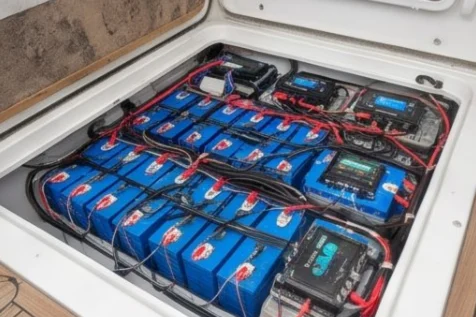
On a boat there are two distinct battery roles: the start battery starts the engine; the house bank (or service battery) powers the boat’s electrical equipment, lighting, refrigeration, electronics and pumps. These two roles call for different battery characteristics; trying to serve both with one battery compromises both engine start reliability and service duration.
Battery types
Flooded lead-acid batteries are the most common and most economical type. They require regular maintenance, electrolyte levels must be checked and topped up with distilled water when necessary. With good care they offer a three to five year service life. Disadvantages: they gas during charging (ventilation is essential), must be mounted upright and need ongoing attention.
AGM (Absorbed Glass Mat) batteries are sealed, maintenance-free lead-acid batteries. Glass-mat separators absorb the electrolyte, eliminating any risk of spillage. They are more resistant to vibration, can be mounted in any orientation and accept a faster charge than flooded types. Cost is fifty to one hundred percent higher than flooded batteries, but service life is generally longer.
Gel batteries have a gelled electrolyte and tolerate deep discharge cycles well, making them good service batteries. They are sensitive to charge voltage; incorrect charging damages them. A suitable charger is essential.
Lithium iron phosphate (LiFePO4) batteries are the most advanced option. They are roughly half the weight of lead-acid, last three to four times as long, and can be discharged to near-zero without damage. Usable capacity is eighty to ninety percent of the rated figure (compared to about fifty percent for lead-acid). The downside is a high upfront cost and the need for a compatible charger and alternator regulator. Over a ten-year horizon the total cost of ownership can approach or undercut lead-acid.
Capacity calculation
To size the house bank, calculate the boat’s daily ampere-hour consumption. For each piece of equipment, multiply the current draw in amps by the daily hours of use and add them up. This total is the daily Ah requirement.
With a lead-acid house bank, aim to use no more than fifty percent of total capacity, deeper discharge dramatically shortens life. So for a daily consumption of 100 Ah, the bank must be at least 200 Ah. With lithium batteries the usable proportion rises to eighty to ninety percent; the same consumption requires only 120 to 130 Ah.
The start battery is selected by the engine’s cold cranking amp (CCA) requirement. Choose a battery that meets or exceeds the manufacturer’s minimum CCA value. A start battery is not regularly deep-cycled; after starting the engine it is quickly recharged by the alternator.
Charging systems
The alternator is the primary charging source at sea. A standard alternator is adequate for keeping the start battery topped up, but may not be sized to charge a large house bank efficiently, consider a high-output alternator and an external smart regulator. A smart regulator optimises the charge profile for the battery type and reduces charge time.
A shore power charger tops up the batteries when connected at a marina. A quality multi-stage (bulk, absorption, float) marine charger extends battery life. The charger must have settings appropriate for the battery type (flooded, AGM, gel, lithium).
Solar panels, wind generators and hydrogenerators are alternative charging sources. Solar is the most cost-effective and silent auxiliary charger for a boat sitting at anchor. An MPPT charge controller between the panel and the battery optimises charging.
Battery maintenance and service life
On flooded batteries, check electrolyte levels monthly and top up to cover the plates with distilled water only. Never add tap water or acid; use only pure (distilled, de-ionised) water.
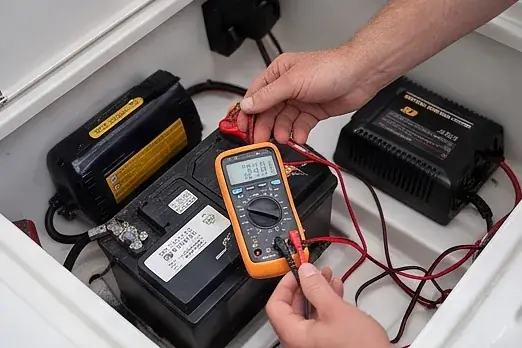
Keep terminals clean and tight. Corrosion increases resistance and reduces charging efficiency. Apply petroleum jelly or an anti-corrosion spray to the terminals.
Store batteries fully charged. A lead-acid battery left discharged for a long time sulphates and permanently loses capacity. During winter lay-up either remove the batteries and store them on a float charger, or connect a float charger directly to the batteries.
Temperature affects battery performance. Excessive heat shortens life; cold reduces capacity. The battery compartment must be ventilated; flooded batteries produce hydrogen gas during charging, hydrogen is explosive and must not be allowed to accumulate.
Correct battery selection: a checklist
Separate start and house batteries and manage them with a battery isolator or combiner and individual isolation switches. Choose a battery type that is compatible with your charging system; never mix battery types in one bank. Size capacity at least double daily consumption (lead-acid) or 1.2 times (lithium). Secure batteries with a hold-down strap or box; a loose battery moves with the boat and risks a short circuit. When a battery reaches the end of its life, take the old one to an approved recycling point.
Read next
 Lithium vs AGM Batteries for Boats: Which Is Worth It?Few upgrades are argued about on the pontoon as much as swapping lead batteries for lithium.…
 Boat battery maintenance guide: charge cycle, winter storage, measurement and life extensionImportance of battery maintenance The battery is the heart of the boat's electrical system, powering starting,…
 Boat steering system guide: mechanical, hydraulic and electronic steering types and maintenanceWhy is the steering system critical? The steering system is the most fundamental safety component providing…
Reader ratings
No ratings yet. Was this useful? Rate it and add what you know: corrections and first-hand tips help the next reader.
★ Rate this guide
Suggest a correction
Cite this page
Boat battery guide: types, capacity, charging and choosing correctly. Boat Almanac, updated 22 October 2026. https://boatalmanac.com/articles/boat-battery-guide-types-capacity-charging-and-choosing-correctly/ (accessed 21 November 2026).