Published By Tuna Karslı, editorHow guides are checked
The basics of a marine 12V system
Most recreational boats run a 12-volt DC system for navigation lights, electronics, pumps and engine starting. Shore power (240V AC) plugs in at the marina to charge batteries and run AC appliances. Understanding how the two systems interact, and how current flows through your boat, is the foundation of fault-finding and safe upgrades.
Battery types
Flooded lead-acid batteries are the cheapest and most widely used. They tolerate overcharging better than sealed types but need monthly electrolyte checks and cannot be installed in a sealed compartment without ventilation. They are heavy and lose capacity if regularly discharged below 50 %.
AGM (Absorbent Glass Mat) batteries are sealed, spill-proof and tolerate deeper discharge than flooded types. They charge faster and have lower self-discharge. They are more expensive but require no maintenance and can be mounted in any orientation. The most common upgrade choice.
Gel batteries are sealed and very deep-cycle tolerant but must not be charged at high voltages, a standard alternator can damage them without a dedicated regulator. They are less forgiving of fast charging.
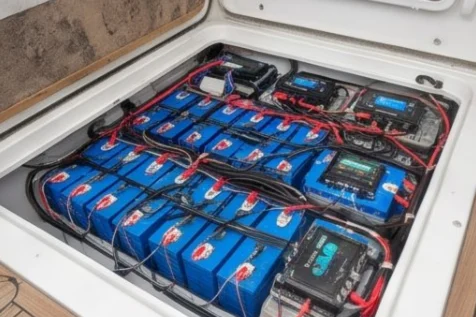
Lithium (LiFePO4) batteries are lighter, charge faster, and can be discharged to near-zero without damage. Usable capacity is roughly double that of lead-acid for the same rated Ah. They require a Battery Management System (BMS) and a lithium-compatible charger and alternator regulator. The upfront cost is high but the total cycle life often makes them cheaper over a ten-year horizon.
House bank vs. start battery
Keep the engine start battery isolated from the house bank. If you flatten the house bank running lights, the refrigerator and the chart plotter overnight at anchor, you still have a full start battery in the morning. A battery isolator, combiner or split-charge relay manages this automatically while the alternator charges both banks when the engine runs.
Sizing the house bank
Calculate your daily Ah consumption: add up every load (amps × hours per day). Double that figure for a lead-acid bank (to stay above 50 % depth of discharge) or use the raw figure for lithium. Add 20 % safety margin. For a typical weekend cruiser with modest electronics, 200–300 Ah of AGM is usually comfortable.
Charging sources
The engine alternator is the primary charging source at sea. Most stock alternators are not sized for large house banks and will run continuously and hot when connected to a depleted AGM or lithium bank, consider an upgraded alternator and an external smart regulator. Solar panels are the most cost-effective auxiliary charger for boats that swing at anchor. A wind generator adds overnight charging when solar output drops. Shore power via a battery charger tops the bank in marinas.
Common faults
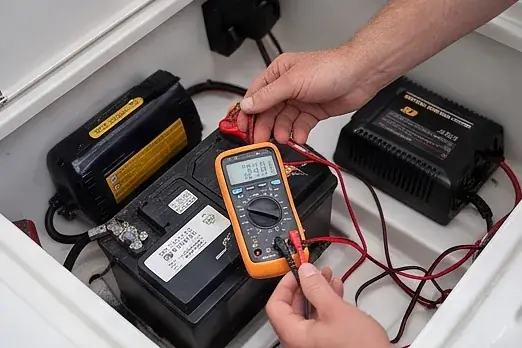
Corroded connections are responsible for most intermittent electrical faults on boats. Salt air attacks every exposed terminal. Inspect and clean terminals annually; protect them with dielectric grease or an anti-corrosion spray. A voltage drop test, measuring voltage at the load rather than at the battery, identifies high-resistance connections that look fine visually.
Read next
 Lithium vs AGM Batteries for Boats: Which Is Worth It?Few upgrades are argued about on the pontoon as much as swapping lead batteries for lithium.…
 Boat battery maintenance guide: charge cycle, winter storage, measurement and life extensionImportance of battery maintenance The battery is the heart of the boat's electrical system, powering starting,…
 Boat steering system guide: mechanical, hydraulic and electronic steering types and maintenanceWhy is the steering system critical? The steering system is the most fundamental safety component providing…
Reader ratings ★ 5.0 (1 rating, 0 with words)
★★★★★ stars only
★ Rate this guide
Suggest a correction
Cite this page
Boat electrical systems and battery guide: 12V, charging and troubleshooting. Boat Almanac, updated 22 October 2026. https://boatalmanac.com/articles/boat-electrical-systems-and-battery-guide-12v-charging-and-troubleshooting/ (accessed 21 November 2026).