Published By Tuna Karslı, editorHow guides are checked
The engine is the heart of a motor boat and a vital safety system on a sailing yacht. The right choice affects speed and fuel consumption, but also maintenance costs, reliability at sea and resale value. This guide compares outboards, inboards, sterndrives and pod drives, diesel and petrol, and electric propulsion, explains how to approach engine sizing, and covers the batteries that keep everything running.
Outboard engines
An is a self-contained unit clamped or bolted to the , combining the engine, gearbox and propeller in one assembly. You steer by turning the whole unit, and it can be tilted clear of the water. Modern outboards are almost all four-stroke petrol engines, with some direct-injection two-strokes still available, and power ranges from 2.5 hp portables to 600 hp V12s.
Advantages: easy access for servicing, no machinery inside the hull, simple removal for repair or replacement, shallow-water capability, and a strong used and parts market. Disadvantages: exposed to weather and theft, weight concentrated on the transom, louder than a well-insulated , and petrol fuel in the boat.
The leading outboard brands worldwide are Yamaha, Mercury, Suzuki, Honda and Tohatsu, all with extensive dealer and service networks in the main boating markets.
Inboard engines
An inboard is mounted inside the hull and drives the propeller through a shaft and a stern gland or shaft seal. It is the standard arrangement on sailing yachts, trawlers and many larger motor yachts.
Advantages: low centre of gravity, good weight distribution, quieter running and suitability for heavy boats and long-range cruising. Disadvantages: more complex installation, less convenient access for servicing in a cramped engine bay, and through-hull components (shaft seal, raw-water intake, exhaust) that need regular inspection.
Sterndrives and pod drives
A places the engine inside the hull and the drive leg outside the transom, combining inboard power with outboard-style steering and trim. They are common on cruisers and sportsboats of 6–10 metres, but the drive leg, bellows and gimbal bearings need regular maintenance. Pod drives, such as Volvo Penta IPS and Cummins Zeus, mount steerable drive units under the hull and, with joystick control, make close-quarters manoeuvring much easier on larger motor yachts.
Diesel or petrol?
Diesel is the standard choice for inboards on boats that are used regularly or travel long distances. Diesel fuel is far less volatile than petrol, so it is safer to carry and store on board, and diesel engines are more fuel-efficient and generally longer-lived. Petrol engines are lighter and cheaper to buy, which suits outboards and smaller sterndrive boats, but petrol vapour is heavier than air and can collect in the . On boats with enclosed petrol engine compartments, US Coast Guard rules require powered ventilation, and owners should run the bilge blower for at least four minutes before starting the engine.
The best-known marine diesel brands include Volvo Penta, Yanmar, Cummins, Caterpillar, MAN, Beta Marine and Nanni, with Volvo Penta and Yanmar especially widespread on sailing yachts and mid-size motor boats.
Electric propulsion
Electric motors offer silent running, no exhaust emissions at the point of use, very low running costs and minimal maintenance. The limits are range, the weight and cost of the battery bank, and charging time. As battery technology improves and marinas install more charging points, electric propulsion is increasingly viable for tenders, day boats, lakes and harbour use; brands such as Torqeedo and ePropulsion lead the small-boat market. For long offshore passages, range remains a practical constraint, which is why hybrid diesel-electric systems are appearing on some larger yachts and catamarans. Check local rules too: some lakes and inland waters restrict or ban combustion engines.
How much horsepower do you need?
There is no single formula, because the right power depends on hull type, weight and how you use the boat:
- Never exceed the builder’s maximum rating. In the US, boats under 20 feet (with some exceptions) must carry a capacity plate stating the maximum horsepower and load. Boats sold in the EU and UK carry a builder’s plate with maximum load and, for outboard boats, maximum power.
- hulls need enough power to get on the plane fully loaded. An underpowered planing boat runs bow-high, burns more fuel and wears its engine harder. Many owners choose an engine near the top of the rated range for this reason.
- hulls, such as sailing yachts and trawlers, have a maximum practical speed set by their waterline length. Adding power beyond what is needed to reach it simply wastes fuel.
- Use real-world data: engine makers and boat test reviews publish performance figures for common hull and engine combinations. These are far more reliable than rules of thumb.
Batteries
Most boats have two separate battery systems: a starting battery for cranking the engine and a house bank for lights, electronics, refrigeration and pumps. Starting batteries deliver a short burst of high current, while house batteries must handle repeated deep discharges. AGM (absorbed glass mat) batteries are a popular house-bank choice because they are sealed, maintenance-free and spill-proof. Lithium iron phosphate (LiFePO4) batteries offer much longer cycle life, more usable capacity and lower weight, but they need a compatible charging system, a battery management system and careful installation. A battery switch or isolator, correctly sized cabling and fusing close to the battery are essential in every installation.
Antifouling and engine efficiency
Barnacles, weed and slime on the hull and propeller add drag and increase fuel consumption, so antifouling is part of keeping any engine efficient. Most antifouling paints release a biocide, usually copper-based, and are renewed at the annual haul-out. Silicone-based foul-release coatings work differently: they create a slippery surface that growth struggles to grip and that cleans itself at speed. TBT-based antifouling has been banned under the International Maritime Organization’s convention on harmful anti-fouling systems. Never use copper-based antifouling on aluminium hulls or drive legs; choose a compatible product.
Practical tips for choosing an engine
- Match the engine to the hull: follow the builder’s rating and use the performance data available for your hull.
- Check local service support: choose a brand with authorised dealers where you keep and use the boat. Parts for less common makes can take weeks to arrive.
- Think about total cost of ownership: a cheaper engine is no bargain if servicing is expensive or parts are hard to find.
- Consider twin engines for offshore use: they add redundancy, but also cost, weight and servicing.
- Plan for the future: if you may move to a larger boat or start cruising further afield, diesel reliability and fuel range become more important.
- Have used engines inspected: ask for the service history and have an independent marine engineer check the engine, including oil analysis or compression testing where appropriate.
For engine servicing and support, visit our maintenance services page. For boats currently on the market, see our listings.
Read next
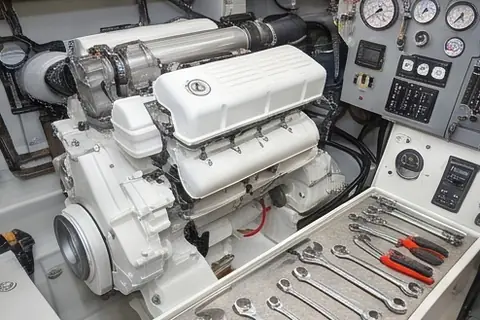 Why Won’t My Boat’s Diesel Engine Start? 10 Checks Before You Call a MechanicA diesel engine is simple at heart. It needs clean air, clean fuel delivered at the…
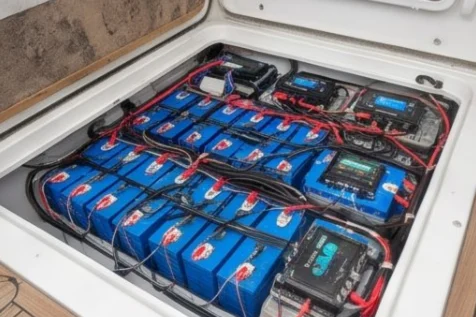 Lithium vs AGM Batteries for Boats: Which Is Worth It?Few upgrades are argued about on the pontoon as much as swapping lead batteries for lithium.…
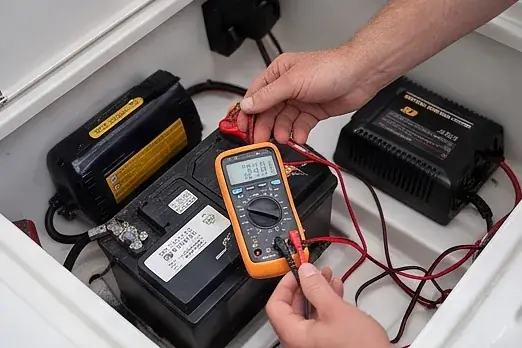 Boat battery maintenance guide: charge cycle, winter storage, measurement and life extensionImportance of battery maintenance The battery is the heart of the boat's electrical system, powering starting,…
Reader ratings
No ratings yet. Was this useful? Rate it and add what you know: corrections and first-hand tips help the next reader.
★ Rate this guide
Suggest a correction
Cite this page
Boat Engines Explained: Outboard, Inboard, Diesel and Electric. Boat Almanac, updated 22 October 2026. https://boatalmanac.com/articles/boat-engines-explained/ (accessed 21 November 2026).