Published By Tuna Karslı, editorHow guides are checked
A well-equipped boat is reliable, comfortable and safe; a poorly equipped one can leave you stranded, uncomfortable or worse. This guide covers the main categories of boat equipment, from ground tackle and navigation electronics to power systems and safety gear, with practical points to consider when choosing each.
Anchors and ground tackle
Traditional anchor designs include the CQR-style plough, the Bruce-style claw, the Danforth-style fluke and the Delta. Newer-generation designs such as the Rocna, Mantus, Spade and Ultra are known for setting quickly and holding well across a wide range of seabeds. Size the anchor using the manufacturer’s chart for your boat’s length and , and choose the larger size if you fall between two; an anchor is one piece of equipment where too big is rarely a problem.
, the ratio of rode length to the depth of water plus the height of the bow roller, is just as important. A common guide is at least 5:1 with all-chain rode in settled conditions and 7:1 or more with a chain-and-rope combination, increasing in strong winds. All-chain rode is the norm on cruising yachts in the Mediterranean and many other popular cruising grounds; a length of chain followed by nylon rope saves weight in the bow and suits smaller boats. Make sure the bitter end is secured to the boat with a line that can be cut in an emergency.
Windlass
An anchor windlass makes retrieving the anchor practical on most boats above about 9–10 metres. Choose a model whose rated pull suits the combined weight of your anchor and the chain you typically deploy; manufacturers publish selection guidance, and many recommend a working capacity of several times that combined weight. Electric windlasses draw a heavy current, so follow the maker’s cable-size and circuit-protection recommendations: undersized cable causes voltage drop, heat and slow recovery. Never use the windlass to hold the boat at anchor; take the load on a chain hook, or bridle.
Fenders and mooring lines
protect the hull when alongside a pontoon, quay or another boat. A widely used rule of thumb is about one inch of fender diameter for every four to five feet of boat length, with larger fenders for heavy boats and exposed berths. Carry at least four, and more if you regularly raft up or lie alongside quays. A fender board, a plank hung outside two fenders, is invaluable against piled walls. For berthing, which is common in the Mediterranean, you will also need fenders on both sides of the stern. Carry mooring lines of adequate length and diameter, with chafe protection where they pass over fairleads.
Chartplotter and navigation electronics
A chartplotter shows your position on an electronic chart and is now standard on almost every cruising boat. When choosing one, consider:
- Chart coverage: make sure the cartography, such as Navionics, C-MAP or the manufacturer’s own charts, covers your cruising area in sufficient detail.
- Screen visibility: a bright, sunlight-readable display that you can read through polarised sunglasses.
- Integration: NMEA 2000 networking with , radar, autopilot, engine data and wind instruments.
- Connectivity: wireless links to phones and tablets for route planning and backup.
Leading marine electronics brands include Garmin, Raymarine, Simrad, B&G, Lowrance and Furuno. Always carry a backup, such as a tablet with charts or paper charts, in case of power or equipment failure.
Depth sounder and fishfinder
A depth sounder is safety equipment as much as a fishing aid: knowing the depth under the hull is vital when anchoring and navigating unfamiliar water. Modern fishfinders combine depth with CHIRP sonar and often down-imaging or side-imaging. For cruising rather than fishing, a basic depth transducer integrated with the chartplotter is enough.
AIS
An AIS (Automatic Identification System) receiver shows nearby commercial ships and other AIS-equipped vessels on your plotter, along with their course and speed. A transceiver also broadcasts your own position, making you visible to other vessels. It is one of the most valuable safety upgrades for any boat that shares waters with shipping.
VHF radio
VHF marine radio is the primary means of communication at sea. Channel 16 is the international distress, safety and calling channel and should be monitored when under way. A fixed VHF with (Digital Selective Calling), connected to a GPS source and programmed with your number, can send a digital distress alert with your position at the press of a button. A fixed set with a masthead or arch-mounted antenna has far greater range than a handheld; carry a handheld as a backup and for use in the tender. Licensing differs between countries: in the UK and much of Europe you need a ship radio licence and an operator’s certificate such as the Short Range Certificate, while in the US recreational boats used only in domestic waters generally do not need a station licence, although an MMSI is still needed for DSC.
Bilge pumps
An automatic bilge pump, triggered by a float or electronic switch, removes water that collects in the bilge. Fit pumps sized for the boat, remembering that the advertised flow rate is measured with no lift or hose resistance, so real-world output is considerably lower. Larger boats should have more than one electric pump plus a manual pump that can be operated from the cockpit. Keep the switch and strainer clean, test the system regularly, and make sure the discharge has a vented loop or is otherwise protected against back-siphoning.
Solar panels and charging
Solar panels are one of the most cost-effective upgrades for any boat that spends time away from shore power. Monocrystalline panels offer the highest output per square metre, while flexible panels are light and can be fitted to curved surfaces such as biminis and coachroofs, but typically have a shorter service life. Shade from booms, rigging and antennas significantly reduces output. Match panel capacity to your daily energy use and battery bank, and always fit a charge controller suited to the battery chemistry; MPPT controllers extract more energy than PWM types, especially in variable conditions.
Inverter
An inverter converts 12 V or 24 V DC from the batteries into mains-voltage AC (230 V in Europe, Australia and most of the world; 120 V in North America) so you can run household appliances. Pure sine wave inverters are compatible with all equipment, including sensitive electronics and chargers; modified sine wave units are cheaper but can cause problems with some devices. Size the inverter for the peak load of everything you plan to run at once, and remember that heavy AC loads drain a battery bank quickly. AC installations on board should be carried out by a qualified marine electrician.
Refrigeration
A marine refrigerator or cool box is designed for the heat of an engine compartment or galley and the limited power of a battery system, with better insulation and efficient compressors. Top-opening units are more efficient than front-opening ones because cold air sinks and stays inside when the lid is lifted.
Bimini and covers
A bimini shades the helm and cockpit, reducing heat and UV exposure for everyone on board. Stainless steel (typically 316 grade) or anodised aluminium frames resist corrosion in salt water. Solution-dyed acrylic canvas is the most common fabric, valued for its fade resistance and breathability. A full cockpit cover or canopy extends the season in cooler climates and protects the boat on its berth.
Safety equipment
Legal minimum requirements depend on where the boat is registered and used, and on its size, so check the rules that apply to you; in the US, the US Coast Guard Boating Safety site sets out federal carriage requirements. As a sensible baseline for coastal boating, carry:
- A correctly sized lifejacket or buoyancy aid for everyone on board, with lifejackets fitted with crotch straps, lights and whistles for offshore use.
- Fire extinguishers suitable for the galley and engine compartment, and a fire blanket in the galley.
- Pyrotechnic flares or electronic visual distress signals that are in date and meet local rules.
- A first aid kit suited to marine use and the length of your trips.
- A sound signal such as a horn or whistle, a throwable buoyancy device and a means of recovering a person from the water.
- A kill cord or wireless engine cut-off device for powerboats, worn at all times when under way.
- A bucket, bailer and basic toolkit with spares.
For offshore passages, add a liferaft serviced to the manufacturer’s schedule, an EPIRB registered to your vessel, personal locator beacons for crew, jackstays and harnesses, and a grab bag with essentials.
Find equipment installers and service providers on our services page.
Read next
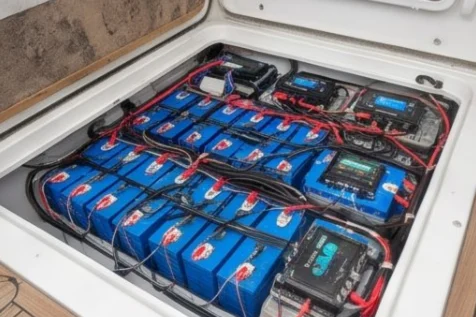 Lithium vs AGM Batteries for Boats: Which Is Worth It?Few upgrades are argued about on the pontoon as much as swapping lead batteries for lithium.…
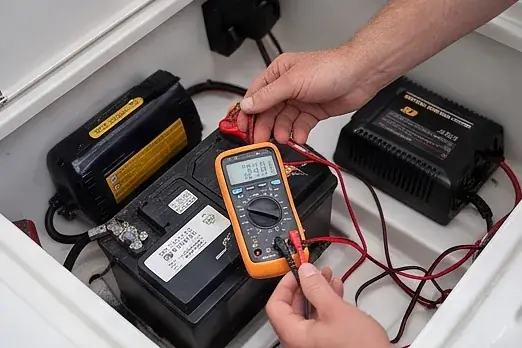 Boat battery maintenance guide: charge cycle, winter storage, measurement and life extensionImportance of battery maintenance The battery is the heart of the boat's electrical system, powering starting,…
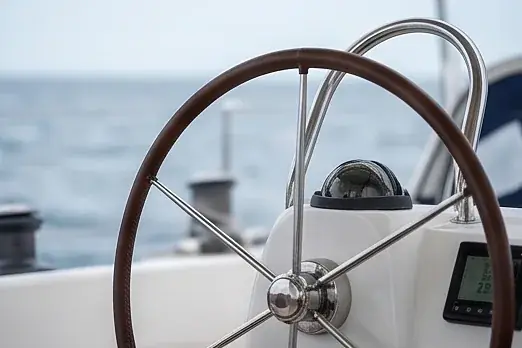 Boat steering system guide: mechanical, hydraulic and electronic steering types and maintenanceWhy is the steering system critical? The steering system is the most fundamental safety component providing…
Reader ratings
No ratings yet. Was this useful? Rate it and add what you know: corrections and first-hand tips help the next reader.
★ Rate this guide
Suggest a correction
Cite this page
Boat Equipment Checklist: Anchors, Electronics, Power and Safety. Boat Almanac, updated 22 October 2026. https://boatalmanac.com/articles/boat-equipment-checklist/ (accessed 21 November 2026).