Published · Updated By Tuna Karslı, editorHow guides are checked
The gulet is the wooden motor-sailer at the heart of crewed cruising in Türkiye and, increasingly, in Croatia and Greece. This guide explains where the gulet came from, how the main hull types differ, how they are built, what to expect from a gulet charter, and what anyone thinking of buying one needs to know about survey, paperwork, running costs and maintenance.
What is a gulet?
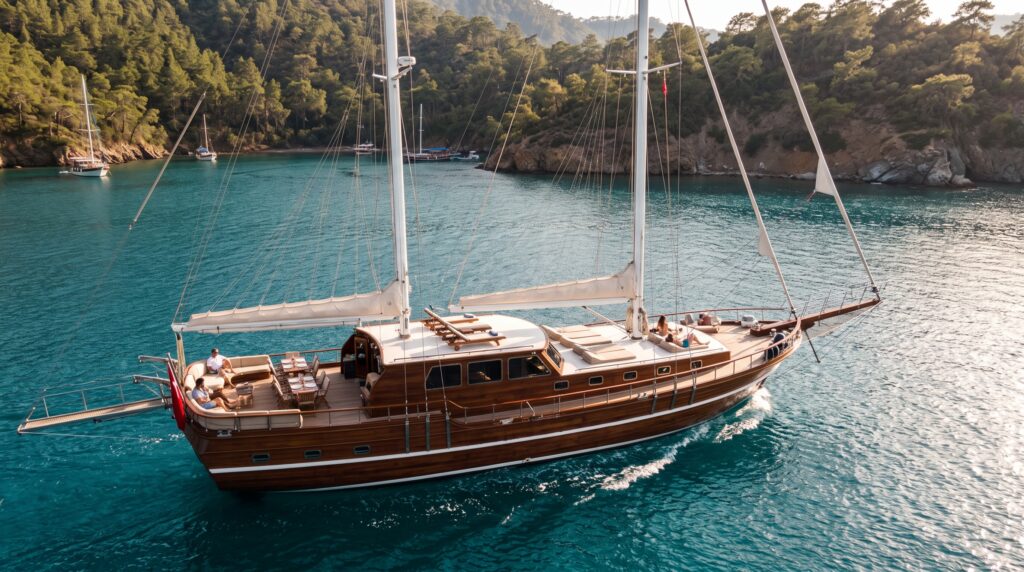
A gulet is a traditional wooden vessel of the eastern Mediterranean, today mostly built in Türkiye, with Bodrum, Bozburun and Marmaris the best-known building centres. It is recognised by its broad, beamy hull, a clipper stem, a large aft deck and, on the classic type, a rounded stern. Most are rigged as two-masted ketches or schooners with Bermuda (Marconi) sails, with some three-masted boats. Modern gulets range roughly from 14 to 35 metres, and a few reach about 40 metres.
Modern charter gulets keep the traditional lines but add contemporary comfort: en-suite cabins, air conditioning, a generator, a , tenders and water toys, and modern navigation electronics. Most run on diesel engines and spend the greater part of their time under power rather than sail.
Origins and name
The word gulet comes through Venetian gołéta and Italian goletta from French goélette, meaning schooner. As the Bodrum Maritime Museum explains, the name first described a rig, not a hull; in Türkiye it came to mean a hull with a clipper stem and round stern.
Before tourism, local wooden boats from about 5 to 28 metres were used for fishing, sponge diving and coastal freight. From 1945, the writer Cevat Şakir Kabaağaçlı and his friends used such boats for the trips from Bodrum that became known as the blue voyage. In the early 1970s Bodrum builders began adding cabins and deck seating to fishing and sponging hulls for tourists, which produced the modern Bodrum-type gulet. Building grew quickly through the 1970s and 1980s as the blue cruise became a mainstream holiday.
Hull types
| Type | Stern | Character | Typical use today |
|---|---|---|---|
| Gulet (round stern) | Rounded, full | Wide aft deck, generous volume, clipper stem | The classic charter gulet |
| Aynakıç ( stern) | Square, flat transom | More usable aft deck and cabin space for the length | Many modern charter gulets |
| Tırhandil | Double-ended, pointed | Length to about 3:1, convex stem; a very old Aegean form | A few blue voyage boats and traditional regatta entries |
Both round-stern and square-stern boats are now called gulets. Other traditional local types, such as the perama, çırnık, piyade and bodi, survive mainly in museums and among traditional boat enthusiasts.
Steel and composite gulets
Some newer boats use gulet lines on a steel or composite hull, or a steel hull with a wooden deck and superstructure. They avoid many of the maintenance issues of a planked wooden hull and can be built to class more easily, but lose some of the traditional character. Long-term running costs may be lower.
How a gulet is built
Traditional building starts with the and backbone, then frames are set up from bow to stern and the hull is planked. Much of the shaping has historically been done by eye by master builders rather than from detailed drawings, although larger modern boats are designed by naval architects. Traditional builders used stone ballast, now often replaced by metal. A new wooden gulet typically takes around 9 to 12 months to build. Some builders now construct to the rules of classification societies such as RINA or Lloyd’s Register, which affects where and how the boat can be operated commercially.
Timbers used include pine (traditionally local pine), iroko, mahogany and other hardwoods; teak is the usual choice for decks. The quality of the timber, how well it was seasoned and the fastenings used have a large effect on a boat’s lifespan.
The gulet cruise
A gulet cruise is a holiday on a crewed boat, anchoring in a different bay each day. Crew normally include a captain, a cook and one or more deckhands; meals are cooked aboard. There are two main formats:
- Cabin charter: you book a cabin on a fixed itinerary and share the boat with other guests.
- Private (whole-boat) charter: you book the whole boat for your group and agree the route with the captain.
In Türkiye the classic routes are Bodrum to Gökova, Marmaris to Bozburun and Hisarönü, Fethiye to Göcek, and Kaş to Kekova. Gulets also work in Croatia (for example Split to Dubrovnik via Hvar, Korčula and Mljet) and in Greece (the Dodecanese, Saronic and Ionian islands).
What to check when booking
- What the price includes: fuel, food and drinks, port fees, transfers and water toys are often extra or charged as an advance provisioning allowance
- Number of crew and whether the cook is dedicated to cooking
- Air conditioning hours: often limited to when the generator runs
- Whether the boat actually sails, if that matters to you
- That the boat is licensed for commercial charter in the country of operation
- Cancellation terms and travel insurance
Life on board
Gulets are designed for living on deck. The aft deck usually holds a large dining table under an awning, with sunbathing cushions forward on the foredeck and the cabin top. Cabins are below, most with their own small shower and toilet. A typical day involves a short morning passage, swimming and lunch at anchor, and a move to an overnight cove or village in the afternoon, often with a stern line taken ashore. Water toys such as kayaks, paddleboards and snorkel gear are common, and larger boats carry a tender with an for trips ashore.
Questions to ask a charter operator
- When was the boat built or last refitted, and when were the photos taken?
- How large are the fresh water and holding tanks, and how often does the boat need to visit port?
- Is the itinerary flexible if the wind is strong?
- What insurance does the operator carry for guests?
- What languages does the crew speak, and can the cook cater for dietary needs?
Charter or buy?
For a few weeks of holiday use a year, chartering is almost always the rational choice. You get a crewed boat without dealing with maintenance, crew employment, insurance, berthing and licensing.
Buying makes sense for those who want to run a commercial charter operation, or for enthusiasts who will use the boat a great deal. The cost of ownership goes far beyond the purchase price. Annual costs include:
- Winter haul-out and maintenance, every year
- Crew salaries and social security, often for much of the year
- Insurance (hull and machinery, and third-party and passenger liability for charter)
- Marina or harbour fees in season and winter storage
- Fuel, lubricants and consumables
- Licence renewals, inspections and safety equipment servicing
- Marketing and booking commissions, if chartering
Offsetting costs with charter revenue is possible, but the projection must be realistic. The main charter season in Türkiye is roughly June to September, with shoulder weeks in May and October. Achieving enough bookings in that window needs professional marketing, a capable crew and good reviews.
Regulations for commercial gulets
- Licensing: charter yachts in Türkiye must be licensed by the Ministry of Culture and Tourism for yacht tourism, as well as holding the flag state’s commercial certificates.
- Cabotage: under Türkiye’s cabotage law, foreign-flagged yachts may not carry paying passengers between Turkish ports. In practice, commercial charters in Türkiye are run on Turkish-flagged boats.
- Waste water: Türkiye requires grey and black water to be held on board and pumped ashore, with discharges recorded in the national Maritime Waste Application (DAU). Boats carrying up to 12 people are reported to need a pump-out at least every 15 days. Holding tank capacity is therefore a practical limit on itineraries.
- Crew: the captain and crew must hold certificates appropriate to the boat’s size and use under the flag state’s rules.
- Operating abroad: working in Croatia or Greece brings those countries’ own licensing, tax and cabotage rules; check before committing to a programme outside Türkiye.
What to check when buying a gulet
Hull and structure
For a wooden gulet the hull is the most important, and most expensive, thing to get right. An independent pre-purchase survey should be done with the boat out of the water. Points a surveyor will typically examine:
- Planking, frames, stem, sternpost and keel for rot, especially in poorly ventilated areas under the deck, around chainplates and in the
- Moisture readings and sounding with a hammer to find soft or delaminated areas
- Fastenings and keel bolts for corrosion
- Seams and caulking condition, and how much the hull leaks after launch
- Shipworm (teredo) damage, a real risk in warm waters if has been neglected
- Deck and deck-to-hull joints for leaks, which feed rot below
- The quality of past repairs, and whether epoxy sheathing or coatings may be trapping moisture
Machinery and systems
Main engines, generators, watermaker, air conditioning, hydraulic steering, windlass, bilge and fire pumps, sewage tanks and electrics should each be assessed. Engines are often worked hard all season; ask for service records and running hours, and have an engine specialist inspect them. Neglect in any of these systems can lead to large bills soon after purchase.
Rig and sails
Masts, booms, and sails are often under-used on gulets, which can hide deterioration. Inspect fittings and chainplates closely.
Paperwork
- Registry, flag and proof of ownership, with no mortgages or liens
- Commercial and tourism operating licences, and their transferability
- Class or statutory survey certificates and their expiry dates
- Crew documents and crew employment obligations that may transfer with the boat
- Tax status, VAT position and any customs implications if the boat moves country
Price
Gulet prices depend on length, age, construction, condition, equipment, licences and charter record. Two boats of similar length can differ greatly in price because of their maintenance standard. Commission the survey from an independent surveyor engaged by you, separately from whoever is selling the boat.
Maintenance through the year
| Period | Typical work |
|---|---|
| November to February | Haul-out, pressure wash, hull inspection, drying out, structural repairs, re-caulking where needed |
| February to April | Engine, generator and systems service; antifouling; varnish and paint; sail and rig inspection |
| April to May | Launch, leak check as the planks take up, sea trials, safety equipment checks, licence renewals |
| June to September | Daily cleaning, deck oiling as needed, weekly checks of bilges, pumps, tanks and anchoring gear |
| October | End-of-season defect list, haul-out booking, crew handover notes |
Teak decks are cleaned gently (hard scrubbing across the grain wears them away) and caulking seams checked. Interior joinery is varnished or oiled. Timber maintenance is demanding, but a well-kept wooden gulet can serve for decades; a neglected one loses both safety and value quickly.
Common mistakes
- Buying on looks: fresh varnish and paint can hide rot and failing fastenings.
- Surveying afloat only: a wooden hull must be inspected out of the water.
- Underestimating crew costs: crew are often the largest annual cost of a charter gulet.
- Assuming licences transfer automatically: check before signing.
- Ignoring holding tank capacity: in Türkiye it limits how long the boat can stay out of port.
- Over-optimistic charter projections: plan on realistic occupancy for a short season.
Sources
Read next
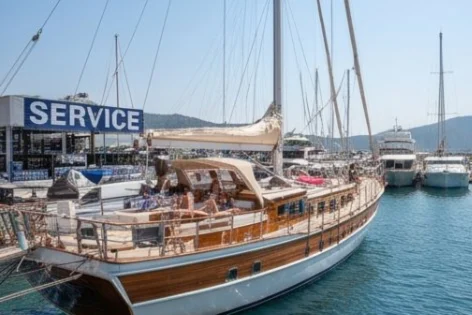 Gulet charter guide: what a gulet is, where to sail and buying oneWhat is a gulet? A gulet is a traditional wooden motor-sailer from the eastern Mediterranean, now…
 Boat charter guide: bareboat vs skippered, prices, contracts and what to watch out forOverview of boat chartering For those who want to enjoy the sea without owning a boat,…
 Bareboat charter vs skippered: costs, contracts and what to checkWhy charter? For anyone who wants to enjoy the sea without owning a boat, chartering is…
Reader ratings
No ratings yet. Was this useful? Rate it and add what you know: corrections and first-hand tips help the next reader.
★ Rate this guide
Suggest a correction
Cite this page
Gulet guide: history, types, charter and buying. Boat Almanac, updated 24 October 2026. https://boatalmanac.com/articles/gulet-guide-history-types-charter-and-buying/ (accessed 21 November 2026).