Published Boat AlmanacHow guides are checked
An offshore skipper’s technical guide to diagnosing marine diesel failures, understanding engine systems, managing overheating, fuel contamination, lubrication problems, cooling failures, electrical faults and propulsion emergencies.
A marine diesel engine has a reputation for reliability, and generally deserves it. It is mechanically robust, relatively economical, capable of running for thousands of hours and, when properly maintained, remarkably tolerant of demanding operating conditions.
But reliability should never be confused with invulnerability.
An engine that starts perfectly in the marina may stop without warning several hundred miles offshore. A temperature alarm may appear just as the yacht enters a narrow channel. Fuel contamination may cause the engine to lose power during a difficult approach. A failed seawater pump can turn an otherwise uneventful passage into an urgent engineering problem.
The difficulty is not always the failure itself. It is identifying the cause while the yacht is moving, the engine compartment is hot, the sea is uncomfortable and the crew is expecting the skipper to produce an answer.
Marine diesel troubleshooting is therefore more than a matter of mechanical knowledge. It requires an understanding of how the engine, fuel system, cooling circuit, lubrication system, electrical installation, gearbox and propeller interact.
It also requires a disciplined approach to diagnosis.
Replacing parts until the engine starts again is not troubleshooting. It is an expensive form of optimism.
This guide examines marine diesel engine failures from the perspective of an offshore skipper, marine surveyor and yacht operator. It covers the principal systems, common failure symptoms, diagnostic procedures, emergency repairs, preventive maintenance and the decisions involved in continuing a passage after an engine problem.
The emphasis is on conventional auxiliary marine diesel engines installed in cruising yachts, although many of the principles also apply to larger recreational vessels.
1. Understanding the Marine Diesel Engine as a System
Before diagnosing a failure, it is necessary to understand the systems that allow a marine diesel engine to operate.
A conventional four-stroke marine diesel requires five fundamental conditions:
- An adequate supply of clean fuel.
- Sufficient air for combustion.
- Correct compression and mechanical condition.
- Appropriate injection timing and fuel delivery.
- Adequate lubrication and temperature control.
It also requires a functioning starting system and, in most modern installations, a reliable electrical supply for engine controls and instrumentation.
A diesel engine does not use a spark plug to ignite the fuel-air mixture. Instead, air is compressed until its temperature rises sufficiently for injected fuel to ignite.
This fundamental difference explains why certain diagnostic principles apply to diesel engines and why some petrol-engine troubleshooting methods are inappropriate.
1.1 The major engine systems
| System | Main function | Typical failure symptoms |
|---|---|---|
| Fuel supply | Delivers clean fuel at the required pressure and quantity | Failure to start, loss of power, hunting, stalling |
| Air intake | Supplies combustion air | Black smoke, reduced power, poor acceleration |
| Exhaust | Removes combustion gases and manages exhaust discharge | Excessive smoke, overheating, abnormal noise, back pressure |
| Cooling | Controls engine operating temperature | High temperature alarm, coolant loss, overheating |
| Lubrication | Reduces friction and carries heat away from moving parts | Low oil pressure, abnormal noise, excessive wear |
| Starting | Cranks the engine at sufficient speed | Clicking, slow cranking, no cranking |
| Charging | Maintains battery charge and supplies electrical loads | Charging alarm, low battery voltage |
| Engine controls | Operates fuel shut-off, sensors and electronic systems | Warning alarms, shutdown, intermittent operation |
| Gearbox and propulsion | Transfers engine power to the propeller shaft | No propulsion, vibration, overheating, abnormal noise |
A useful diagnostic principle is to separate the engine into systems and establish which system has stopped performing its function.
For example, an engine that cranks normally but does not start has a different problem from an engine that does not crank at all.
Similarly, an engine that starts but loses power under load is not necessarily suffering from the same fault as one that runs smoothly at idle but overheats at cruising RPM.
1.2 Understanding the four-stroke cycle
Most conventional yacht diesel engines operate on a four-stroke cycle:
- Intake: The piston moves down and draws air into the cylinder.
- Compression: The piston moves up and compresses the air.
- Power: Fuel is injected into the hot compressed air and combustion forces the piston down.
- Exhaust: The piston moves up and expels combustion gases.
Any failure that interferes with these stages can affect engine performance.
A restricted air intake, for example, can reduce available oxygen and produce black smoke. Incorrect fuel injection can cause poor combustion. Low compression can make cold starting difficult and produce uneven running.
Understanding the operating cycle helps distinguish symptoms that might otherwise appear unrelated.
2. The First Five Minutes: What to Do When the Engine Stops
When a marine diesel stops unexpectedly, the skipper should resist the temptation to begin dismantling equipment immediately.
The first task is to establish whether the yacht is safe.
An engine failure in open water may be inconvenient. The same failure near a , in a narrow channel, in a busy shipping lane or during a harbour approach may become an emergency.
2.1 Establish the vessel’s immediate situation
Before troubleshooting, consider:
- Is the yacht clear of hazards?
- Is there sufficient sea room?
- Is the wind driving the vessel towards land?
- Is the current setting the yacht towards danger?
- Is the vessel in a traffic separation scheme or shipping channel?
- Can the yacht sail safely?
- Is the anchor available and appropriate?
- Is assistance required?
If the yacht is approaching danger, the crew should deal with navigation and collision avoidance before attempting detailed engine repairs.
The skipper may need to:
- Set an appropriate sail configuration.
- Establish a safe heading.
- Prepare the anchor.
- Display or communicate the vessel’s restricted ability to manoeuvre where applicable.
- Contact other vessels or the relevant maritime authority.
- Request assistance if the situation warrants it.
A functioning engine is useful. A controlled yacht is more important.
2.2 Record the symptoms before restarting
The circumstances immediately before failure are valuable diagnostic evidence.
Record:
- Engine RPM.
- Engine temperature.
- Oil pressure.
- Charging voltage.
- Fuel level.
- Exhaust appearance.
- Any warning alarms.
- Whether the engine stopped suddenly or gradually lost power.
- Whether there was unusual noise or vibration.
- Whether the failure occurred during acceleration, steady running or manoeuvring.
The difference between a sudden shutdown and a gradual loss of power is particularly useful.
A sudden stop may indicate an electrical shutdown, fuel shut-off problem, severe mechanical failure or sudden loss of fuel delivery.
A gradual reduction in RPM may point towards restricted fuel supply, air intake problems, overheating, excessive load or another developing fault.
2.3 Check for obvious danger
Before opening the engine compartment, consider the possibility of:
- Fire.
- Fuel leakage.
- Hot pressurised coolant.
- Oil leakage onto hot surfaces.
- Water ingress.
- Exhaust gas accumulation.
- Rotating machinery.
- Damaged electrical wiring.
Ventilate the compartment where appropriate and use suitable personal protection.
Do not open a hot pressurised cooling-system cap. Do not place hands near belts, pulleys or rotating shafts while the engine is running.
2.4 Avoid repeated starting attempts
Repeatedly operating the starter can:
- Overheat the starter motor.
- Discharge the batteries.
- Damage the starter solenoid.
- Introduce additional seawater into the exhaust system.
- Fill the engine’s waterlock and potentially allow seawater to enter the cylinders through the exhaust.
The risk of water ingress depends on the exhaust installation, waterlock capacity, siphon-break arrangement and the way the engine is operated.
Follow the engine manufacturer’s starting and stopping instructions. If the engine will not start after a few sensible diagnostic attempts, investigate the cause rather than continuing to crank it.
3. Engine Will Not Start: A Systematic Diagnosis
One of the most common offshore problems is an engine that refuses to start.
The phrase “the engine won’t start” is not sufficiently precise for diagnosis.
There are several distinct situations:
- The starter does not operate.
- The starter clicks but does not turn the engine.
- The engine turns slowly.
- The engine turns normally but does not fire.
- The engine fires briefly and stops.
- The engine starts but immediately produces abnormal smoke or noise.
Each situation points towards a different group of possible faults.
3.1 The engine does not crank
If the engine does not turn when the start button is pressed, investigate the starting circuit.
Possible causes include:
- Discharged battery.
- Loose battery terminals.
- Corroded connections.
- Failed battery switch.
- Defective starter solenoid.
- Failed starter motor.
- Damaged wiring.
- Faulty ignition switch.
- Neutral safety switch or gearbox interlock.
- Electronic engine-control fault.
- Poor engine grounding.
Begin with the battery.
Measure voltage directly at the battery terminals rather than relying solely on the dashboard display.
A healthy, fully charged conventional 12 V lead-acid battery will typically show approximately 12.6–12.8 V at rest, depending on chemistry, temperature and state of charge. A resting voltage reading does not, by itself, prove that the battery can deliver the high current required for starting.
Check the voltage while attempting to crank. A substantial voltage drop may indicate a weak battery, poor connection or excessive current draw.
The precise acceptable cranking voltage depends on the battery type, engine and temperature. Use the manufacturer’s specifications.
3.2 The starter clicks but the engine does not turn
A clicking sound usually indicates that the control circuit is attempting to operate the starter solenoid.
Possible causes include:
- Insufficient battery voltage.
- Poor battery connections.
- High resistance in the starter cables.
- Defective solenoid contacts.
- Failed starter motor.
- Mechanical seizure of the engine.
- Damaged starter engagement mechanism.
A single click is not proof that the starter motor itself is defective.
Check battery voltage, connections, cables and grounding before condemning the starter.
If the engine cannot be turned manually using the manufacturer’s approved procedure, do not continue applying electrical power. Mechanical seizure, hydraulic lock or another serious obstruction must be considered.
3.3 The engine cranks slowly
Slow cranking may result from:
- Weak batteries.
- Poor electrical connections.
- Undersized or damaged cables.
- A failing starter motor.
- Excessive mechanical resistance.
- Cold engine conditions.
- Incorrect oil viscosity.
- Water in a cylinder.
Cold starting is particularly demanding because the battery delivers less effective power at low temperatures while the engine may require greater cranking torque.
If the engine normally starts well but suddenly cranks much more slowly, investigate the electrical system and mechanical condition rather than assuming that the batteries simply need charging.
3.4 The engine cranks normally but does not fire
This is a different diagnostic category.
The starting motor is doing its job, but combustion is not taking place.
The main areas to investigate are:
- Fuel supply.
- Air supply.
- Fuel shut-off.
- Injection system.
- Compression.
- Electronic engine controls.
- Engine stop circuit.
For a conventional mechanical diesel, begin with fuel availability and fuel delivery.
For a modern electronically controlled engine, also consider sensor faults, ECU power supply, immobiliser systems and electronic shutdown conditions.
3.5 The engine fires and immediately stops
This may indicate:
- Fuel starvation.
- Air trapped in the fuel system.
- Blocked fuel filter.
- Faulty stop solenoid.
- Restricted tank vent.
- Electrical supply interruption.
- Electronic control fault.
If the engine runs briefly and then stops, the initial fuel available in the injection system may be sufficient to start it, but the ongoing supply may be inadequate.
That makes the primary fuel filter, secondary filter, tank pickup and fuel vent important inspection points.
4. Fuel System Failures: The Most Common Source of Diesel Problems
Fuel-related problems are among the most frequent causes of marine diesel engine failure.
Marine fuel systems are exposed to conditions that can encourage contamination:
- Long storage periods.
- Temperature changes.
- Condensation.
- Water accumulation.
- Microbial growth.
- Dirty fuel transfer equipment.
- Contaminated bunkering supplies.
- Corrosion inside tanks.
- Poorly maintained filters.
A diesel engine may tolerate a surprising amount of neglect before showing obvious symptoms. Once fuel delivery becomes restricted, however, performance can deteriorate quickly.
4.1 Understanding the fuel system
A typical marine diesel fuel system consists of:
- Fuel tank.
- Tank shut-off valve.
- Primary water-separating filter.
- Fuel lift pump.
- Secondary engine-mounted filter.
- High-pressure injection pump or common-rail system.
- Injectors.
- Fuel return line.
The exact arrangement varies between engines.
The primary filter normally removes larger contaminants and separates water. The secondary filter provides finer filtration before fuel reaches the injection equipment.
The injection system is particularly sensitive to contamination. Modern common-rail systems operate at very high pressures and require extremely clean fuel.
4.2 Blocked primary fuel filter
A blocked filter restricts the amount of fuel reaching the engine.
Typical symptoms include:
- Loss of power.
- Difficulty maintaining RPM.
- Engine hunting.
- Stalling under load.
- Difficult starting.
- Engine stopping at higher throttle settings.
An engine may idle normally but fail to achieve cruising RPM because fuel demand increases under load.
This is a useful diagnostic distinction.
If the engine runs reasonably well at low RPM but loses power when the throttle is increased, investigate fuel restriction before assuming that the injection pump has failed.
4.3 Water in diesel fuel
Water can enter a tank through contaminated bunkering, defective deck fillers, damaged seals or condensation.
Water may settle at the bottom of the tank because it is generally denser than diesel fuel.
A water-separating filter is designed to collect water before it reaches the injection system.
Symptoms may include:
- Irregular running.
- Loss of power.
- Engine stopping.
- Corrosion in fuel components.
- Water visible in the filter bowl.
- Difficulty restarting.
Drain water from the primary separator in accordance with the manufacturer’s procedure.
Collect the sample in a transparent, suitable container and inspect it carefully.
Water may appear as a distinct lower layer. Fuel contamination can also include sediment, rust particles and biological material.
Never drain contaminated fuel directly into the sea.
4.4 Diesel microbial contamination
The term “diesel bug” is commonly used to describe microbial contamination associated with the presence of water in fuel storage systems.
The organisms generally develop at the interface between water and fuel, producing biomass and deposits that can block filters and contaminate the tank.
Symptoms may include:
- Sludge in filter bowls.
- Repeated filter blockages.
- Dark or unusual deposits.
- Loss of power.
- Fuel contamination returning shortly after filter replacement.
Replacing a blocked filter may restore engine operation temporarily, but it does not remove the underlying contamination.
The tank and fuel system may require cleaning, water removal and treatment using products appropriate to the fuel system and engine manufacturer’s recommendations.
Biocide should not be treated as a substitute for cleaning a heavily contaminated tank.
It may kill organisms, but dead biomass can still block filters.
4.5 Restricted tank ventilation
A diesel tank must be able to admit air as fuel is consumed.
If the tank vent becomes blocked, a vacuum can develop inside the tank, restricting fuel flow.
Possible causes include:
- Insects or debris.
- Salt deposits.
- Damaged vent hose.
- Kinked ventilation line.
- Blocked external fitting.
- Incorrect installation.
A yacht may initially run normally, then lose power after a period of operation.
If the engine improves after the fuel filler is carefully opened, a restricted vent should be considered.
However, do not operate the engine with the filler cap removed as a routine diagnostic method. Fuel spillage, contamination and other hazards must be considered.
Inspect the vent system and restore it to its correct operating condition.
4.6 Air in the fuel system
Air entering the fuel system can interrupt fuel delivery.
Possible sources include:
- Loose filter seals.
- Damaged fuel hoses.
- Defective hose connections.
- Leaking bleed screws.
- Faulty lift-pump diaphragm.
- Poorly fitted filter elements.
- Cracked fuel lines.
Symptoms may include:
- Difficult starting.
- Irregular running.
- Engine stopping unexpectedly.
- Repeated need for bleeding.
- Loss of power under load.
The correct bleeding procedure depends on the engine.
Some mechanical systems can be bled using manual lift-pump operation and designated bleed screws. Other systems require specific procedures.
Common-rail engines may require specialist equipment and procedures. Do not loosen high-pressure fuel pipes on a running engine. Escaping high-pressure fuel can penetrate the skin and cause severe injury.
4.7 Emergency fuel-filter replacement
Replacing a blocked primary or secondary filter is a realistic offshore repair if the crew has the correct spare.
The procedure should follow the engine and filter manufacturer’s instructions.
A general approach is:
- Stop the engine.
- Close the fuel shut-off valve if required.
- Prepare a suitable container and absorbent materials.
- Remove the filter carefully.
- Inspect the old element and collected fuel.
- Clean the filter housing without introducing contamination.
- Install the correct replacement element and seals.
- Open the fuel valve.
- Bleed the system using the specified procedure.
- Check for leaks before starting.
- Start the engine and inspect again.
- Monitor performance under load.
Do not over-tighten filter housings or reuse damaged seals.
Keep spare filter elements sealed and clean. A spare filter contaminated during storage is not a spare in any meaningful sense.
5. Fuel Quality, Storage and Tank Management
Good fuel management begins long before the engine is started.
A yacht may carry hundreds of litres of diesel and still have an unreliable fuel supply if the tank is contaminated or poorly maintained.
5.1 Tank inspection
Where access permits, inspect:
- Tank interior.
- Tank bottom.
- Pickup pipe.
- Fuel return connection.
- Internal baffles.
- Inspection covers.
- Tank seams and welds.
- Drain points.
- Ventilation arrangements.
A tank that cannot be inspected internally deserves particular attention in the maintenance plan.
5.2 Fuel polishing
Fuel polishing is a process of circulating stored fuel through filtration and water-separation equipment to remove contaminants.
It can be useful where:
- Fuel has been stored for extended periods.
- Water contamination is suspected.
- Sediment is present.
- A yacht has experienced repeated filter blockages.
- Fuel quality is uncertain before a long passage.
Fuel polishing is not a universal cure. The process must be designed so that it does not simply redistribute contamination or damage the tank system.
5.3 Bunkering precautions
When taking fuel:
- Use reputable suppliers.
- Avoid visibly contaminated transfer equipment.
- Check the filler identification.
- Monitor the fuel delivery.
- Avoid overfilling.
- Inspect the water separator after bunkering.
- Retain a fuel sample where appropriate.
- Record the quantity and source.
A small amount of water introduced during bunkering can become a much larger operational problem when the yacht is several days offshore.
6. Cooling System Failures: Managing Engine Temperature
Overheating is one of the most serious and potentially expensive marine diesel engine problems.
An engine that operates above its designed temperature range may suffer damage to:
- Cylinder head.
- Head gasket.
- Pistons.
- Cylinder liners.
- Exhaust components.
- Turbocharger.
- Lubricating oil.
- Cooling-system seals.
The key is to identify whether the problem originates in the seawater circuit, freshwater circuit, heat exchanger or another part of the installation.
6.1 Understanding the two-circuit cooling system
Many marine diesel engines use an indirect cooling system with two separate circuits.
Typical indirect marine diesel cooling arrangement
Seawater circuit
Sea inlet
/ strainer
Raw-water pump
Impeller-driven seawater circulation
Heat exchanger
Removes heat from the closed cooling circuit
Exhaust injection / discharge
Seawater cools the exhaust system before discharge
Freshwater circuit
Engine coolant
Engine passages
Freshwater circulation pump
Circulates coolant through the engine
Thermostat and heat exchanger
Controls operating temperature and transfers heat
Conceptual arrangement only. Some engines use different heat-exchanger, exhaust and cooling configurations.
Understanding the distinction between the two circuits is essential.
A seawater-flow problem may cause overheating even when the freshwater coolant level is correct.
Conversely, an engine may overheat despite a strong seawater discharge because the freshwater pump, thermostat or heat exchanger is not functioning correctly.
6.2 Blocked seawater intake
A blocked intake is a common cause of overheating.
Possible causes include:
- Marine growth.
- Plastic bags.
- Seaweed.
- Mud.
- Shells.
- Debris.
- A blocked seacock.
- Collapsed or damaged intake hose.
Symptoms may include:
- Reduced water discharge at the exhaust.
- High engine temperature.
- Rapid temperature rise under load.
- Unusual exhaust-system heat.
If seawater flow is reduced, stop the engine and investigate the intake.
Do not continue operating the engine in the hope that the blockage will clear itself.
6.3 Raw-water pump impeller failure
The raw-water pump impeller is a critical component.
It is generally made from flexible elastomer and uses rotating blades to move seawater through the cooling system.
Impellers deteriorate through:
- Age.
- Heat.
- Dry running.
- Chemical exposure.
- Excessive wear.
- Incorrect installation.
- Abrasion.
- Prolonged storage in a deformed position.
Typical symptoms include:
- Reduced cooling-water discharge.
- Overheating.
- Impeller debris downstream.
- Visible damage during inspection.
An impeller can lose one or more blades without the remainder appearing severely damaged.
This is important because missing fragments may travel downstream and lodge in:
- Heat-exchanger inlet passages.
- Elbows and hose connections.
- Exhaust injection points.
- Other restricted parts of the cooling circuit.
Replacing the impeller without locating missing fragments may not resolve the problem.
6.4 Replacing an impeller offshore
A typical procedure, subject to the pump manufacturer’s instructions, is:
- Stop the engine.
- Close the seawater intake seacock.
- Allow the pump to cool.
- Remove the pump cover.
- Extract the damaged impeller using an appropriate tool.
- Inspect the pump housing and cover plate.
- Examine the shaft and seal.
- Install the correct replacement impeller.
- Use the specified lubricant.
- Fit a new cover gasket or O-ring where required.
- Reopen the seacock.
- Confirm seawater flow after starting.
- Check for leaks and abnormal noise.
The seacock must be reopened before the engine is restarted.
This simple step is sufficiently important to justify including it in the engine-start checklist. A newly installed impeller cannot circulate seawater through a closed intake.
6.5 Freshwater coolant loss
If coolant is disappearing from the expansion tank, investigate the source.
Possible causes include:
- External hose leaks.
- Loose clamps.
- Damaged heat exchanger.
- Faulty pressure cap.
- Water pump seal failure.
- Internal engine leakage.
- Head gasket failure.
- Cracked cylinder head.
A falling coolant level should never be treated as normal without an identified explanation.
If coolant is leaking externally, identify the location and assess whether a temporary repair is possible.
If there is evidence of internal leakage, persistent white exhaust vapour, coolant contamination in the oil or unexplained pressure in the cooling system, the engine may have suffered a more serious failure.
Do not open a hot pressurised expansion tank.
6.6 Thermostat failure
The thermostat regulates coolant flow according to engine temperature.
A thermostat stuck closed can cause overheating because coolant cannot circulate through the heat exchanger as intended.
A thermostat stuck open may prevent the engine from reaching its designed operating temperature.
Possible symptoms of a thermostat problem include:
- Slow warm-up.
- Unstable operating temperature.
- Overheating.
- Temperature changes inconsistent with engine load.
A thermostat should be tested or replaced according to the manufacturer’s instructions.
Running without a thermostat is not a universally acceptable solution. Some engines rely on the thermostat to control coolant circulation and maintain correct temperature distribution.
6.7 Heat-exchanger fouling
Heat exchangers can become restricted by:
- Salt deposits.
- Corrosion products.
- Biological growth.
- Impeller fragments.
- Sediment.
- Poor maintenance.
- Internal tube deterioration.
A partially blocked heat exchanger may allow the engine to operate normally at low load but overheat at higher RPM.
This is a useful clue.
If the engine runs at normal temperature while manoeuvring but overheats after prolonged operation at cruising speed, investigate cooling capacity under load.
6.8 Exhaust water injection failure
Many marine engines inject seawater into the exhaust system downstream of the exhaust manifold or turbocharger.
This water cools the exhaust gases and associated components.
A blockage, failed hose or restricted injection elbow can create serious problems.
Warning signs include:
- Excessive exhaust temperature.
- Reduced water discharge.
- Abnormal exhaust noise.
- Smoke or vapour changes.
- Overheating.
- Damaged exhaust hose.
A blocked exhaust injection elbow can also contribute to poor engine performance because exhaust gases cannot escape efficiently.
7. Lubrication Failures: Oil Pressure, Oil Quality and Mechanical Damage
Lubrication is essential to the survival of a diesel engine.
The oil film separates moving metal surfaces, reduces friction, carries heat and helps transport contaminants towards the filtration system.
A loss of oil pressure can cause severe engine damage in a very short period.
7.1 Low oil pressure
Low oil pressure may be caused by:
- Insufficient oil level.
- Oil pump failure.
- Blocked oil pickup.
- Excessive bearing clearance.
- Incorrect oil viscosity.
- Oil dilution.
- Worn internal components.
- Faulty pressure relief valve.
- Defective pressure sensor or wiring.
If a genuine low-oil-pressure warning occurs, stop the engine as soon as it is safe to do so.
Do not continue running the engine simply because the temperature remains normal.
Temperature and oil pressure are different measurements. An engine can be at a normal temperature while suffering severe lubrication failure.
7.2 Checking engine oil
When checking oil:
- Use the correct dipstick.
- Follow the manufacturer’s procedure.
- Check the level with the engine in the specified condition.
- Look for abnormal colour or contamination.
- Examine the oil filler cap and surrounding areas.
- Investigate unexpected changes in oil level.
Oil that appears milky may indicate water or coolant contamination, although condensation can sometimes create similar deposits in limited circumstances.
Fuel dilution can make oil thinner and may increase the oil level.
An unexplained rise in oil level is therefore not necessarily good news.
7.3 Oil leaks
Inspect:
- Oil filter housing.
- Sump.
- Rocker cover.
- Oil cooler.
- Turbocharger oil lines.
- Crankshaft seals.
- Oil pressure sender.
- Dipstick tube.
- Oil hoses and connections.
An oil leak near a hot exhaust component can create a fire risk.
If oil is leaking onto the engine or into the , identify the source and assess the risk before restarting.
7.4 Oil filter failure
A damaged filter, failed seal or incorrect installation can cause oil leakage and loss of lubrication.
After changing an oil filter:
- Confirm that the old gasket has been removed.
- Lubricate the new seal as specified.
- Tighten the filter correctly.
- Start the engine and inspect for leakage.
- Verify oil pressure.
- Recheck the oil level after shutdown and settling.
A double-gasketed oil filter is a small installation error with potentially expensive consequences.
7.5 Bearing failure
Serious bearing damage may produce:
- Deep knocking.
- Metallic noise.
- Low oil pressure.
- Metal particles in oil.
- Increased vibration.
- Rapid deterioration in engine performance.
If bearing failure is suspected, shut down the engine.
Continuing to run it may turn a repairable problem into a complete engine replacement.
8. Air Intake and Exhaust Problems
Diesel engines require a continuous supply of clean air and an unobstructed exhaust path.
Restrictions in either system can reduce performance and increase operating temperatures.
8.1 Restricted air filter
A dirty or blocked air filter may cause:
- Reduced power.
- Black smoke.
- Poor acceleration.
- Increased fuel consumption.
- Elevated exhaust temperatures.
Inspect the air filter and air intake ducting.
Marine engine compartments can contain salt deposits, dust, oil mist and other contaminants that gradually restrict airflow.
Do not operate an engine with the intake system improperly exposed to water, loose debris or engine-compartment contamination.
8.2 Turbocharger problems
Turbocharged marine diesels use exhaust energy to drive a turbine connected to a compressor.
The compressor increases the amount of air entering the engine, allowing more fuel to be burned efficiently.
Turbocharger problems may include:
- Bearing wear.
- Oil leakage.
- Damaged compressor blades.
- Turbine damage.
- Restricted air intake.
- Exhaust restriction.
- Wastegate or variable-geometry mechanism faults, where fitted.
Symptoms may include:
- Loss of power.
- Black smoke.
- Unusual whining or scraping noise.
- Excessive oil consumption.
- Blue smoke.
- Poor acceleration.
Do not attempt to dismantle or repair a turbocharger offshore unless the work is within the crew’s competence and supported by the manufacturer’s procedures.
A damaged turbocharger can send oil or metal fragments into the engine intake or exhaust system.
8.3 Exhaust back pressure
An obstructed exhaust can prevent the engine from expelling combustion gases efficiently.
Potential causes include:
- Carbon deposits.
- Restricted injection elbow.
- Collapsed exhaust hose.
- Damaged waterlock.
- Blocked exhaust outlet.
- Internal deterioration.
Symptoms may include:
- Loss of power.
- Increased smoke.
- Excessive exhaust temperature.
- Abnormal engine noise.
- Difficult starting.
The exhaust system should be inspected as a complete installation, not just at the visible outlet.
8.4 Exhaust leaks and carbon monoxide
Exhaust leaks inside the engine compartment or accommodation spaces are potentially life-threatening.
Carbon monoxide is colourless and odourless. The absence of an unusual smell does not indicate that the atmosphere is safe.
Symptoms of carbon monoxide exposure may include:
- Headache.
- Dizziness.
- Nausea.
- Weakness.
- Confusion.
- Loss of consciousness.
If an exhaust leak is suspected:
- Stop the engine if safe.
- Ventilate the affected spaces.
- Move anyone with symptoms into fresh air.
- Follow the vessel’s emergency procedures.
- Seek medical assistance where exposure is suspected.
Carbon monoxide detectors should be installed and maintained in accordance with the vessel’s design and applicable safety guidance.
9. Black, White and Blue Smoke: What the Exhaust Is Telling You
Exhaust smoke can provide useful diagnostic information, but colour alone does not establish the cause of a fault.
The engine’s operating condition, temperature, load and exhaust arrangement must also be considered.
9.1 Black smoke
Black smoke generally indicates incomplete combustion and excessive soot formation.
Possible causes include:
- Restricted air intake.
- Excessive engine load.
- Dirty air filter.
- Turbocharger malfunction.
- Incorrect fuel injection.
- Injector problems.
- Restricted exhaust.
- Over-fuelling.
A brief puff of black smoke during acceleration may occur on some engines.
Persistent black smoke under normal operating conditions requires investigation.
9.2 White smoke
White smoke or vapour may have several causes.
Possible explanations include:
- Condensation.
- Unburned fuel.
- Incorrect injection timing.
- Poor compression.
- Cold combustion chambers.
- Coolant entering a cylinder.
A cold engine may produce temporary white vapour that disappears as it warms.
Persistent white smoke accompanied by coolant loss, rough running or unusual engine behaviour is more concerning.
9.3 Blue smoke
Blue smoke generally indicates that lubricating oil is entering the combustion chamber and being burned.
Potential causes include:
- Worn piston rings.
- Cylinder wear.
- Valve guide or seal problems.
- Turbocharger oil leakage.
- Excessive crankcase pressure.
- Incorrect oil level.
Blue smoke should be investigated, particularly when accompanied by increased oil consumption.
9.4 Smoke diagnosis table
| Exhaust observation | Possible causes | First checks |
|---|---|---|
| Persistent black smoke | Air restriction, overload, injection fault | Air filter, engine load, turbocharger, injectors |
| White vapour when cold | Condensation or incomplete combustion | Engine temperature and whether it disappears |
| Persistent white smoke | Unburned fuel, coolant ingress, poor compression | Coolant level, engine running quality, injection system |
| Blue smoke | Oil entering combustion chamber | Oil level, turbocharger, crankcase ventilation |
| Sudden heavy smoke after a fault | Mechanical or fuel-system problem | Reduce load or stop and investigate |
Do not diagnose an engine solely by looking at the colour of the exhaust plume. Combine visual observations with temperature, pressure, RPM, sound and operating history.
10. Electrical Failures That Stop a Diesel Engine
A conventional mechanical diesel engine can continue running without an alternator once it has started, provided its fuel shut-off arrangement does not depend on electrical power.
However, many modern marine engines rely on electrical systems for starting, fuel control, instrumentation and safety functions.
Electrical failures can therefore prevent starting or cause the engine to stop.
10.1 Battery failure
The starter battery must deliver sufficient current to operate the starter motor.
Common causes of battery problems include:
- Age.
- Sulphation.
- Loose connections.
- Corrosion.
- Internal cell failure.
- Inadequate charging.
- Excessive parasitic loads.
- Incorrect battery selection.
A battery may show acceptable resting voltage but fail under load.
A proper load or conductance test is more useful than relying on voltage alone.
10.2 Alternator failure
The alternator supplies electrical power and charges the batteries while the engine runs.
Possible failures include:
- Worn brushes.
- Failed regulator.
- Damaged bearings.
- Broken drive belt.
- Loose wiring.
- Failed rectifier.
- Poor grounding.
- Incorrect alternator excitation.
Symptoms include:
- Charging warning light.
- Low charging voltage.
- Battery discharge.
- Abnormal belt noise.
- Alternator overheating.
If the alternator stops charging, the engine may continue running, but the available battery capacity will gradually decrease.
On electronically controlled engines, the consequences may be more immediate.
10.3 Engine stop solenoid
Many mechanical diesel engines use an electrically operated stop solenoid.
Depending on the design, the solenoid may energise to permit running or energise to stop the engine.
A failed solenoid, wiring fault or interrupted supply can prevent starting or cause shutdown.
Before attempting any emergency intervention, establish the exact system design.
Improvised electrical bypasses can defeat safety functions or create a fire hazard. They should not be attempted without the correct wiring diagram and competence.
10.4 Sensor failures
Modern engines may use sensors for:
- Oil pressure.
- Coolant temperature.
- Crankshaft position.
- Camshaft position.
- Boost pressure.
- Fuel pressure.
- Engine speed.
- Exhaust temperature.
- Coolant level.
A failed sensor can produce a false warning, prevent starting or cause the engine control unit to reduce power or shut down.
The skipper should distinguish between an actual mechanical failure and a sensor or wiring fault.
However, a warning should never be dismissed as a faulty sensor merely because the engine sounds normal.
Verify the condition using appropriate independent checks where possible.
11. Gearbox and Propulsion Failures: When the Engine Runs but the Yacht Does Not Move
An engine that runs normally does not necessarily mean that the propulsion system is healthy.
A yacht may have a perfectly serviceable diesel engine and still lose propulsion because of a gearbox, shaft, coupling, stern gland or propeller problem.
11.1 Gearbox failure
Marine gearboxes transfer engine torque to the propeller shaft and provide forward and reverse operation.
Possible faults include:
- Low gearbox oil.
- Incorrect oil specification.
- Internal clutch wear.
- Hydraulic pressure loss.
- Damaged bearings.
- Faulty control cable.
- Incorrect adjustment.
- Internal mechanical damage.
Symptoms may include:
- Engine RPM rising without corresponding vessel speed.
- Delayed engagement.
- Gearbox slipping.
- Abnormal noise.
- Excessive vibration.
- Loss of forward or reverse.
- Gearbox overheating.
Check the oil level and condition according to the gearbox manufacturer’s procedure.
Do not assume that engine oil and gearbox oil are interchangeable. Some gearboxes use engine oil, others use dedicated transmission fluids. The specification must be verified.
11.2 Propeller fouling
A rope, fishing net, plastic sheet or other material around the propeller can cause:
- Increased vibration.
- Loss of speed.
- Excessive engine load.
- Reduced RPM.
- Damage to the shaft seal.
- Propeller damage.
A fouled propeller may also create a dangerous situation if the material becomes entangled around the shaft and damages the stern seal.
If the engine suddenly develops abnormal vibration or loses speed, reduce power and investigate.
Do not attempt to clear an entangled propeller by operating the engine repeatedly in forward and reverse. This may worsen the problem.
11.3 Shaft and coupling failures
Potential failures include:
- Loose coupling bolts.
- Failed flexible coupling.
- Damaged shaft.
- Worn shaft bearings.
- Misalignment.
- Damaged stern gland.
- Failed cutless bearing.
A sudden increase in vibration, metallic noise or water ingress around the shaft should be treated seriously.
11.4 Engine mounts
Engine mounts isolate vibration and maintain alignment between the engine and shaft.
Damaged mounts may produce:
- Excessive vibration.
- Movement of the engine.
- Shaft misalignment.
- Increased coupling wear.
- Abnormal noise.
- Exhaust or hose stress.
Check the mounts for rubber deterioration, corrosion, loose fasteners and signs of movement.
An engine that has shifted on its mounts may create problems elsewhere in the installation.
12. Emergency Engine Repairs Offshore
Not every engine failure can be repaired at sea.
The skipper must distinguish between faults that can be safely addressed using onboard spares and those that require specialist assistance or a complete shutdown.
The following table provides a practical overview.
| Failure | Possible offshore action | Important limitation |
|---|---|---|
| Blocked primary fuel filter | Replace filter and bleed system | Find the contamination source |
| Water in fuel separator | Drain and inspect | Heavy contamination may require tank cleaning |
| Failed raw-water impeller | Replace impeller and inspect downstream passages | Locate missing fragments |
| Loose hose clamp | Correct clamp and inspect hose | Do not use damaged or unsuitable hose |
| Broken alternator belt | Replace with correct spare | Confirm belt routing and pulley condition |
| Loose battery connection | Isolate and clean/resecure | Check for heat damage and corrosion |
| Coolant loss from accessible hose | Temporary repair may be possible | Pressure and temperature limits remain critical |
| Faulty temperature sender | Verify actual temperature independently | Never ignore a genuine overheating condition |
| Fuel lift-pump failure | Depends on system and available spare | Avoid improvised arrangements that compromise fuel integrity |
| Failed starter motor | Limited options | Requires safe electrical and mechanical assessment |
| Gearbox failure | Usually requires reduced operation or external assistance | Do not continue operating a damaged transmission |
| Internal engine failure | Usually no safe offshore repair | Stop engine and arrange assistance |
12.1 Hose failures
A split cooling hose may sometimes be temporarily repaired, but the repair must withstand the temperature, pressure and chemical environment involved.
A temporary repair may use a suitable replacement hose or an approved emergency repair method.
Do not assume that ordinary adhesive tape will repair a pressurised coolant hose.
The damaged section may need to be replaced, and the system must be refilled, bled and checked according to the manufacturer’s procedure.
12.2 Belt failure
A broken alternator or water-pump belt may disable charging or coolant circulation, depending on the engine design.
Before fitting a replacement:
- Identify why the original belt failed.
- Check pulleys for seizure.
- Check alignment.
- Inspect the tensioning mechanism.
- Confirm the correct belt specification.
- Follow the manufacturer’s tensioning procedure.
Installing a new belt onto a seized pulley is an effective way of producing a second broken belt.
12.3 Temporary electrical repairs
Electrical repairs should be carried out with suitable cable, connectors, protection and isolation.
Avoid:
- Loose exposed conductors.
- Undersized cable.
- Unprotected temporary joints.
- Bypassing circuit protection.
- Uncontrolled battery paralleling.
- Improvised connections near fuel vapour or hot exhaust components.
A temporary repair should restore a known function without introducing a new hazard.
13. Engine Failure in Heavy Weather
Engine failure during heavy weather creates a different set of priorities.
The yacht may be unable to maintain its preferred heading, manoeuvre away from breaking seas or keep clear of a lee shore.
The skipper must consider the vessel’s ability to remain under control without propulsion.
13.1 Sailing as the primary alternative
A sailing yacht with a functioning rig may still be capable of making progress after an engine failure.
However, the sailing plan must consider:
- Wind direction.
- Sea state.
- Available sea room.
- Sail condition.
- Crew capability.
- Traffic.
- Navigational hazards.
- The yacht’s ability to manoeuvre.
The engine failure may also have occurred because of an event that affected other systems, so the crew should check the entire vessel rather than assuming the problem is isolated.
13.2 Anchoring
Anchoring may be appropriate in some situations, particularly where the yacht is approaching a safe, suitable anchorage.
It may be inappropriate where:
- Water depth exceeds the available .
- The seabed provides poor holding.
- Wind and waves are excessive.
- The yacht is near a lee shore.
- The anchor cannot be deployed safely.
- The vessel is in a shipping lane.
- There is insufficient room to swing.
An anchor is not an emergency brake for the ocean.
13.3 Use of a drogue or sea anchor
A drogue or sea anchor may help control vessel motion in certain conditions.
These devices serve different purposes.
A drogue is generally deployed from the stern to influence speed and directional stability.
A sea anchor is generally deployed from the bow to help maintain a preferred orientation and reduce drift.
Their use depends on vessel design, sea state, deployment arrangement and the manufacturer’s recommendations.
They should not be confused with a solution to every engine failure.
13.4 When to request assistance
Assistance should be requested when the yacht cannot maintain a safe position or course, or when the remaining systems and crew capability are insufficient to manage the situation.
Factors include:
- Proximity to a lee shore.
- Deteriorating weather.
- Loss of steering.
- Water ingress.
- Fire risk.
- Crew injury.
- Loss of essential electrical systems.
- Inability to maintain a safe heading.
- Lack of sea room.
- Inability to reach a suitable harbour.
The skipper should not wait until the situation becomes irreversible before communicating.
14. Fuel Consumption, Engine Load and Offshore Range
An engine may be mechanically sound but operationally unsuitable for a passage if fuel consumption and available range have not been calculated properly.
A yacht’s motoring range depends on more than tank capacity.
Important variables include:
- Engine size.
- Propeller characteristics.
- Hull .
- Hull fouling.
- Sea state.
- Wind.
- Current.
- Engine RPM.
- Fuel quality.
- Generator use.
- Alternator load.
- Engine condition.
14.1 Calculating theoretical range
A basic fuel calculation is:
\[ \text{Operating hours}= \frac{\text{Usable fuel}}{\text{Fuel consumption per hour}} \]
Theoretical distance is:
\[ \text{Distance}= \text{Operating hours}\times\text{Speed} \]
For example:
A yacht has 300 litres of usable diesel and consumes 4 litres per hour at its selected cruising RPM.
\[ 300 \div 4=75\text{ hours} \]
If its average speed is 6 knots:
\[ 75 \times 6=450\text{ nautical miles} \]
This is a theoretical calculation, not a safe passage range.
The skipper must allow for:
- Reserve fuel.
- Weather deterioration.
- Changes in speed.
- Manoeuvring.
- Generator consumption.
- Unplanned engine operation.
- Fuel contamination.
- Inaccurate tank readings.
The actual usable range may be significantly lower.
14.2 Fuel reserve policy
A yacht should establish its own minimum reserve based on the intended voyage and operating environment.
A fixed percentage is not universally appropriate.
A passage through remote waters with limited bunkering opportunities requires a different reserve strategy from a short coastal trip with several suitable fuel stops.
The skipper should calculate expected fuel consumption using realistic engine operating data, then add an appropriate contingency.
14.3 Operating RPM
Running continuously at very low RPM may be unsuitable for some engines, depending on their design and load.
Prolonged low-load operation can contribute to:
- Carbon deposits.
- Incomplete combustion.
- Exhaust fouling.
- Cylinder glazing in certain operating conditions.
- Poor operating efficiency.
Conversely, continuously operating at excessive RPM can increase fuel consumption, temperature and mechanical stress.
The correct operating range should be established using the manufacturer’s guidance and the actual propeller and hull installation.
15. Diesel Engine Maintenance: What Matters Before Departure
Preventive maintenance is considerably more effective than carrying a large collection of spare parts and hoping for the best.
A sensible maintenance programme should be based on engine hours, calendar intervals, operating conditions and manufacturer requirements.
15.1 Daily or pre-start checks
Before starting:
- Check engine oil level.
- Check coolant level when safe and appropriate.
- Inspect the bilge beneath the engine.
- Look for fuel leaks.
- Look for oil leaks.
- Inspect cooling hoses.
- Check belt condition.
- Check seawater seacock position.
- Inspect the primary fuel filter.
- Check battery condition and connections.
- Confirm that engine controls operate correctly.
After starting:
- Check oil pressure.
- Confirm charging.
- Observe engine temperature.
- Check seawater discharge.
- Listen for abnormal noise.
- Inspect for leaks.
- Check exhaust condition.
15.2 Routine maintenance
Typical maintenance tasks include:
- Engine oil replacement.
- Oil filter replacement.
- Fuel filter replacement.
- Raw-water impeller inspection or replacement.
- Coolant inspection and replacement.
- Belt inspection.
- Heat-exchanger service.
- Air-filter inspection.
- Engine mount inspection.
- Exhaust hose inspection.
- Gearbox oil checks.
- Valve clearance checks where specified.
- Alternator and starter inspection.
Intervals must be taken from the engine manufacturer’s maintenance schedule.
Operating hours alone may not be sufficient. A yacht that runs relatively few hours may still require calendar-based maintenance because of corrosion, ageing seals, fuel storage and environmental exposure.
15.3 Maintenance records
A proper engine maintenance record should include:
- Date.
- Engine hours.
- Work completed.
- Parts used.
- Fluid specifications.
- Filter references.
- Observed defects.
- Measurements where relevant.
- Name of the person carrying out the work.
- Outstanding recommendations.
Records help identify developing patterns.
For example, repeated coolant loss, recurring filter blockages or unexplained oil consumption may reveal a developing fault that would otherwise be overlooked.
16. Offshore Engine Spares: Building a Sensible Inventory
The correct spares inventory depends on the engine model, passage length, operating area and the availability of assistance.
Carrying a spare for every component is neither practical nor necessary.
The objective is to carry the parts most likely to be required and those that can realistically be replaced by the crew.
16.1 Recommended core spares
| Component | Reason for carrying |
|---|---|
| Primary fuel-filter elements | Fuel contamination and blockage |
| Secondary fuel-filter elements | Restricted fuel delivery |
| Raw-water pump impeller | Common cooling-system failure |
| Impeller cover gasket or O-ring | Required during impeller service |
| Alternator belt | Charging or pump-drive failure |
| Correct engine oil | Oil consumption or leakage |
| Correct coolant | Coolant loss and servicing |
| Fuel hose and suitable clamps | Fuel-line damage |
| Cooling hose and clamps | Cooling-system leaks |
| Hose repair materials | Limited temporary repairs |
| Spare fuses and relays | Electrical faults |
| Starter-related electrical spares, where appropriate | Starting-system failures |
| Suitable electrical cable and connectors | Electrical repairs |
| Spare engine sensors, where appropriate | Sensor-related faults |
| Gearbox oil | Transmission servicing or leakage |
| Spare seacock-related components | Intake-system maintenance, where applicable |
16.2 Essential tools
A practical engine tool kit should include:
- Metric spanners and sockets.
- Screwdrivers.
- Pliers.
- Adjustable wrench.
- Torque wrench where required.
- Filter removal tool.
- Multimeter.
- Battery voltage tester.
- Inspection mirror.
- Head torch.
- Hose cutters.
- Suitable clamps.
- Funnel.
- Oil extraction equipment where appropriate.
- Absorbent pads.
- Suitable containers for fluids.
- Gloves and eye protection.
A diagnostic multimeter is particularly useful.
It can help identify voltage loss, charging problems, open circuits and poor connections. However, it cannot replace proper diagnostic equipment for modern electronic engine systems.
16.3 Keep documentation onboard
The yacht should carry:
- Engine operation manual.
- Workshop manual where available.
- Electrical wiring diagrams.
- Cooling-system diagram.
- Fuel-system diagram.
- Gearbox manual.
- Spare-parts references.
- Maintenance records.
- Engine serial numbers.
- Supplier and service contact details.
Digital copies are useful, but critical documentation should also be available offline.
A manual that requires an internet connection is less helpful when the yacht is several days from shore.
17. Modern Common-Rail Diesel Engines: Additional Considerations
Modern marine diesels may use common-rail fuel injection, electronic control units and multiple sensors.
These systems offer advantages in fuel efficiency, emissions, power delivery and engine management.
They also introduce additional diagnostic complexity.
17.1 Common-rail fuel injection
In a common-rail system, fuel is supplied at high pressure to a shared rail before being delivered to the injectors.
The system relies on:
- High-pressure fuel pump.
- Rail pressure sensor.
- Pressure control components.
- Electronic injectors.
- ECU.
- Low-pressure fuel supply.
- Accurate sensor inputs.
Possible symptoms of common-rail problems include:
- Failure to start.
- Reduced power.
- Engine shutdown.
- Warning lights.
- Diagnostic fault codes.
- Irregular running.
- Abnormal fuel pressure readings.
17.2 High-pressure fuel safety
Common-rail fuel systems operate at pressures capable of causing severe injection injuries.
Never use a hand or finger to search for a high-pressure fuel leak.
Never loosen a high-pressure fuel pipe while the engine is running.
Fuel injected through the skin may initially produce a small wound while causing serious internal tissue damage.
Any suspected high-pressure injection injury requires immediate emergency medical treatment, even if the visible wound appears minor.
17.3 Electronic diagnostics
Modern engines may store fault codes that identify a detected problem.
A diagnostic reader compatible with the engine’s ECU may provide information about:
- Engine speed.
- Coolant temperature.
- Fuel pressure.
- Boost pressure.
- Sensor faults.
- ECU supply voltage.
- Shutdown events.
- Derating conditions.
However, a fault code identifies a condition detected by the control system. It does not necessarily identify the root cause.
For example, a low fuel pressure code may result from a blocked filter, weak lift pump, air ingress, faulty sensor or a more serious high-pressure system fault.
Replacing the component named in a fault description without further diagnosis is not always the correct solution.
18. Diagnosing Problems by Operating Symptoms
The following diagnostic matrix can help narrow down possible causes.
It is intended as an initial troubleshooting aid rather than a definitive diagnosis.
| Symptom | Likely areas to investigate |
|---|---|
| No crank | Battery, cables, starter, solenoid, interlock |
| Slow crank | Battery condition, cable resistance, starter, mechanical resistance |
| Cranks but will not start | Fuel supply, stop control, air, compression, electronic control |
| Starts and immediately stops | Fuel restriction, air ingress, stop solenoid, ECU supply |
| Runs at idle but loses power under load | Fuel filters, tank vent, air intake, turbocharger, exhaust restriction |
| Black smoke | Air restriction, overload, injection system, turbocharger |
| White smoke | Condensation, unburned fuel, coolant ingress, compression |
| Blue smoke | Oil consumption, turbocharger, piston rings, valve guides |
| Overheating at high RPM | Restricted seawater flow, heat exchanger, impeller, thermostat |
| Overheating at all RPM | Cooling-system failure, coolant loss, pump, thermostat |
| Low oil pressure | Oil level, pump, filter, bearings, sensor |
| Excessive vibration | Mounts, shaft alignment, propeller, gearbox, engine misfire |
| Engine RPM rises but boat speed falls | Propeller, gearbox, shaft, fouling |
| Charging warning | Alternator, belt, regulator, wiring, batteries |
| Coolant loss | Hose leak, heat exchanger, cap, pump, internal leakage |
| Repeated fuel-filter blockage | Contaminated tank, water, microbial growth, dirty fuel |
A useful rule is to investigate the simplest and most likely causes first, while remaining alert to evidence of serious mechanical damage.
19. When Should the Engine Be Shut Down Immediately?
Some warning signs justify immediate shutdown rather than further diagnosis with the engine running.
These include:
- Genuine low oil pressure.
- Severe overheating.
- Major fuel leakage.
- Oil spraying onto hot components.
- Smoke or fire in the engine compartment.
- Heavy mechanical knocking.
- Sudden severe vibration.
- Suspected hydraulic lock.
- Severe coolant loss.
- Exhaust gas entering accommodation spaces.
- Loss of cooling-water flow where the engine installation requires it.
- Abnormal noise suggesting internal mechanical damage.
The precise response must account for the yacht’s immediate safety. In some situations, stopping the engine may remove the only available means of avoiding an immediate navigational hazard. The skipper must manage both the mechanical risk and the vessel’s position.
However, continuing to operate an engine with a genuine lubrication or severe cooling failure can cause irreversible damage.
19.1 The cost of running an engine after a warning
A minor problem may become a major one if the engine continues operating.
Examples include:
- A leaking coolant hose becoming a failed cylinder head.
- A low oil level becoming bearing seizure.
- A blocked exhaust becoming severe overheating.
- A failed impeller becoming heat-exchanger damage.
- A damaged gearbox becoming complete transmission failure.
The cost of stopping, investigating and arranging assistance is often much lower than the cost of destroying the engine.
20. Engine Failure During a Pre-Purchase Survey
Engine condition is one of the most commercially significant aspects of a yacht purchase survey.
A clean engine compartment and a successful start are not sufficient evidence of mechanical condition.
A proper assessment should consider the engine’s history, installation, operating behaviour and available maintenance records.
20.1 Documentation
Request:
- Engine make and model.
- Serial number.
- Engine-hour reading.
- Service history.
- Oil and filter replacement records.
- Cooling-system maintenance.
- Injector and injection-pump work.
- Turbocharger service records, where fitted.
- Gearbox service history.
- Previous overheating incidents.
- Previous oil-pressure warnings.
- Major repairs and component replacements.
An engine with 1,500 recorded hours and no maintenance history may present greater uncertainty than an engine with 4,000 hours and comprehensive documented maintenance.
Hours alone do not establish condition.
20.2 Cold-start assessment
Where practical, the engine should be inspected from a genuinely cold condition.
A warm engine may conceal:
- Difficult starting.
- Excessive cranking.
- Poor compression symptoms.
- Cold-start smoke.
- Uneven running.
- Starting-system weaknesses.
Before starting, check:
- Oil level.
- Coolant level.
- Fuel condition.
- Visible leaks.
- Belt condition.
- Battery condition.
- Engine compartment condition.
Record the time taken to start and observe the initial running behaviour.
20.3 Running assessment
During operation, assess:
- Starting behaviour.
- Idle stability.
- Oil pressure.
- Coolant temperature.
- Charging voltage.
- Exhaust smoke.
- Cooling-water discharge.
- Engine noise.
- Vibration.
- Fuel and oil leakage.
- Response to throttle changes.
The engine should be assessed across a suitable operating range, subject to safe conditions and the manufacturer’s recommendations.
20.4 Sea trial
A is important because some engine problems only appear under sustained load.
Where appropriate, assess:
- Acceleration.
- RPM response.
- Maximum achievable RPM in the specified conditions.
- Cruising RPM.
- Engine temperature under load.
- Oil pressure.
- Exhaust appearance.
- Vibration.
- Gearbox engagement.
- Shaft and propeller behaviour.
- Fuel consumption where measurable.
Maximum RPM should be compared with the engine manufacturer’s specifications and the vessel’s correct propeller installation.
An engine that reaches the specified RPM at the dock without load may still be unable to achieve the correct operating range at sea.
20.5 Oil analysis and further testing
Where the purchase value and engine condition justify it, further investigation may include:
- Laboratory oil analysis.
- Coolant analysis.
- Compression testing.
- Cylinder leak-down testing where applicable.
- Injector testing.
- Cooling-system pressure testing.
- Exhaust temperature measurements.
- Diagnostic ECU readings.
- Borescope inspection.
These tests provide additional evidence, but none should be interpreted in isolation.
A satisfactory oil analysis does not guarantee that every mechanical component is sound. Similarly, a normal compression reading does not establish the condition of the gearbox, cooling system or turbocharger.
20.6 Survey reporting
A professional survey report should distinguish between:
- Observed defects.
- Measured operating conditions.
- Defects requiring immediate attention.
- Suspected problems requiring specialist investigation.
- Maintenance recommendations.
- Items not inspected or not accessible.
- Limitations imposed by the survey conditions.
For example, if the engine was not run under load, the report should state that its performance under sea-trial conditions has not been established.
The surveyor should not imply that an engine has been fully assessed when only a visual inspection and dockside start have been completed.
21. A Practical Engine-Failure Response Matrix
This condensed table is intended for quick reference during an incident.
| Situation | Immediate priority | Diagnostic direction |
|---|---|---|
| Engine stops near a lee shore | Establish vessel control and request assistance if necessary | Troubleshoot only when the yacht is safe |
| Engine overheats | Reduce load and stop if overheating is genuine | Check seawater flow and coolant circuit |
| Oil-pressure alarm | Stop engine when safe | Verify oil level and pressure; investigate before restarting |
| Engine loses power | Reduce load | Fuel restriction, air intake, exhaust, overheating |
| Engine cranks but will not start | Preserve battery capacity | Fuel supply, air ingress, stop control |
| Engine does not crank | Check electrical supply | Battery, cables, solenoid, starter |
| Heavy black smoke | Reduce load | Air restriction, turbocharger, injection |
| Severe vibration | Reduce power or stop | Propeller, shaft, mounts, gearbox |
| Coolant leak | Stop if temperature or coolant loss is unsafe | Hose, pump, heat exchanger, internal leakage |
| Fuel leak | Stop engine and control ignition sources | Identify leak and assess fire risk |
| Gearbox loses drive | Avoid further loading | Transmission, control system, shaft |
| Exhaust leak | Protect crew from carbon monoxide | Isolate source and ventilate |
22. Building a Reliable Marine Diesel Maintenance Programme
For a yacht expected to undertake extended offshore passages, engine maintenance should be planned rather than reactive.
A practical programme should have four levels.
Level 1, Before every departure
- Oil level.
- Coolant level.
- Fuel filter inspection.
- Belt condition.
- Hose condition.
- Battery condition.
- Seacock position.
- Bilge inspection.
- Visible leaks.
- Exhaust discharge.
- Warning-light check.
Level 2, Periodic maintenance
- Oil and filter replacement.
- Fuel filter replacement.
- Impeller inspection.
- Cooling-system inspection.
- Belt adjustment.
- Air-filter inspection.
- Gearbox oil checks.
- Electrical connection inspection.
- Engine mount inspection.
Level 3, Annual or major service
Subject to the manufacturer’s schedule:
- Cooling-system service.
- Heat-exchanger inspection.
- Exhaust-system inspection.
- Injector assessment where indicated.
- Valve clearance checks where specified.
- Starter and alternator inspection.
- Engine alignment checks.
- Detailed fuel-system inspection.
- Battery testing.
- Review of maintenance records.
Level 4, Before an ocean passage
- Confirm the engine’s maintenance history.
- Investigate all unresolved defects.
- Replace ageing or suspect components where justified.
- Carry model-specific spares.
- Confirm fuel quality.
- Check usable fuel capacity.
- Test engine operation under load.
- Verify charging performance.
- Check gearbox and propulsion.
- Review emergency procedures.
- Ensure crew know how to perform basic checks.
23. The Skipper’s Engine-Room Discipline
A good skipper should understand the engine well enough to recognise abnormal behaviour before it becomes a failure.
This does not mean becoming a professional marine diesel mechanic. It means knowing the installation, its normal operating parameters and the significance of changes.
Every skipper should know:
- Where the fuel shut-off valves are located.
- Where the seawater intake is located.
- How to inspect the seawater strainer.
- Where the primary and secondary fuel filters are fitted.
- How to check engine oil.
- How to check coolant safely.
- How to inspect the raw-water pump.
- How to identify the alternator belt.
- How to isolate the engine battery.
- How to operate the emergency stop.
- Where the relevant spares are stored.
- How to contact technical assistance.
The crew should also know which tasks they are competent to perform and which should be left to a qualified engineer.
23.1 Know the engine’s normal operating figures
A useful engine log should record normal values for:
- Idle RPM.
- Cruising RPM.
- Maximum rated RPM.
- Oil pressure.
- Coolant temperature.
- Charging voltage.
- Fuel consumption.
- Engine hours.
- Gearbox behaviour.
The figures should come from the manufacturer’s documentation and the yacht’s verified operating history.
Once normal behaviour is established, deviations become easier to identify.
A temperature that is normal for one engine may be abnormal for another. The same applies to oil pressure, charging voltage and operating RPM.
23.2 Listen to the engine
Experienced operators often recognise problems by sound before an alarm appears.
Changes may include:
- New knocking.
- Increased vibration.
- Belt squealing.
- Irregular combustion noise.
- Exhaust changes.
- Turbocharger whine.
- Bearing noise.
- Water-pump noise.
These observations are not a substitute for measurements, but they can provide valuable early warning.
A change in sound should prompt investigation, particularly when it occurs alongside changes in temperature, pressure or performance.
23.3 Keep the engine compartment clean
A clean engine compartment is easier to inspect.
Oil, fuel and coolant deposits can conceal developing leaks. Loose objects can become trapped in belts or pulleys. Contaminated bilges may create fire and environmental hazards.
A clean compartment also makes it easier to identify new leakage.
However, cleaning should be performed carefully. High-pressure washing can force water into electrical connections, bearings and other vulnerable components.
24. Final Assessment: Reliability Is a Maintenance Outcome
Marine diesel engines are designed to provide dependable propulsion in difficult environments. They are not designed to compensate indefinitely for neglected maintenance, contaminated fuel, restricted cooling or poor installation.
The most serious offshore failures often begin as relatively small problems:
- A filter that has gradually become restricted.
- A hose that has deteriorated.
- An impeller that has aged.
- A battery connection that has developed resistance.
- A cooling passage that has accumulated deposits.
- A gearbox that has been operated with insufficient oil.
- A leak that has gone unnoticed.
The challenge is to identify these problems before they combine with weather, distance and operational pressure.
For the offshore skipper, the essential skills are system knowledge, observation, diagnosis and sound judgement.
For the surveyor, the task is to establish what has actually been inspected, identify defects, assess the significance of the findings and explain what further investigation is required.
For the owner, the objective is to maintain a propulsion system that can be relied upon when sailing conditions are no longer favourable.
A yacht may cross an ocean under sail, but its engine remains a critical part of the safety system. It provides manoeuvrability in confined waters, assists in difficult conditions, supports electrical generation and can be essential when a yacht needs to reach shelter.
The best approach is to treat the engine as a complete mechanical system, maintain it according to its manufacturer’s requirements and ensure that the skipper can recognise the early signs of failure.
An engine does not become reliable because it starts. It becomes reliable through correct installation, proper maintenance, verified performance and informed operation.
Technical References and Further Reading
The following sources are useful starting points for technical study. The exact engine model’s workshop manual and maintenance documentation should always take precedence over generic guidance.
- Yanmar Marine International, Engine operation manuals, maintenance schedules and technical documentation. Yanmar Marine
- Volvo Penta, Marine engine manuals, service information and technical support. Volvo Penta
- Cummins Marine, Marine diesel engine technical and service information. Cummins Marine
- Caterpillar Marine, Marine propulsion and engine support documentation. Caterpillar Marine
- The American Boat and Yacht Council (ABYC), Standards and technical guidance covering gasoline and diesel engine installations, fuel systems, electrical systems and related safety requirements. ABYC
- International Maritime Organization (IMO), International maritime safety and pollution-prevention framework. IMO
- US Coast Guard Boating Safety, Recreational vessel safety and maintenance information. US Coast Guard Boating Safety
Technical disclaimer: This article is an educational reference for yacht owners, skippers and marine professionals. It is not a substitute for the engine manufacturer’s workshop procedures, professional diagnosis or emergency assistance. Do not bypass safety devices, open hot pressurised systems, or work on high-pressure fuel equipment without the required competence and procedures.
Read next
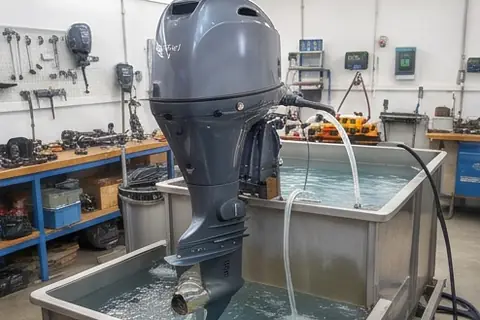 How to Bleed a Marine Diesel Engine After Running Out of FuelA diesel engine cannot run with air in its fuel system. Run the tank dry, change…
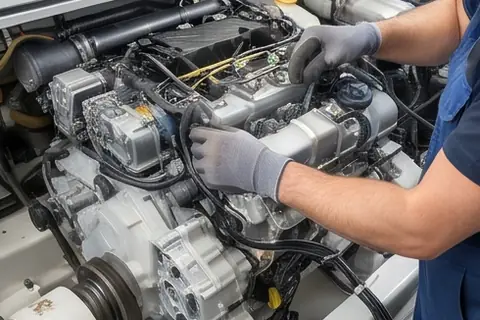 Marine Diesel Overheating: Causes and How to Fix It at SeaThe temperature alarm on a marine diesel always seems to sound at the worst moment: entering…
 How to Change the Impeller on a Marine EngineThe raw water impeller is a small rubber wheel inside the engine's seawater pump. It pushes…
Reader ratings
No ratings yet. Was this useful? Rate it and add what you know: corrections and first-hand tips help the next reader.
★ Rate this guide
Suggest a correction
Cite this page
Marine Diesel Engine Failure at Sea: Advanced Troubleshooting, Emergency Repairs and Getting Home Under Power. Boat Almanac, updated 4 November 2026. https://boatalmanac.com/articles/marine-diesel-engine-failure-at-sea-advanced-troubleshooting-emergency-repairs-and-getting-home-under-power/ (accessed 21 November 2026).