Breakdowns at sea and at anchor
Most breakdowns on a cruising boat come from a short list: fuel, cooling water, electrics, steering and the rig. Knowing the list, checking in order and carrying the right spares turns a crisis into an hour's work. The skippers who cope best are not the best mechanics; they are the calmest and the best prepared.
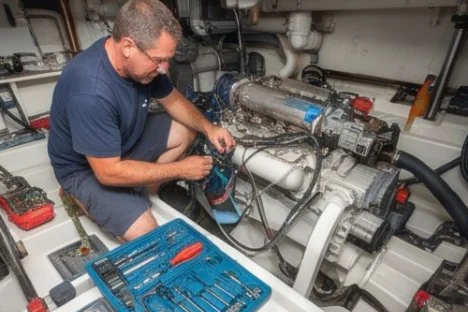
First: make the boat safe
Before you open anything, deal with the situation: if the engine has stopped near rocks or in a busy channel, sail or anchor first. Tell the crew what is happening and give them jobs. If you may need help, call on the radio early, a Pan-Pan, not late. Only then start finding the fault.
The engine stops or will not start
- Fuel: is there fuel; is the tank vent clear; is the filter blocked or full of water? A rough sea stirs the dirt from the bottom of the tank: most diesel stops at sea are fuel.
- Air: after a filter change or running a tank dry the system must be bled; know where the bleed screws are.
- Electrics: battery voltage, the main switch, a loose or corroded connection, the starter solenoid, the fuse for the engine panel.
- The stop: a stop cable half pulled or a stop solenoid stuck is a classic.
- Something round the propeller: the engine stalls when put in gear.
The engine overheats
- Look at the exhaust: is cooling water coming out?
- The raw water strainer: weed, a plastic bag, jellyfish.
- The : open?
- The : missing vanes (and find the pieces, they block the heat exchanger).
- The belt, then the coolant level (closed systems), then the heat exchanger and the exhaust elbow.
Stop the engine before it boils, and let it cool before opening the coolant cap.
The other usual suspects
- Electrics: a voltage that falls overnight means something is drawing current or a battery is failing. A blown fuse is a symptom: find the cause before you replace it.
- Steering: cables stretch, hydraulic systems leak, quadrants slip. Know where your emergency is and practise fitting it.
- Rig: look up every day on passage. A broken strand on a shroud is a warning: ease the load on that side, rig a spare as a temporary shroud and get into port.
- Water in the boat: taste it (salt or fresh), find the source, start with the through-hulls, the shaft seal, the rudder stock and the drains.
- Toilet and holding tank: blocked heads are the most common failure on a family boat; a spare joker valve weighs nothing.
- Windlass: know how to raise the anchor by hand, and how to cut it free if you must.
Spares that save the season
- Fuel filters (several), impellers (two), drive belts, a raw water pump seal kit, engine oil and coolant for a full change, a spare fuel lift pump on older engines.
- Fuses of every size on board, crimp terminals and a crimper, spare wire, a multimeter.
- Hose clamps and a length of each hose size, self-amalgamating tape, epoxy putty, soft wooden plugs tied next to every through-hull.
- A spare for whatever has broken on your boat before: it will break again.
- The manuals, on paper, and a list of part numbers.
Seasonal timing
- Northern temperate waters
- Most breakdowns happen in the first weeks after launch, when systems laid up for months start working again: shake down close to home in April and May.
- Southern temperate waters
- The same in October and November.
- The tropics
- After a storm or monsoon season ashore, and in heat: engines and fridges work hardest in the tropics; check cooling and charging before long passages.
Tips from experience
- Change one thing at a time when diagnosing, and note what you changed.
- Practise the common jobs at the dock: changing the impeller, the fuel filter, bleeding the fuel system.
- Keep a torch, a mirror and a magnet on a string with the tools.
- Label every hose and wire you disconnect.
- Carry the tools to fit your spares; check that they fit.
- Keep spares in labelled, waterproof boxes and a list of what is where.
- Write down every fault and fix in the log: patterns show.
- When in doubt, slow down: most failures get worse under load.
- Long-distance sailors say cruising is fixing your boat in exotic places. The ones who enjoy it carry the spares and have done the common jobs once at the dock.
What it usually costs depends on
- Where the breakdown happens (a tow or a remote repair costs far more than a planned service).
- Whether the spare is on board.
- The age of the boat and its systems.
Ask for written quotes locally: prices differ a great deal between countries, harbours and seasons.
Common mistakes, and the lesson from each
- ❌ Starting to repair before making the boat safe. Sail or anchor away from danger first; then find the fault.
- ❌ Changing parts at random. Diagnose in order: fuel, air, electrics for a stop; water flow before anything else for overheating.
- ❌ Carrying spares but not the tools to fit them. Practise each common job at the dock once, with the tools you carry.
- ❌ Not knowing where the emergency tiller is. Fit it once in harbour, so you know it fits and how long it takes.
- ❌ Calling for help too late. A Pan-Pan early costs nothing; a Mayday late can cost everything.
- ❌ Losing the impeller vanes. Find every missing piece; they block the cooling downstream.
- ❌ Replacing a fuse with a bigger one. The fuse protects the wire. Find the fault instead.
- ❌ No wooden plugs at the through-hulls. Tie a soft plug of the right size next to each one.
- ❌ Only one person on board who knows the systems. Show the crew the seacocks, the fuel shut-off, the main switch and the emergency tiller.
Go deeper
← The Skipper's Handbook · ‹ Budgeting a boat: the real yearly cost · Engine care ›
General guidance from experience, not instructions for your boat: follow the maker's manuals and ask a qualified professional for work you are not sure of.