Published By Tuna Karslı, editorHow guides are checked
Most survey reports for fibreglass boats include moisture readings, often presented as a table or a coloured diagram of the hull. Buyers see high numbers, sellers argue, and brokers say “all old boats read high”. The truth is that moisture readings are useful only when they are taken properly and read in context. Here is how to understand them.
What the meter measures
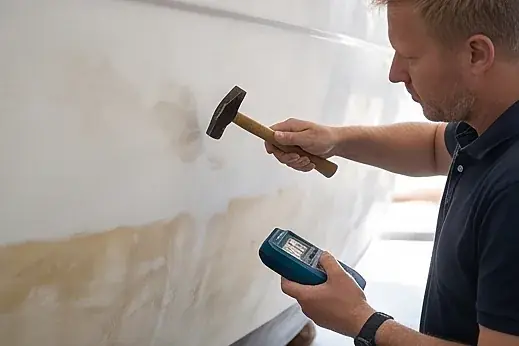
Most marine moisture meters used by surveyors work by sending a low-frequency electrical signal into the laminate and measuring how it responds. Water changes that response. The meter shows a reading on a scale, often called a relative or comparative scale. It is not a percentage of water in the laminate, even if the display shows a number that looks like a percentage.
The meter also responds to other things: metal, carbon fibre, some fillers and paints, and the density of the laminate. A reading over a metal backing plate or a bronze through-hull is high for reasons that have nothing to do with water.
Timing is everything
A hull that has just been lifted out has water on and in its surface layers. Readings taken then measure mostly surface moisture and are high on nearly every boat. For readings that mean something, the boat should have been out of the water and drying for at least a week, in reasonable weather. Many surveyors record when the boat was lifted alongside the readings for exactly this reason.
If the timing forces a quick survey, the surveyor should say so in the report and interpret the readings cautiously.
Comparison, not absolute numbers
A good survey compares:
- Below waterline with topsides. The topsides, above the waterline, are a dry reference on the same boat. The difference matters more than the number.
- Pattern across the hull. Readings in a grid show whether moisture is spread evenly or concentrated in some areas.
- Hot spots. High readings around through-hulls, the joint, the rudder, or a previous repair suggest specific problems such as a leak or a wet core.
An older hull with evenly raised readings below the waterline, no blisters and good percussion sounding may be perfectly sound. A newer hull with a sharp local high reading near a fitting deserves a closer look.
Common situations and what they suggest
- Evenly elevated below the waterline, dry topsides: typical of a hull that has spent a long time afloat. Not alarming on its own. Often an argument for longer drying periods and regular haul-outs.
- High readings with blisters: may indicate . See our osmosis guide.
- High readings around fittings on deck: water may have reached the core through bolt holes. Percussion sounding helps confirm.
- High readings in the rudder: water inside the rudder is common, and it can matter if it freezes or the stock is corroding inside.
- Readings that change after a few days ashore: surface moisture drying out, a good sign.
Confirmation tools
Surveyors use other checks alongside the meter: percussion sounding with a hammer to detect , visual inspection for blisters and cracks, and sometimes taking small samples or drilling test holes, with the owner’s permission. Thermal imaging can help spot wet core areas on decks in suitable conditions.
For buyers
- Ask when the boat was lifted and how long it dried before readings.
- Ask what the topside reference readings were.
- Look for patterns and hot spots, not single numbers.
- If unsure, ask the surveyor to explain the readings in plain words: what they suggest and what, if anything, needs doing.
For owners
Take your own readings at the same points every haul-out, at the same drying time. A dated record over several years tells you more than any single survey, and it is valuable evidence when you sell.
Common questions
Can I buy a moisture meter myself?
Yes, and many owners do to track their own boat over time. Use the same meter at the same points and drying time each year, and remember that readings are comparative.
Do aluminium or steel boats need moisture readings?
No. Moisture readings are for fibreglass and wood. Metal hulls are checked for thickness and corrosion with an ultrasonic thickness gauge instead.
Will the seller let the boat dry for a week?
Many will if the haul-out is planned in advance and the yard costs are agreed. Put it in the offer: a short delay is cheaper for both sides than arguing over readings later.
Field notes
When planning a survey, book the haul-out a week before the survey date if the seller agrees. It costs a little more in yard time and saves arguments about readings later. You can ask surveyors for quotes and compare what each includes.
Read next
 What Does a Marine Survey Cover? A Buyer’s ChecklistBuying a boat without a survey is like buying a house without looking in the loft.…
 Boat Survey Guide: When You Need One and What to ExpectBuying a used boat without an independent survey is one of the most common and most…
 Sea trial guide: what to check, inspection checklistWhat is a sea trial? A sea trial is a test passage that shows how a…
Reader ratings
No ratings yet. Was this useful? Rate it and add what you know: corrections and first-hand tips help the next reader.
★ Rate this guide
Suggest a correction
Cite this page
Moisture Readings in a Survey: What the Numbers Mean. Boat Almanac, updated 18 November 2026. https://boatalmanac.com/articles/moisture-readings-in-a-survey-what-the-numbers-mean/ (accessed 21 November 2026).