Published · Updated By Tuna Karslı, editorHow guides are checked
Few words cause more nervous silence at a haul-out than “”. Buyers walk away from boats over it, owners lose sleep over it, and yet a lot of what gets called osmosis is something else, and a lot of real osmosis never threatens the boat’s strength at all. This guide explains what is happening in the laminate, how a careful owner or surveyor tells the cases apart, and what treatment actually involves.
What osmosis is, in plain words
A fibreglass hull is glass fibre held in resin, covered on the outside with . Gelcoat is not completely waterproof. Over years, water molecules work their way through it and meet water-soluble leftovers in the laminate: traces of uncured resin, binders from the glass mat, or contaminants from the day the boat was built. Those leftovers dissolve into a slightly acidic liquid. Because that liquid is more concentrated than the seawater outside, it draws more water in, pressure builds in small pockets, and the gelcoat pushes out into a blister.
Boats from the 1970s and 1980s, built with orthophthalic resins and less controlled workshop conditions, show it more often. Many later boats were built with vinylester or isophthalic barrier coats and suffer much less, though no hull is immune.
How to spot it
Look at the hull within a day or two of lifting, before it dries. Blisters are easiest to see with a torch held flat against the surface so the light rakes across it. Things to note:
- Size and spread. A handful of pea-sized blisters near the waterline is a very different story from hundreds spread across the whole bottom.
- What is inside. Prick one blister with a pin, wearing glasses. Liquid that smells like vinegar and feels slightly sticky points to true osmosis. Dry blisters, or ones only in the layers, are often paint problems.
- Depth. Blisters in the antifouling or primer are cosmetic. Blisters in the gelcoat are the early stage. Blisters within the laminate itself are the serious stage and need professional assessment.
Moisture readings: useful, but only when taken properly
A moisture meter tells you how wet the laminate is compared to a dry reference area, usually the topsides above the waterline. It does not give an absolute “percent of water”. Two rules matter most:
- The hull must have been out of the water and drying for at least a week. Readings taken a few hours after the lift mostly measure surface water and will look alarming on almost any boat.
- Readings are compared, not judged alone. A surveyor maps the bottom in a grid, compares it with the topsides and looks for patterns. A uniformly damp bottom on an old boat is common; a wet patch around a bolt or a through-hull tells a different story.
Read more in our guide to moisture readings in a survey.
The treatment options
Do nothing, and watch
For light, scattered blistering on a sound hull, many experienced surveyors advise exactly this: open and fill the few blisters, keep an eye on it each haul-out, and spend the money elsewhere. Plenty of boats sail for decades this way.
Local repair
Each blister is ground out, left to dry, washed with fresh water to remove the acidic residue, filled with epoxy filler and faired. Afterwards an epoxy barrier coat is applied over the area or the whole bottom.
Full treatment
The gelcoat is peeled or blasted off the whole underwater hull, the laminate is washed repeatedly and left to dry, sometimes with heat lamps or a tent and dehumidifier, until readings are stable. Then come laminating repairs where needed, many coats of epoxy barrier, fairing and new antifouling.
What it really costs
The single biggest cost is time. Drying can take from a few weeks to several months, depending on how wet the laminate is and on the climate. During that time the boat occupies yard space. For a typical 10 to 12 metre boat in a European yard, a full peel and epoxy treatment usually runs into five figures in euros once storage is included. A local repair of a few dozen blisters with a barrier coat costs a fraction of that, and much of it is within reach of a careful owner.
Prices vary a great deal between countries and yards, so ask more than one. You can request quotes from several yards at once and compare what each includes: peeling method, number of barrier coats, drying checks and storage.
Buying a boat with osmosis
Osmosis is a price question more often than a deal-breaker. If a survey shows it, get the yard’s written estimate for the treatment the surveyor recommends and negotiate on that basis. Boats that have had a documented full treatment with dated moisture records are often among the drier hulls on the market.
Field notes
Hauling out for the winter helps a lot. A hull that spends four or five months a year ashore dries out regularly and rarely gets bad. Keep the bottom clean, avoid leaving a boat afloat for years on end, and record your moisture readings at the same points every haul-out: a dated series of numbers is worth more to you and to any future buyer than any single reading.
Quick check at the yard: Osmosis blisters check.
If you suspect osmosis
Ticks stay on this phone. All checklists
Sources and further reading
- Gelcoat blisters: diagnosis, repair and prevention (manual), WEST SYSTEM. Checked 31 Oct 2026
- Skipper Plus moisture meter: user guide, Tramex. Checked 31 Oct 2026
- Osmosis, Marine and Safety Tasmania (MAST). Checked 31 Oct 2026
Rules, standards and makers' advice change. Seen something here that a source now says differently? Tell us.
Read next
 The 1979 Oil Crisis and Osmosis: Is There a Connection?The late 1970s and early 1980s are an important period in the history of fibreglass yacht…
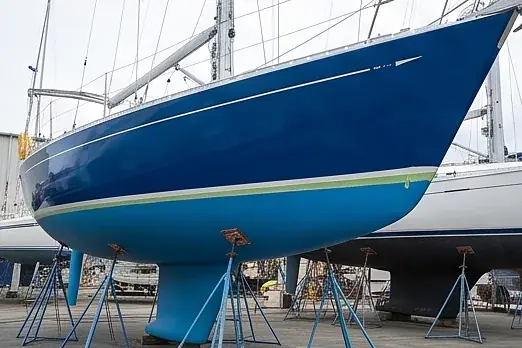 Antifouling: How to Choose the Right Paint and Apply It YourselfAntifouling is the one job almost every owner does every year or two, and it is…
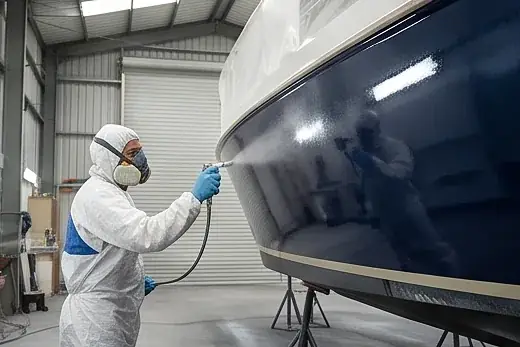 Boat painting guide: gelcoat renewal, hull paint and step-by-step applicationWhy does a boat need painting? A fibreglass hull is coated in gelcoat, a coloured,…
Reader ratings
No ratings yet. Was this useful? Rate it and add what you know: corrections and first-hand tips help the next reader.
★ Rate this guide
Suggest a correction
Cite this page
Osmosis on a Fibreglass Boat: How to Spot It and What It Really Costs to Treat. Boat Almanac, updated 18 November 2026. https://boatalmanac.com/articles/osmosis-in-fibreglass-boat-hulls-symptoms-moisture-testing-and-repair/ (accessed 21 November 2026).