Published · Updated Boat AlmanacHow guides are checked
The late 1970s and early 1980s are an important period in the history of fibreglass yacht construction. Many boats built during these years later became associated with osmotic blistering, raising a question that remains relevant to buyers of older yachts: could the economic pressures of the period have contributed to the problem?
The 1979 oil crisis provides a useful historical context, but the relationship needs to be examined carefully. There is a difference between showing that two developments occurred around the same time and demonstrating that one caused the other.
Why the period matters
During the 1970s and early 1980s, many production fibreglass boats were built using conventional unsaturated polyester resins, including orthophthalic polyester, reinforced with glass fibre. These materials made GRP construction commercially attractive, but their resistance to long-term water exposure depended on the resin formulation, laminate quality, curing, reinforcement, , and manufacturing process.
Research and technical literature on have identified several mechanisms that can contribute to blistering. Water can migrate through the gelcoat and into the laminate. Water-soluble substances and incompletely reacted resin components may contribute to concentrated solutions within the material. Hydrolysis can degrade susceptible polyester structures, while osmotic pressure can contribute to blister formation.
The result may be visible as small blisters on the underwater hull. Their presence, however, does not automatically establish serious structural damage: the extent and significance of the underlying deterioration must be assessed individually.
Technical discussions of older GRP boats describe the use of conventional polyester resins and chopped-strand mat as relevant factors in some cases of blistering. Some builders began using more water-resistant resin formulations in outer laminate layers, although the timing and extent of these changes varied between manufacturers.
For further technical background, see Practical Boat Owner’s explanation of osmosis and the U.S. Coast Guard fiberglass boat repair and maintenance manual.
Could the oil crisis have made the problem worse?
The 1979 oil crisis created economic uncertainty and contributed to pressure on energy-intensive industries. In principle, a manufacturer facing higher costs, weaker demand, or cash-flow difficulties might respond by changing suppliers, reducing waste, modifying specifications, or attempting to lower production costs.
Such decisions can affect quality if they lead to unsuitable material substitutions, insufficient process control, inadequate curing, or reduced inspection. But cost reduction is not inherently synonymous with poor workmanship, and there is no sound basis for assuming that every boat built during this period was affected.
More importantly, the existence of osmotic blistering in boats from the late 1970s and early 1980s does not, by itself, prove that the oil crisis caused it. Establishing that connection would require manufacturer-specific production records, evidence of material or process changes, and comparative data on defects before, during, and after the crisis.
Without that evidence, the oil crisis should be treated as a possible source of economic pressure–not as an established cause of osmotic damage.
What buyers of 1970s and 1980s GRP yachts should look for
For a buyer or surveyor, the practical lesson is to investigate the construction of the individual boat rather than judge it by its production year alone.
Relevant questions include:
- Which resin system was used, and is there reliable documentation of the original construction?
- Was a more water-resistant resin used in the outer laminate, and is the extent of its use known?
- Are there visible blisters, previous osmosis repairs, or unexplained areas of hull coating?
- Has the hull been stored ashore for sufficient time to allow meaningful moisture assessment?
- Are moisture readings consistent across comparable areas, and could coatings, temperature, or other factors affect their interpretation?
- Is further investigation needed to distinguish superficial blistering from deeper laminate deterioration?
Moisture-meter readings alone do not prove that a hull has osmosis, nor do they reliably establish the severity of any underlying damage. A competent surveyor must interpret the readings in context, consider the hull’s construction and coating history, and recommend further testing when justified.
The historical lesson
The most defensible conclusion is that many GRP boats from this era warrant careful inspection because of the materials and construction practices used by some manufacturers–not because the 1979 oil crisis automatically made them inferior.
Economic conditions may have influenced individual manufacturers, but the link between the oil crisis and osmosis remains a hypothesis unless supported by direct evidence.
For anyone considering a classic fibreglass yacht, the decisive factors are the actual laminate condition, construction details, repair history, and quality of any previous treatment. The year of manufacture can guide the investigation; it cannot replace it.
Read next
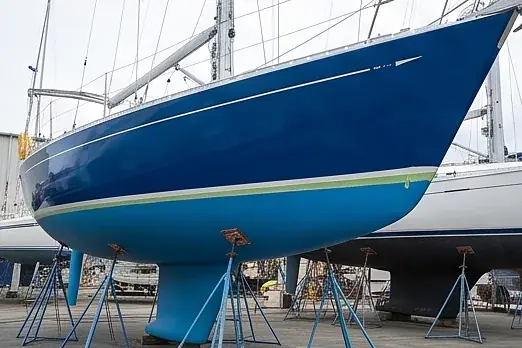 Antifouling: How to Choose the Right Paint and Apply It YourselfAntifouling is the one job almost every owner does every year or two, and it is…
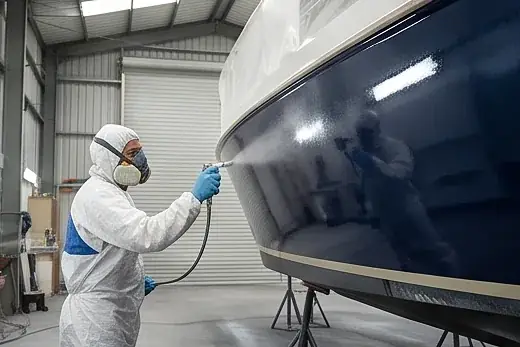 Boat painting guide: gelcoat renewal, hull paint and step-by-step applicationWhy does a boat need painting? A fibreglass hull is coated in gelcoat, a coloured,…
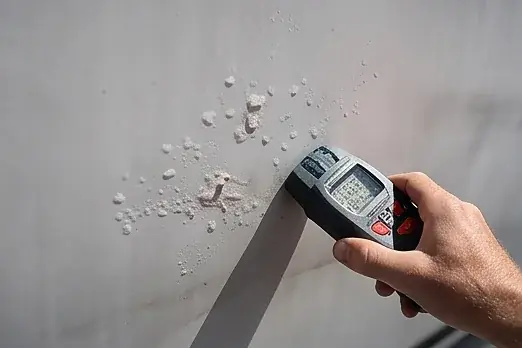 Osmosis on a Fibreglass Boat: How to Spot It and What It Really Costs to TreatFew words cause more nervous silence at a haul-out than "osmosis". Buyers walk away from boats…
Reader ratings ★ 5.0 (1 rating)
★★★★★
interesting point of view. I have never think relation between crisis and boat quality
★ Rate this guide
Suggest a correction
Cite this page
The 1979 Oil Crisis and Osmosis: Is There a Connection?. Boat Almanac, updated 16 November 2026. https://boatalmanac.com/articles/the-1979-oil-crisis-and-osmosis-is-there-a-connection/ (accessed 21 November 2026).