Published · Updated By Tuna Karslı, editorHow guides are checked
is the one job almost every owner does every year or two, and it is easy to spend a lot of money on the wrong paint. The right choice depends less on the brand and more on three questions: how your boat is used, where she is kept, and what is already on the hull.
The main types
Eroding (self-polishing, ablative)
The paint wears away slowly as the boat moves through water, exposing fresh biocide all the time. It suits most cruising sailboats and slower motorboats. Coats do not build up into a thick crust over the years, because each season’s layer is mostly gone by the next. A boat that sits still for months loses less paint but also gets less polishing, so a quick scrub mid-season helps.
Hard (contact, non-eroding)
A hard film that releases biocide but does not wear away. It suits fast motorboats, boats that are scrubbed often, and racing boats that are burnished smooth. Layers build up, so every few years the old paint needs to come off.
Hybrid or semi-hard
A middle ground that wears slowly but holds up better to scrubbing. Popular for boats that sit for long periods and are cleaned by a diver.
Copper-free and biocide-free options
Many waters now restrict copper-based or particular biocides, and rules differ by country and change over time. Copper-free paints use other biocides. Foul-release coatings use a slippery surface instead and work best on boats that move fast and often. Check what is allowed where you keep the boat before you buy; the chandlery or the yard will know the local rules.
Aluminium hulls and drives
Never put copper-based paint on aluminium hulls or on aluminium outdrives and saildrive legs: copper next to aluminium causes galvanic corrosion. Use paint made for aluminium.
Compatibility: the rule people forget
New paint must be compatible with what is already on the hull. Hard over eroding, or one chemistry over an incompatible one, can lift and peel within weeks. If you do not know what is on the boat, either use a paint that the maker says can go over unknown antifoulings, or apply a sealer primer first. Ask the previous owner, check old receipts, or look at the boat’s maintenance log.
How much paint you need
Paint makers publish coverage figures per litre. A rough way to estimate the underwater area for a typical fin-keel sailboat is length on the waterline multiplied by multiplied by multiplied by about 0.75 to 0.85 for the hull, then add the and rudder. Most owners apply two coats, with an extra coat at the waterline, the leading edges of the keel and rudder, and anywhere the water flows fastest. Buying an extra litre is cheaper than running out on a Sunday.
Applying it yourself
1. Preparation
Pressure-wash the hull as soon as the boat is lifted, while the fouling is still soft. Let it dry. Sand lightly with wet-and-dry paper used wet, to remove loose paint and give a key. Old antifouling dust is toxic: wear a mask rated for fine dust, gloves and goggles, and collect the residue. Many yards require dust-free or wet sanding.
2. Mask the waterline
Use a good quality tape and press the edge down firmly. Remove it while the last coat is still slightly soft, pulling back at a low angle, so the edge is clean.
3. Stir properly
Antifouling biocide settles at the bottom of the tin. Stir thoroughly for several minutes, scraping the bottom, and stir again during the job.
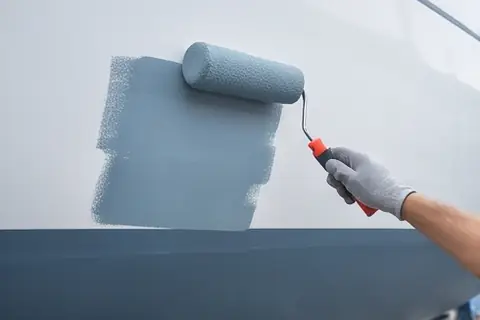
4. Roll, then brush the details
A short-pile solvent-resistant roller is fastest. Apply even coats, keeping the wet edge moving. Brush around through-hulls, transducers and the rudder gaps. Respect the overcoat times printed on the tin, and the minimum and maximum time before launch. Some paints must go in the water within a set number of days.
5. Under the pads
Ask the yard to move the cradle pads or lift the boat in the slings before launching so you can paint the areas they covered.
Anodes, props and transducers
Never paint anodes. Change them at the same time if they are half gone. Propellers need a propeller-specific coating or a primer system; normal antifouling does not stick to bronze. Depth and speed transducers have their own water-based antifoulings, or a thin coat of the maker’s recommended product.
Field notes
The warmer the water, the harder fouling works. Boats in a warm sea all summer may need a stronger paint or a mid-season scrub. Write the paint name, colour, batch and date on the boat’s maintenance log and on a piece of tape inside a locker: next year, whoever does the job will thank you. If you would rather the yard do it, ask a few for prices and compare whether the paint, preparation and the cradle move are included.
Quick checklist: Antifouling yourself.
Sources and further reading
- How should I apply antifouling?, International (AkzoNobel). Checked 31 Oct 2026
- Antifouling: key advice for boaters, The Green Blue (RYA and British Marine). Checked 31 Oct 2026
- Protecting the marine environment: anti-fouling, European Maritime Safety Agency (EMSA). Checked 31 Oct 2026
Rules, standards and makers' advice change. Seen something here that a source now says differently? Tell us.
Read next
 The 1979 Oil Crisis and Osmosis: Is There a Connection?The late 1970s and early 1980s are an important period in the history of fibreglass yacht…
 Boat painting guide: gelcoat renewal, hull paint and step-by-step applicationWhy does a boat need painting? A fibreglass hull is coated in gelcoat, a coloured,…
 Osmosis on a Fibreglass Boat: How to Spot It and What It Really Costs to TreatFew words cause more nervous silence at a haul-out than "osmosis". Buyers walk away from boats…
Reader ratings
No ratings yet. Was this useful? Rate it and add what you know: corrections and first-hand tips help the next reader.
★ Rate this guide
Suggest a correction
Cite this page
Antifouling: How to Choose the Right Paint and Apply It Yourself. Boat Almanac, updated 18 November 2026. https://boatalmanac.com/articles/antifouling-paint-guide-paint-types-application-and-maintenance/ (accessed 21 November 2026).