Anchoring in depth
A cruising boat spends most of her nights at anchor, and good anchoring is the skill that most decides how well the crew sleeps. Anchors rarely fail; anchoring does: the wrong place, the wrong bottom, too little , the anchor never properly set, or a wind shift nobody planned for. Done well, anchoring is calm and boring. That is the aim.
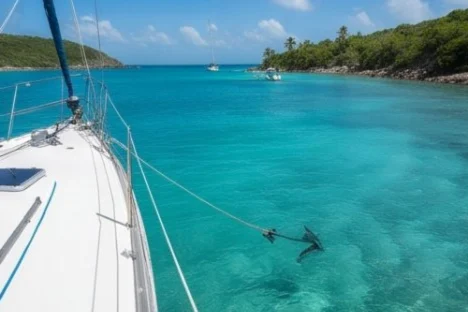
Choosing the spot
- Shelter from the wind you will have tonight, not the wind you have now. Read the forecast for the whole night and the next day: a wind shift at 3 am can turn a sheltered bay into a .
- Swell: a bay can be sheltered from the wind and still roll with swell wrapping round a headland. Look at how the other boats lie and roll.
- The bottom: sand and mud hold well; weed and grass hold badly and are often protected; rock and coral hold unpredictably and damage the anchor and the reef. The chart symbols and a look through clear water tell you.
- Depth and room: enough depth for the lowest tide and the boat's swing, and room to swing a full circle clear of other boats, rocks and the shore.
- An escape route: if the wind turns onshore at night, can you leave in the dark? Note the course out on the chart before you sleep.
Scope and swinging room
Scope is the length of rode let out compared with the depth plus the height of the bow roller above the water. As rules of thumb used by many skippers: with all chain, about 5 times in settled weather and 7 or more when the wind rises; with rope and a chain leader, more. Deep anchorages (common in the Pacific and the Indian Ocean) need long chain: 60 to 100 m is not unusual on a cruising boat. Remember the tide: scope is measured at high water, and depth must be enough at low water. The boat swings in a circle of the rode length plus the boat's length; so does every other boat, and they do not all swing together. Use the anchoring calculator.
Setting and checking
- Come in slowly head to wind, stop, and let the anchor down to the bottom as the boat starts to drift back.
- Pay out the rode as the boat drifts, laying it in a line along the bottom, not in a pile on top of the anchor.
- When most of the scope is out, snub it and let the boat's weight swing her straight.
- Back down gently with the engine, then firmly (a good part of cruising power), and hold it. Watch two marks on shore in line: if they stay in line, the anchor is set.
- Put on a or bridle to take the load off the windlass and stop the chain jerking.
- Swim or snorkel over the anchor where the water is clear. Seeing it dug in is the best sleep aid there is.
- Set the anchor alarm on the GPS or the app, with a radius that allows for the swing.
Two anchors, tide and current
- Two anchors in a "V" (about 45 degrees apart, both forward) help in a storm from a steady direction. Two anchors in line on one rode (tandem) increase holding on poor ground. Bow-and-stern anchoring stops the swing in narrow places but makes the boat lie beam-on to any wind or swell from the side: only in calm, sheltered spots.
- Where the tide runs, the boat may lie to the current rather than the wind, and turn on the change of tide: allow for a full swing, and expect the anchor to be pulled from the opposite direction. Re-check after the first turn.
- In strong currents and on the change of tide, chain can wrap round the anchor or a rock; a slight over-scope and a snubber reduce the jerk.
Coral and protected seabeds
- Never drop an anchor on live coral: it destroys reefs that took centuries to grow, it is forbidden in many places, and coral heads catch chains and hold boats on very short scope in a blow.
- Look for a patch of sand, and float the chain off the coral heads with floats or tied to it every few metres.
- Use mooring buoys where they are provided (and check their condition: a diver look is worth the swim).
- Seagrass meadows are protected in many seas: anchor on sand, and check the local rules.
Storms at anchor
- If a storm is forecast, choose the best-protected spot with the best holding and the most room, and get there early, before the others.
- Let out all the scope the room allows, use a long, stretchy snubber, reduce windage (take off the bimini, the dodger and any canvas, lash the sails), and put chafe protection wherever a line touches.
- Prepare to leave if the anchor drags: engine ready, course to clear water noted, crew dressed.
- Keep an anchor watch through the worst of it, in turns.
- If the anchorage turns into a lee shore, leaving early in daylight for open water is often safer than staying.
The anchor alarm and the anchor watch
An anchor alarm on a GPS, a chartplotter or a phone app wakes you if the boat moves outside a circle you set. Set it after the boat has settled, with a radius that allows for her swing plus a margin, and put it where you will hear it. It is a second pair of eyes, not a replacement for a good anchoring and a look outside when the wind changes. In a blow, a person on watch notices a neighbour dragging long before any alarm.
Before entering an anchorage
- Will wind direction shift overnight? Check the forecast and know the anchorage's sheltered quadrant.
- Enter in daylight; don't enter an unfamiliar anchorage at night.
- Find out the bottom type: sand gives good holding for most anchors; weed or rock gives poor holding.
- Avoid anchoring on seagrass (Posidonia) and coral; choose a sandy patch. On coral, buoy the chain with a few floats so it does not wrap round coral heads.
- In tidal waters, anchor for the depth at high water plus the scope, and check you will still float at low water everywhere in your swing circle. With wind against the tide, boats lie to the current and may swing towards each other.
- Measure depth, calculate scope, allow for your swing circle and nearby boats.
- Did the anchor hold? Reverse to check, watch a fixed reference, set an anchor alarm.
- If taking a stern line ashore, consider wind and swell direction and your emergency exit route.
- Night watch or alarm; be ready to leave immediately if conditions change.
If you have experience or corrections for an anchorage, write to us →. Checked information is added; we don't publish shelter direction or bottom type without confirmation from at least one reliable source.
Seasonal timing
- Northern temperate waters
- In the summer season, anchorages fill by the afternoon: arrive early to get the good spot.
- Southern temperate waters
- The same in the southern summer.
- The tropics
- In the tropics, squalls and fronts bring sudden wind shifts at night; anchor with the shift in mind.
Tips from experience
- Mark the chain every 10 m (paint or cable ties in colours) so you know how much is out.
- A snubber of nylon a few metres long takes the shock off the boat and the windlass and silences the chain.
- Anchor for the strongest wind of the night, not the calm of the evening.
- Keep the engine key handy and the dinghy on deck or on short painter if the forecast is uncertain.
- Take a bearing or a GPS position of the anchor as you drop it.
- Watch how other boats lie before you choose: they show the wind and current.
- In a crowded bay, ask a neighbour how much scope they have out.
- Practise setting the anchor under sail once; one day the engine will not start.
- Check the anchor shackle's pin is moused (wired) every season.
- When in doubt, let it out: more chain costs nothing but swinging room.
What it usually costs depends on
- The size of the boat and the weight of anchor and chain she needs.
- How deep the anchorages are where you cruise (more chain).
- Mooring buoy fees where anchoring is not allowed.
Ask for written quotes locally: prices differ a great deal between countries, harbours and seasons.
Common mistakes, and the lesson from each
- ❌ Anchoring for the evening calm. Read the night's forecast and anchor for the worst wind of the night.
- ❌ Not backing down to set the anchor. An anchor lying on the bottom is not set. Back down and watch two marks on shore.
- ❌ Too little scope to stay close to the beach. Short scope drags. Give it the scope it needs, or choose another spot.
- ❌ Dropping the chain in a pile on the anchor. Lay it out as the boat drifts back, or the anchor fouls.
- ❌ Anchoring too close to other boats. Every boat swings; some swing differently. Leave a full swing circle.
- ❌ Forgetting the tide. Depth at low water and scope at high water. Check both.
- ❌ Anchoring in weed or on coral. Weed holds badly and coral is destroyed. Find sand.
- ❌ No anchor alarm, or one set too tight. Set it after the boat settles, with a radius for her swing.
- ❌ No plan to leave at night. Note the course out before you sleep. A wind shift does not wait for daylight.
- ❌ Leaving the bimini and canvas up in a blow. Windage loads the anchor. Strip the boat before the wind arrives.
Go deeper
- Anchoring calculator
- Anchorage guide
- Anchorages and coves
- Anchoring guide
- Anchor alarm in Almanac App
- Storm preparation
← The Skipper's Handbook · ‹ Marina culture and sea courtesy · Weather for sailors ›
General guidance from experience, not instructions for your boat: follow the maker's manuals and ask a qualified professional for work you are not sure of.