Tide height (rule of twelfths)
Estimate the height of tide at any time between low and high water. The calculations run in your browser.
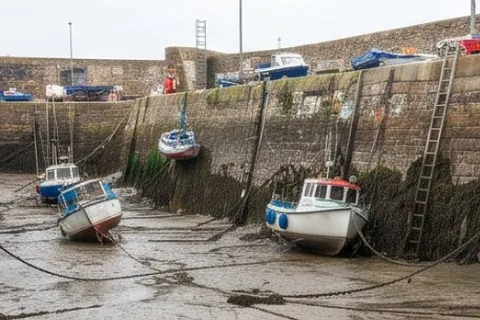
Take the times and heights of the low and high water either side of the time you need from your tide table, then pick the time. It works for a rising tide (low water first) and a falling tide (high water first).
The rule
Between low and high water the tide rises (or falls) about 1/12 of its range in the first hour, 2/12 in the second, 3/12 in the third and fourth, 2/12 in the fifth and 1/12 in the sixth. A "tidal hour" is the time between low and high water divided by six. It is a rough model: real curves are skewed in many places (the Solent, estuaries, the Wadden Sea) and the Mediterranean has small, irregular tides where wind and pressure matter more than the moon. Use the port's tidal curve where one is published.
Depth you will have
Depth = charted depth + height of tide. Add your safety margin under the keel and a margin for swell and squat, and remember high pressure lowers the sea level and strong onshore winds can raise it.
Not for navigation. These tools give estimates from simple models; they support good seamanship and do not replace it. Check every result against official charts, tide tables, nautical publications, your instruments and the conditions you see. The skipper is responsible for the boat and the people on board.
More tools
24 calculators and planners
- World route plannerMarina to marina anywhere on the sea: the route, sailing days, overnight and fuel stops, fuel, water, provisions and packing.
- Provisions plannerHow many people, how many days: shopping list, daily menu and estimated cost, for a single hob and a compact fridge.
- Packing plannerClothing, documents, health and electronics by season and region; tick off and print.
- Where to anchor tonight?Bays near you ranked for tonight's forecast wind, from what sailors reported about their shelter, bottom and holding.
- World voyage plannerA circumnavigation planned season by season: every ocean passage in its window, where to spend each hurricane and cyclone season, distances and time.
- Position and distanceConvert between position formats and get the distance and bearing between two points.
- True, magnetic and compassConvert headings and bearings with variation and deviation, and update variation to this year.
- Course to steer in a currentThe heading that keeps you on track across a tidal stream, your speed over the ground and arrival time.
- Distance off and horizonDistance to the horizon, when a light rises, distance off by vertical angle, doubling the angle and the rule of 60.
- Collision risk (CPA)From two bearings and ranges of another vessel: closest point of approach, when, and its course and speed.
- Sun and moonSunrise, sunset, twilight and the moon phase for any position and date.
- Beaufort scale and sea stateWind force from speed, what the sea looks like, what it means for a yacht and how hard the wind pushes.
- Barometer trendWhat a rise or fall in pressure over three hours tells you, in the words forecasters use.
- True and apparent windWork out the wind you feel on board from the true wind, or the true wind from your instruments.
- Anchoring calculatorScope, how much chain or rode to let out, and the circle your boat will swing in.
- Hull speed and design ratiosHull speed, displacement/length, sail area/displacement, capsize screening and comfort ratio.
- Battery and solar budgetWhat you use in a day, how big the battery bank should be and how much solar covers it.
- Cable size and voltage dropThe cable cross-section a DC circuit needs for its length and current.
- Water and watermakerHow long your fresh water lasts and how long the watermaker must run.
- Unit converterKnots, miles, metres and feet, litres and gallons, bar and psi, kW and hp, °C and °F.
- Radio, signals and lightsVHF channels, the phonetic alphabet, Mayday, Pan-Pan and Sécurité, sound signals, lights and buoyage regions.
- Signal flags and flag etiquetteThe single-letter flags of the International Code of Signals and where to fly ensign, courtesy flag and Q.
- Crew list for clearing inThe crew list harbour offices, customs and police ask for when you clear in or out: boat details and every person aboard, printed in one tidy page.
- Watch scheduleA fair watch rota for your crew and passage, in the common watch systems.