Below the waterline
What is under the water decides whether the boat stays afloat and how fast it goes. It is seen once a year, so that once must be used well; between haul-outs, a mask and snorkel tell you a lot.
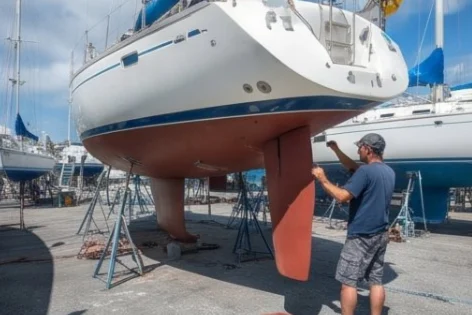
Every haul-out
- : the right type for your water and use (hard paints for boats that dry out, are scrubbed or are fast; eroding paints for boats that sit), applied in the thickness the maker says, with more at the waterline and the leading edges.
- Anodes: replace when about half gone. If they went much faster than before, something on board or in the marina is leaking current.
- : open and close each one; they must move freely. Ball valves of a material suited to below the waterline; gate valves have no place there.
- Hoses and clamps: two stainless clamps on every hose below the waterline; replace hoses that are hard, cracked or soft.
- Propeller, shaft and cutless bearing: damage and erosion on the blades, play in the bearing, the shaft seal or stern gland.
- Sail drive: the diaphragm, which makers usually say to replace about every seven years.
- Rudder: play in the bearings, water weeping from the blade, and drained in frost climates.
- : the keel-to-hull joint and, inside, the keel bolts and the floors around them.
Osmosis and moisture
Small blisters on a fibreglass hull may be , or only in the paint. Moisture readings on a hull that has dried ashore for at least a week, compared above and below the waterline, and a few blisters opened tell you which. Real osmosis is treated by stripping, drying the hull for a long time and re-coating: a big job, which a buyer should know about before agreeing a price.
Between haul-outs
- Snorkel round the boat every few weeks in the season: growth on the propeller costs speed and fuel, and you see an going.
- Clean the propeller and the speed log; a scraper and a pair of gloves are enough.
- In warm water growth comes fast: plan a scrub or a diver more often than in cold water.
- Work each seacock every few months so it never seizes.
Seasonal timing
- Northern temperate waters
- Antifouling in late winter or early spring, so it is fresh for the season; a full inspection at every haul-out.
- Southern temperate waters
- Antifouling in late winter or early spring of the south (August to October).
- The tropics
- Growth is fastest in warm water: antifouling is a big job every year or two, and a diver or a scrub every few weeks keeps the bottom clean in the season.
Tips from experience
- Take photographs of the bottom every year from the same angles; changes show.
- Keep a record of anode changes and how much was left.
- Paint the waterline and the rudder's leading edge with an extra coat.
- Tie a soft wooden plug next to every through-hull.
- Grease the seacocks that need it, with the right grease.
- Check the shaft seal's drip if it is a packed gland: a few drips a minute under way, little or none at rest.
- If you dry out often, choose a hard antifouling.
- Have the keel bolts looked at after any grounding.
What it usually costs depends on
- The paint type and the hull area.
- Whether the yard must do the work.
- How much old paint must come off.
- What the inspection finds: bearings, seacocks and diaphragms are cheap to replace when planned, dear when they fail.
Ask for written quotes locally: prices differ a great deal between countries, harbours and seasons.
Common mistakes, and the lesson from each
- ❌ Seacocks that are never moved. A seized seacock cannot be closed when a hose bursts. Work each one every few months.
- ❌ Ignoring fast-disappearing anodes. It warns of stray current. Find the cause before it eats the propeller or the sail drive.
- ❌ Moisture readings taken just after the lift. A wet hull reads wet. Let it dry at least a week before you judge.
- ❌ Single hose clamps below the waterline. Two clamps, stainless all through, on every hose below the waterline.
- ❌ The wrong antifouling for the use. Hard for scrubbing and drying out; eroding for boats that sit.
- ❌ Forgetting the sail-drive diaphragm. Replace it on the maker's interval, whatever it looks like.
- ❌ Ignoring a crack at the keel joint. It can be paint, or a hidden problem. Have it looked at, especially after a grounding.
- ❌ Painting over blisters. Find out what they are first; paint hides a problem for a buyer, and for you.
Go deeper
← The Skipper's Handbook · ‹ Rig and sails · Modifications that pay, and ones that do not ›
General guidance from experience, not instructions for your boat: follow the maker's manuals and ask a qualified professional for work you are not sure of.