Arriving by boat in Ecuador
Last checked against 1 official source
The Galápagos and mainland Ecuador are cleared separately, and both need an agent and a permit called an autógrafo arranged before you arrive. For the Galápagos, apply through an agent at least 60 days ahead; the autógrafo allows up to 30 days (extendable by 30) and up to five inhabited ports. Arrive with a clean hull and a hull inspection certificate from your last port: boats with fouling are sent 60 NM offshore to clean it. The mainland autógrafo (required since August 2023) does not cover the Galápagos.
Arrival step by step
Yes. Galápagos ports of entry: Puerto Baquerizo Moreno (San Cristóbal), Puerto Ayora (Santa Cruz), Puerto Villamil (Isabela) and Baltra (mainly for superyachts). Agree your first port with your agent and do not stop anywhere else first. On the mainland, Puerto Amistad (Bahía de Caráquez), Puerto Lucía Yacht Club (La Libertad) and the Guayaquil Yacht Club are the ports most used to foreign yachts.
- Choose an agent and apply for the Galápagos autógrafo at least 60 days before arrival; processing usually takes about six weeks.
- Before leaving your last port, have the hull cleaned and inspected and get the hull inspection certificate, plus a fumigation certificate.
- Keep your agent updated on your ETA as you approach.
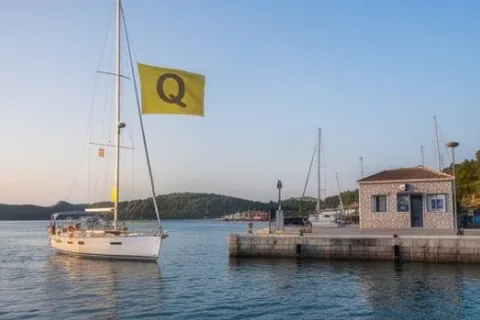
- Arrive only at the port named on your autógrafo, flying the Q flag, and stay on board.
- Expect 8 to 12 officials (Port Captain, Immigration, National Park, Environment, Biosecurity, Health, Navy) who may board at different times; they check the hull, holding tank, oil-spill kit and food.
- Pay the National Park entrance fee and the Transit Control Card for each person, and the port fees in cash.
- To move between islands, ask your agent for a domestic zarpe at least 24 hours ahead.
- For the mainland: get the separate mainland autógrafo through a marine agency at least 30 days ahead and give the Navy three days' notice of arrival.
Ports of entry boaters use
- Puerto Baquerizo Moreno · San Cristóbal, Galápagos
Port of entry; usually the first stop for boats from Panama. - Puerto Ayora · Santa Cruz, Galápagos
Port of entry with the most services; crowded and rolly anchorage. - Puerto Villamil · Isabela, Galápagos
Port of entry and a calm anchorage; no fuel or ATM. - Puerto Lucía Yacht Club · La Libertad, mainland
Marina used to foreign yachts; asks for a fumigation certificate. - Puerto Amistad · Bahía de Caráquez, mainland
Popular with cruisers; the marina can act as agent.
Papers to have on board
- Autógrafo (Galápagos or mainland, as applicable)
- Zarpe (clearance) from your last port
- Passports for everyone on board and the ship's registration papers
- Crew list (many copies)
- Proof of health insurance for all crew
- Hull inspection certificate from your last port before departure
- Fumigation certificate and a sanitation certificate
- AIS transmitter and an AIS certificate
- Transit Control Card for each person (Galápagos)
- Original Port Captain receipt (factura), not a photocopy
- Mainland: Navy arrival authorisation email, black-water (sewage) certification and a traveller health declaration for each person; yellow fever vaccination proof may be asked
Crew, passports and visas
Galápagos: tourists may stay up to 60 days a year; everyone needs the Transit Control Card (US$20) and pays the National Park entrance fee on arrival. Crew who leave the boat in the islands are stamped out when they fly. Mainland: Immigration issues a free 90-day tourist visa on arrival. Overstaying makes you irregular and can lead to deportation.
How long the boat may stay
Galápagos: the autógrafo allows up to 30 days, with a possible 30-day extension. Without an autógrafo, a one-port stop at Puerto Ayora or Puerto Baquerizo Moreno is possible for up to 20 days at the Port Captain's discretion (often about seven days), and an emergency stop gives 72 hours. Mainland: Customs issues a one-year temporary import permit (DJT) for the yacht.
Fees, taxes and permits
- Galápagos autógrafo: no government fee; the agent's fee is extra and agents may ask for half in advance
- Local arrival and departure zarpe: US$15.75 each
- Local arrival fee and departure fee: US$50 each
- Anchorage: US$0.14 per metre of length per day, in inhabited ports
- Garbage disposal: US$30; failed hull inspection re-inspection: US$150
- Transit Control Card: US$20 per person
- Galápagos National Park entrance fee: US$200 for most foreign adult visitors since 1 August 2024 (Galapagos Conservation Trust)
- Overtime outside 08:00 to 17:00 Monday to Friday, at weekends and on holidays: almost double the normal fees
- Mainland autógrafo: about US$250 to 300; fumigation about US$150 if you have no recent certificate
Buoyage and navigation marks
IALA region BEcuador uses region B buoyage.
Red right returning: red to starboard when coming in from sea. Preferred channel marks (a lateral mark with a band of the other colour) follow the same colours: the main colour tells you which side to leave the mark on when following the preferred channel.
The same everywhere: yellow and black cardinal marks (pass on the named side: north, east, south or west of the danger), black and red isolated danger marks, red and white safe water marks, yellow special marks, and the blue and yellow emergency wreck mark. Where a channel has no obvious direction, the chart shows the direction of buoyage with a small arrow. All marks explained. Always follow the chart and local notices: these are summaries, not a navigation source.
Anchoring, marine parks and protected areas
Almost all of the Galápagos is national park. With an autógrafo you may visit only the inhabited ports listed on it; cruising the park's other anchorages on your own boat needs a separate park permission arranged at least two months ahead (about US$2,000), a daily charge per crew member and a naturalist guide on board.
Waste and holding tanks
Inspectors check the holding tank and the oil-spill kit on arrival in the Galápagos. Garbage is taken for a fee. The mainland asks for black-water (sewage) certification with the arrival notice.
Seasons and office hours
Most yachts pass the Galápagos between February and May on their way to the Marquesas, so agents and anchorages are busiest then; apply for the autógrafo early. Calms are common between Panama and the Galápagos: carry fuel to motor.
Leaving the country
Galápagos: give your agent 48 hours' notice for an international departure; you can clear out from San Cristóbal, Santa Cruz or Isabela (Isabela has no fuel, no ATM and no resident Immigration officer, so an officer must be sent, about US$150 that boats can share). Officials may search the boat before departure. Leave immediately once you have the zarpe and return the Transit Control Card. Mainland: Port Captain (zarpe), then Customs (with the DJT), then Immigration.
Common mistakes and fines
- Arriving in the Galápagos without an autógrafo leaves you only an emergency stop or a short one-port stay.
- Any fouling on the hull can mean being refused and sent 60 NM offshore to clean it, plus a re-inspection fee.
- The autógrafo covers the ports listed on it, not the anchorages around them; some sites need a registered guide.
- Plans are hard to change once submitted: give your agent the full itinerary early.
- The mainland autógrafo is not valid for the Galápagos, and the Galápagos one does not cover the mainland.
- Overtime almost doubles the fees: plan a weekday arrival in office hours.
Where the sources disagree
These points were unclear or have changed recently. Ask the port authority or customs on arrival.
- Fees change often and without notice; most amounts here come (2024), not an official schedule.
- The National Park entrance fee for crew arriving by yacht was not shown separately on the official sources opened.
- Whether self-clearance without an agent is allowed on the mainland depends on the Port Captain and must be agreed in advance.
- Sources disagree on whether the mainland needs its own autógrafo: the Galápagos autógrafo is long established, while the mainland requirement (reported from August 2023) should be confirmed with an agent before you sail.
Questions boaters ask
Do I need an agent for the Galápagos?
Yes, for any stay longer than a day. The agent applies for the autógrafo, handles the officials and collects the fees.
Can I stop without an autógrafo?
Only for an emergency (72 hours) or a short one-port stop at Puerto Ayora or Puerto Baquerizo Moreno that the Port Captain decides, often about a week.
Why might I be refused?
Mostly for a dirty hull. Clean it and get the inspection certificate in your last port, and keep it clean on the passage.
Does the Galápagos autógrafo cover the mainland?
No. The mainland needs its own autógrafo, and the mainland one is not valid in the Galápagos.
Official sources
The authority pages this guide rests on, with the date each was last opened and read.
- Galápagos Transit Control Card pre-registration
Consejo de Gobierno de Galápagos · checked 26 Oct 2026
Cruising guides and sailor reports
Used for practical detail and recent experience; where they disagree with an official page, the official page wins and the point is listed under "Where the sources disagree".
This guide is general information for private, non-commercial yachts and is not legal advice. Rules and fees change; confirm with the port authority, customs or your agent before arrival. Seen something out of date? Tell us.
Other countries
Albania · Antigua and Barbuda · Australia · Bahamas · Barbados · Belgium · Belize · Bermuda · Brazil · British Virgin Islands · Bulgaria · Canada · Cape Verde (Cabo Verde) · Colombia · Cook Islands · Costa Rica · Croatia · Denmark · Dominica · Dominican Republic · Egypt · Estonia · Fiji · Finland · France · French Polynesia · Georgia · Germany · Gibraltar · Greece · Grenada · Guadeloupe · India · Indonesia · Ireland · Israel · Italy · Japan · Madagascar · Malaysia · Maldives · Malta · Martinique · Mauritius · Mexico · Montenegro · Morocco · Netherlands · New Caledonia · New Zealand · Norway · Oman · Panama · Papua New Guinea · Philippines · Poland · Portugal · Réunion · Saint Helena · Saint Lucia