Arriving by boat in Martinique
 Arriving by boat in Martinique
Last checked against 7 official sources
Martinique is a French overseas region: part of the EU but outside the Schengen area. Since 1 September 2024 clearance in the French Antilles is done online on the government site demarches-simplifiees.fr. If you file before arrival you get a clearance certificate by email and do not need to visit an office. Without internet, use an approved clearance point ashore (about 5 EUR).
Arrival step by step
Clearance is online, so you clear in wherever you first anchor or berth; You only need to call at a port of entry if you want your form stamped. The French Customs list of approved clearance points (Jan 2026) names Le Marin (CAP fuel station on pontoon 3, open daily until 16:30, and the marina office), Fort-de-France (Étang Z'Abricots marina, Sea Services chandlery, the Baie des Tourelles careening centre), Les Trois-Îlets (Pointe du Bout marina), Sainte-Anne, Saint-Pierre (tourist office), Les Anses d'Arlet, Le François and the Customs station at La Trinité.
- Before arrival, create an account on demarches-simplifiees.fr (declaration-clearance-antilles) and save the boat and crew profile.
- File the arrival declaration with dates, times, previous port and crew; you receive a clearance certificate with a digital Customs stamp by email.
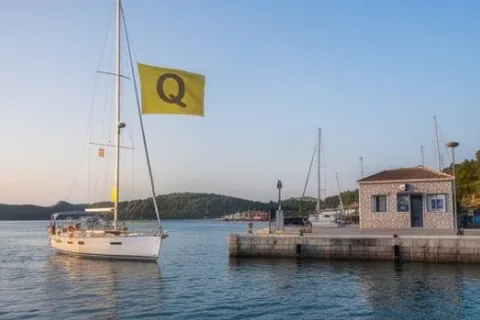
- Fly the French courtesy flag on arrival. If you have not filed online, fly the Q flag and only the skipper goes ashore to an approved clearance point.
- At a clearance point, bring the registration papers and passports or a full crew list (names, nationalities, passport numbers, dates and places of birth); a fee of about 5 EUR applies.
- Declare restricted goods such as firearms and ammunition on arrival.
- If you stay more than one week, file a departure declaration online before leaving; under a week the arrival form can cover it.
- Clear out again before sailing to Guadeloupe, St Barts or Saint-Martin: each French department is a separate clearance.
- Print the certificate if your next country wants a paper clearance (zarpe).
Ports of entry boaters use
- Le Marin · South
Main yacht centre; clearance point at the CAP fuel station on pontoon 3 (daily until 16:30) and at the marina office. - Sainte-Anne · South
Large anchorage next to Le Marin; listed clearance point at Snack Boubou. - Fort-de-France · West, Bay of Fort-de-France
Capital; clearance at Étang Z'Abricots marina and Sea Services chandlery. Fishing closed in the bay. - Les Trois-Îlets (Pointe du Bout) · West, Bay of Fort-de-France
Marina with a listed clearance point. - Saint-Pierre · North-west
First stop from Dominica; clearance at the tourist office.
Papers to have on board
- Boat registration papers
- Passports for everyone on board, with visas where needed
- Crew list with full names, nationalities, passport numbers and dates of birth
- Clearance certificate from demarches-simplifiees.fr (printed copy for the next country)
- Clearance from your last port
- Pet health certificate, microchip and rabies records if a pet is aboard
Crew, passports and visas
French entry rules apply. Martinique is in the EU, but France-Visas states that no French territory outside Europe is part of the Schengen area and that these territories have their own entry rules, so a Schengen visa should not be assumed to cover Martinique and Schengen 90/180 counting and the EES do not apply there. UK citizens need no visa for up to 90 days and need a passport valid at least 3 months after departure (GOV.UK, Oct 2026). Others should check the France-Visas site. Immigration details go on the online clearance form.
🇪🇺 Part of France and of the EU, but outside the Schengen area and outside the EU VAT area. Days spent here do not count towards Schengen's 90 days in any 180, and a Schengen visa is not on its own enough for every nationality: check the French rules for this territory before you sail. The euro is the money. Customs rules for the boat are those of this territory: ask the port of entry how long a non-EU boat may stay. Read the Schengen and EU rules for boats for mainland Europe.
How long the boat may stay
EU customs rules apply. Yachts in transit can use duty-free ship stores and VAT-free repair procedures.
Fees, taxes and permits
- Online clearance on demarches-simplifiees.fr: no charge.
- Clearance at an approved clearance point ashore: about 5 EUR admin charge.
- Marina and mooring fees are set by each marina; none are official clearance fees.
Buoyage and navigation marks
IALA region BMartinique uses region B buoyage.
Red right returning: red to starboard when coming in from sea. Preferred channel marks (a lateral mark with a band of the other colour) follow the same colours: the main colour tells you which side to leave the mark on when following the preferred channel.
The same everywhere: yellow and black cardinal marks (pass on the named side: north, east, south or west of the danger), black and red isolated danger marks, red and white safe water marks, yellow special marks, and the blue and yellow emergency wreck mark. Where a channel has no obvious direction, the chart shows the direction of buoyage with a small arrow. All marks explained. Always follow the chart and local notices: these are summaries, not a navigation source.
Anchoring, marine parks and protected areas
The whole coast lies in the Parc naturel marin de Martinique (created 2017). Do not anchor on seagrass or coral; the park is laying ecological moorings, including at Rocher du Diamant, Cap Salomon and the Pothuau area. In December 2025 anchoring (by prefectoral order) and mooring were banned in the Bourg and Grande Anse bays at Les Anses d'Arlet. Follow SHOM sailing directions for marked channels and swimming zones.
Fishing
In the marine park, catches are for your own use and may not be sold. Spearfishing with scuba gear is banned, as is carrying a speargun and breathing gear together. Lobster is closed 1 June to 30 September (minimum 6 cm or 8 cm by species); conch is closed 1 January to 30 June, with a limit of 3 per day. Corals, sea fans, sponges, groupers, sharks, manta rays and several other species are protected. Some areas, including the Bay of Fort-de-France, are closed because of chlordecone pollution.
Pets on board
French Customs rules for pets from outside the EU: microchip, rabies vaccine at least 21 days before travel, and a rabies titre test taken at least 30 days after vaccination with at least 90 days before the health certificate, unless the animal comes from a listed exempt country such as the USA or Canada. An official health certificate is needed and must be shown to Customs on arrival. Maximum 5 animals. Start with your vet at least 3 months ahead.
Seasons and office hours
Atlantic hurricane season runs 1 June to 30 November, peaking around 10 September (NOAA). Lobster fishing is closed 1 June to 30 September and conch 1 January to 30 June. The marine park steps up checks during sensitive periods such as the sea urchin season and regattas.
Coming from or going to Turkey
No rules specific to boats from Turkey were found. Most boats arrive after the trade-wind crossing from the Canaries or Cape Verde, often via Barbados or Saint Lucia. Pet owners should plan the rabies titre test months ahead, since EU rules apply.
Leaving the country
File a departure declaration online if you stayed more than a week, or have the printed certificate endorsed at a clearance point (about 5 EUR) if the next country needs a stamped paper. Clear out before every trip to another French island.
Common mistakes and fines
- Not filing a clearance on arrival: the official guide warns of prosecution and penalties under the Customs Code, and Authorities track yachts by AIS and helicopter.
- Forgetting to clear out before sailing to Guadeloupe or another French island.
- Anchoring at Les Anses d'Arlet (Bourg and Grande Anse) after the closure announced in December 2025.
- Anchoring on seagrass or coral inside the Parc naturel marin de Martinique.
- Unmarked fishing buoys off the Anses d'Arlet and the north-east coast.
- Fishing in areas closed because of chlordecone pollution, including the Bay of Fort-de-France.
Where the sources disagree
These points were unclear or have changed recently. Ask the port authority or customs on arrival.
- Whether the anchoring and mooring closure at Les Anses d'Arlet (reported 28 Dec 2025) is still in force.
- The demarches-simplifiees.fr site may need a European IP address; some prompts stay in French.
- The 18-month temporary admission period comes (Apr 2025); no French Customs page stating it for Martinique could be read.
- How EU pet rules are applied on arrival by yacht in Martinique is not stated on the French Customs pet page.
- SailClear and eSeaClear are not used; the French Antilles have their own online system.
Questions boaters ask
Is Martinique in Schengen?
No. It is part of France and the EU, but France-Visas says no French territory outside Europe is in the Schengen area. It has its own entry rules.
Do I have to visit Customs?
Not if you file the online declaration before arrival. You get the certificate by email, with no fee and no office visit.
Does Martinique use SailClear or eSeaClear?
No. The French Antilles use their own form on demarches-simplifiees.fr.
What if I cannot get online?
Go to an approved clearance point such as the CAP fuel station in Le Marin. Expect a charge of about 5 EUR.
Do I need to clear out before going to Guadeloupe?
Yes. Each French department is a separate clearance, so file departure and arrival each time.
How long can the boat stay?
Up to 18 months under EU temporary admission for a non-EU boat.
Can I anchor at Les Anses d'Arlet?
Anchoring and mooring in the Bourg and Grande Anse bays were banned in December 2025. Check locally whether this still applies.
Official sources
The authority pages this guide rests on, with the date each was last opened and read.
- French Customs: Clearance guide for the French Antilles (2024)
French Customs (Douane) · checked 26 Oct 2026 - Démarches simplifiées: Déclaration clearance Antilles
French Government online procedures · checked 26 Oct 2026 - French Customs: List of approved clearance points (Jan 2026)
French Customs (Douane) · checked 26 Oct 2026 - French Customs: Travelling with a dog, cat or ferret
French Customs (Douane) · checked 26 Oct 2026 - France-Visas: France in the Schengen area
France-Visas, French Government · checked 26 Oct 2026 - GOV.UK: Martinique entry requirements
GOV.UK · checked 26 Oct 2026 - NOAA NHC Tropical cyclone climatology
US National Hurricane Center (NOAA) · checked 26 Oct 2026
Cruising guides and sailor reports
Used for practical detail and recent experience; where they disagree with an official page, the official page wins and the point is listed under "Where the sources disagree".
This guide is general information for private, non-commercial yachts and is not legal advice. Rules and fees change; confirm with the port authority, customs or your agent before arrival. Seen something out of date? Tell us.
Other countries
Albania · Antigua and Barbuda · Australia · Bahamas · Barbados · Belgium · Belize · Bermuda · Brazil · British Virgin Islands · Bulgaria · Canada · Cape Verde (Cabo Verde) · Colombia · Cook Islands · Costa Rica · Croatia · Denmark · Dominica · Dominican Republic · Ecuador · Egypt · Estonia · Fiji · Finland · France · French Polynesia · Georgia · Germany · Gibraltar · Greece · Grenada · Guadeloupe · India · Indonesia · Ireland · Israel · Italy · Japan · Madagascar · Malaysia · Maldives · Malta · Mauritius · Mexico · Montenegro · Morocco · Netherlands · New Caledonia · New Zealand · Norway · Oman · Panama · Papua New Guinea · Philippines · Poland · Portugal · Réunion · Saint Helena · Saint Lucia