Arriving by boat in Norway
 Arriving by boat in Norway
Last checked against 18 official sources
Norway is in Schengen but not in the EU, so goods are checked by Norwegian Customs even when you arrive from Sweden or Denmark. Send a pre-arrival notice with your crew list at least 24 hours before you reach Norwegian waters, through SafeSeaNet Norway or by email to the police district of your first port. If you arrive from outside Schengen, everyone on board must go through police border control, and non-EU/EEA crew are registered in the EES.
Boating in Norway: the essentials
- Emergency112 · VHF 16 / DSC at sea
- MoneyNorwegian krone (NOK)
- Shore power230 V / 50 Hz
- Border areaSchengen (90 days in any 180 for non-EU crew)
- Customs / VATOutside the EU customs area
- LanguageNorwegian
Rules change: confirm entry formalities with the harbour master or your port of entry before you sail.
Arrival step by step
Clearance is done at a port of entry, and Customs must be cleared at a quay in the main harbour before you move to a yacht berth. No official public list of yacht ports of entry was found. In practice the police district of your first port tells you where to report: the border station, a local police station, or a patrol visit to the boat.
- At least 24 hours before crossing the baseline, send the arrival notice with a full crew and passenger list via SafeSeaNet Norway, or email it to the police district of your first port.
- If the boat is 15 m LOA or more, or 50 GT or more, get entry clearance from the Coastal Surveillance Centre (CSC) before you arrive and keep a current sailing plan.
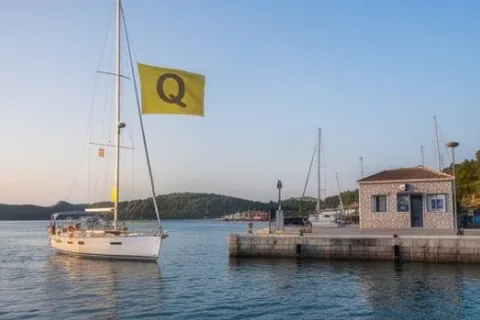
- Fly the Q flag on entering Norwegian waters and go to your notified first port.
- If you could not notify in advance, call the police non-emergency number +47 02800 on landfall and follow their instructions.
- Report to customs with ship's papers and passports, and declare any alcohol, tobacco or goods over the quota.
- If arriving from outside Schengen, complete police border control; non-EU/EEA crew are registered in the EES.
- Keep the police or CSC informed of changes to your plan, and give notice again before you leave Norway.
Ports of entry boaters use
- Bergen · West coast
Official port of entry. Passports have been stamped at the police desk in Bergen airport, about an hour away by tram. - Stavanger · South-west coast
- Kristiansand (Agder) · South coast
Natural first stop from Denmark and the Skagerrak. Agder police border control can be emailed at Agder.grensekontroll@politiet.no.
Papers to have on board
- Passports (valid for all crew)
- Visas, if your nationality needs a Schengen visa
- Original registration document of the boat
- Crew and passenger list (sent with the pre-arrival notice)
- Skipper's certificate of competence as required by the flag state (ICC widely accepted)
- Proof of insurance
- MMSI number and radio documents (Bergen officials asked for the MMSI number)
- Owner's authorisation if the owner is not on board
- European Firearms Pass or Norwegian police import licence, if you carry firearms
- Pet documents (EU pet passport or health certificate), if you carry a pet
Crew, passports and visas
Norway applies the Schengen rules: non-EU/EEA visitors may stay up to 90 days in any 180-day period across the whole Schengen area, and some nationalities need a visa. EES replaces passport stamps. Norwegian police say third-country nationals are registered or checked in the EES on arrival in and departure from Norway. The crew and passenger list goes to the police with the 24-hour notice; tell the police about crew changes, especially when crew join or leave from outside Schengen. Temporary internal border controls can mean extra checks, even from Schengen countries.
🇪🇺 Norway is in Schengen but not in the EU, so the people rules below apply and the EU customs rules for the boat do not. Schengen rules, explained once.
How long the boat may stay
Norwegian Customs: tourists and other temporary visitors may bring a foreign recreational boat into Norway without paying taxes, for personal use only, and it may not be used by anyone resident in Norway. Visitors who meet these conditions do not need to report the boat to customs, and the boat must leave Norway with you. If you want to leave the boat in Norway while you go home, no application is needed if it stays 6 weeks or less in a 12-month period. For longer storage you must apply to Norwegian Customs (via Altinn) before you leave Norway: the first approval covers one year from entry, extendable up to 2 consecutive years in total. Nobody else may use the boat meanwhile.
Fees, taxes and permits
- Clearance: There are normally no fees for clearance formalities (2025).
- Storage of a foreign boat beyond 6 weeks: application to Norwegian Customs, no fee stated by the source (2026).
Skipper's licence and VHF
For a foreign-flagged boat, the RYA says you must meet your flag state's rules. The ICC is widely accepted in Norway as evidence of competence. For a Norwegian-flagged (for example chartered) boat, the ICC is accepted only up to 15 m. Norway's own boating certificate (båtførerbevis) is required for people born in 1980 or later who skipper a Norwegian pleasure craft over 8 m or with more than 25 hp. No source opened states a VHF operator certificate rule for foreign visitors; carry your flag state's radio licence and operator certificate.
Buoyage and navigation marks
IALA region ANorway uses region A buoyage.
Red to port when coming in from sea (the opposite of the Americas, Japan, Korea and the Philippines). Preferred channel marks (a lateral mark with a band of the other colour) follow the same colours: the main colour tells you which side to leave the mark on when following the preferred channel.
The same everywhere: yellow and black cardinal marks (pass on the named side: north, east, south or west of the danger), black and red isolated danger marks, red and white safe water marks, yellow special marks, and the blue and yellow emergency wreck mark. Where a channel has no obvious direction, the chart shows the direction of buoyage with a small arrow. All marks explained. Always follow the chart and local notices: these are summaries, not a navigation source.
Anchoring, marine parks and protected areas
Boats of 15 m or 50 GT and over need CSC approval before anchoring. Drones may not be flown over or near military areas. Local speed limits apply, often 5 knots in sheltered areas within 100 to 500 m of land; the BåtFart app shows them. No source opened gives general anchoring restrictions or fines for marine protected areas.
Fishing
Sea angling with hand-held tackle is open to tourists; the official overview does not mention a licence for sea angling. Selling your catch is illegal. Halibut over 2 m must be released. Several species are protected all year (for example spiny dogfish, porbeagle, lobster, eel, and cod in the Oslofjord), and cod is protected 1 January to 30 April along the Skagerrak coast. Only tourists aged 12 or over who fish through a registered fishing camp may export fish: 15 kg of fish or fish products, twice per calendar year. From 1 January 2027 the limit drops to 10 kg. Fishing from your own boat outside a registered camp gives no export right.
Pets on board
From EU countries: ISO microchip, valid rabies vaccination (at least 21 days old) and an EU pet passport. Dogs also need a tapeworm (Echinococcus) treatment by a vet 24 to 120 hours before entering Norway. From unlisted third countries such as Turkey: microchip, rabies vaccination, a rabies antibody test (at least 0.5 IU/ml) taken at least 30 days after vaccination and at least 3 months before entry, an official health certificate, and tapeworm treatment for dogs. Such animals may enter only through Oslo Airport or Storskog with 48 hours' notice to the Norwegian Food Safety Authority, so arrival by boat is not an allowed route. Maximum five animals per trip.
Flares, firearms and drones
Firearms: with a European Firearms Pass you may bring hunting or sport firearms for up to 3 months and show them on request; without it you need a police import licence, applied for at least two months before arrival, and must present the firearm to customs. No source opened sets rules for flares on yachts. Drones: no flying within 5 km of an airport without permission from the tower (often via the NinoxDrone2 app), and no flying over or near military areas and vessels, prisons or embassies. Some national parks and nature reserves have their own drone bans; check dronesoner.no.
Fuel and duty
The RYA says marked (usually green), tax-free diesel is the standard marine fuel in Norway, with tax depending on road or non-road use. No source opened says whether foreign yachts can buy duty-free fuel beyond this.
Waste and holding tanks
Since 1 July 2024 all leisure boats up to 24 m are banned from discharging toilet waste anywhere in the Oslofjord. A holding tank is not mandatory, but without one you cannot use the toilet there. Use the pump-out stations shown on the Norwegian Environment Agency map. Elsewhere, MARPOL standards apply and the RYA says discharge closer than 300 m from shore is prohibited.
Seasons and office hours
The Coastal Surveillance Centre is open 24/7. VHF channel 16 announces the weather working channel at 09:00, 12:00, 15:00 and 21:00 local time.
Coming from or going to Turkey
A boat coming from Turkey arrives from outside Schengen and outside the EEA, so all crew must pass police border control and non-EU/EEA crew are registered in the EES. Pets coming directly from Turkey cannot enter Norway by boat: animals from unlisted third countries may enter only through Oslo Airport or Storskog, after a rabies antibody test taken at least 3 months before.
Leaving the country
Notify the police well before departure (through SafeSeaNet Norway or the police district of your last port), with the crew list. Boats under 15 m clear only at the first port of arrival and the last port before leaving Norwegian waters. Clear immigration and customs at the last port. If you leave the Schengen area, non-EU/EEA crew must exit through border control so the EES records the exit; a missing exit can be treated as an overstay.
Common mistakes and fines
- Not sending the 24-hour arrival notice. Readers who arrived from Scotland without notice in 2024 were told they should have emailed the police in advance.
- Forgetting the 15 m / 50 GT rule, in force since 1 January 2025: these boats need advance CSC approval and an up-to-date sailing plan, or face fines.
- Bringing more alcohol or tobacco than the quota without declaring it. Penalties are severe.
- Discharging toilet waste in the Oslofjord. It has been banned for all leisure boats since 1 July 2024.
- Drink-driving: the limit is 0.8 per mille for boats under 15 m and 0.2 per mille for 15 m and over.
Where the sources disagree
These points were unclear or have changed recently. Ask the port authority or customs on arrival.
- Who must use SafeSeaNet Norway: police say every vessel must notify 24 hours before crossing the baseline, while Norwegian Customs says qualifying visitors do not need to report the boat.
- There is no public official list of ports of entry for yachts; local police decide where you report.
- How EES registration works in small ports for leisure boats is not described by the Norwegian police; it may require going to a border station or airport.
- The vessel size threshold for military reporting changed from 24 m to 15 m on 1 January 2025.
- The RYA mentions 300 m from shore as a general discharge limit outside the Oslofjord; no Norwegian official page was opened to confirm this.
Questions boaters ask
Norway is in Schengen. Do I need to do anything when sailing in from Sweden or Denmark?
Yes for goods. Norway is outside the EU customs area, so alcohol, tobacco and goods quotas apply. Nordic yachts need no customs declaration if they carry no excess goods; other yachts should report at a port of entry.
How much alcohol can I bring?
Per adult: 1 litre of spirits, 1.5 litres of wine and 2 litres of beer. Tourists can bring 200 cigarettes or 250 g of tobacco. You can swap spirits for 1.5 litres of wine or beer. Anything above must be declared.
My boat is 15 m long. Is that a problem?
Since 1 January 2025, foreign vessels of 15 m LOA or more, or 50 GT or more, need advance approval from the Coastal Surveillance Centre (csc@coss.mil.no, +47 7553 6295) and must keep their sailing plan updated.
Can I leave my boat in Norway over winter?
Yes. Up to 6 weeks in a 12-month period needs no application. Longer requires an application to Norwegian Customs before you leave, valid for up to 2 years in total.
Do I need a licence to fish from my yacht?
The official sea angling rules do not mention a licence. You may only use hand-held gear, may not sell the catch, and can only export fish if you fished through a registered fishing camp.
Can I bring my dog on board from Turkey?
Not by boat. Dogs and cats from unlisted countries such as Turkey may only enter through Oslo Airport or Storskog, with a rabies antibody test done at least 3 months before.
Marinas in Norway
Official sources
The authority pages this guide rests on, with the date each was last opened and read.
- Norwegian Customs: Import of recreational boats
Norwegian Customs · checked 25 Oct 2026 - Norwegian Customs: Storing a foreign recreational boat
Norwegian Customs · checked 25 Oct 2026 - Norwegian Customs: Alcohol and tobacco quotas
Norwegian Customs · checked 25 Oct 2026 - Norwegian Customs: The value limit
Norwegian Customs · checked 25 Oct 2026 - Norwegian Customs: Travelling to Norway with a firearm
Norwegian Customs · checked 25 Oct 2026 - Norwegian Police: Crew and passenger lists
Norwegian Police · checked 25 Oct 2026 - Norwegian Police: Border crossings
Norwegian Police · checked 25 Oct 2026 - Norwegian Police: Entry/Exit System
Norwegian Police · checked 25 Oct 2026 - Norwegian Armed Forces: Regulations for foreign vessels in territorial waters
forsvaret.no · checked 25 Oct 2026 - Norwegian Coastal Administration: Recreational craft
kystverket.no · checked 25 Oct 2026 - Norwegian Maritime Authority: Oslofjord discharge ban
sdir.no · checked 25 Oct 2026 - Directorate of Fisheries: Sea angling regulations
Norwegian Directorate of Fisheries · checked 25 Oct 2026 - Directorate of Fisheries: Export quota
Norwegian Directorate of Fisheries · checked 25 Oct 2026 - Norwegian Food Safety Authority: Pets from EU countries
Norwegian Food Safety Authority · checked 25 Oct 2026 - Norwegian Food Safety Authority: Pets from third countries
Norwegian Food Safety Authority · checked 25 Oct 2026 - CAA Norway: No-drone zones
luftfartstilsynet.no · checked 25 Oct 2026 - European Commission: new Entry/Exit System went live on 12 October 2025
European Commission, Migration and Home Affairs · checked 25 Oct 2026 - Gov.pl: The EES is fully operational since 10 April 2026
Government of Poland · checked 25 Oct 2026
Cruising guides and sailor reports
Used for practical detail and recent experience; where they disagree with an official page, the official page wins and the point is listed under "Where the sources disagree".
This guide is general information for private, non-commercial yachts and is not legal advice. Rules and fees change; confirm with the port authority, customs or your agent before arrival. Seen something out of date? Tell us.
Other countries
Albania · Antigua and Barbuda · Australia · Bahamas · Barbados · Belgium · Belize · Bermuda · Brazil · British Virgin Islands · Bulgaria · Canada · Cape Verde (Cabo Verde) · Colombia · Cook Islands · Costa Rica · Croatia · Denmark · Dominica · Dominican Republic · Ecuador · Egypt · Estonia · Fiji · Finland · France · French Polynesia · Georgia · Germany · Gibraltar · Greece · Grenada · Guadeloupe · India · Indonesia · Ireland · Israel · Italy · Japan · Madagascar · Malaysia · Maldives · Malta · Martinique · Mauritius · Mexico · Montenegro · Morocco · Netherlands · New Caledonia · New Zealand · Oman · Panama · Papua New Guinea · Philippines · Poland · Portugal · Réunion · Saint Helena · Saint Lucia